









Summary
- Standalone net profit increased 38% to ₹7,003 crore.
- Net interest income rose 12% to ₹15,371 crore.
- Net interest margin stood at 3.36%, or 3.47% excluding the specified FCNR(B) impact.
- Total advances grew 23% to ₹13.74 lakh crore.
- Deposits increased 21% to ₹14.52 lakh crore.
- Gross NPA improved to 1.16%, while net NPA declined to 0.35%.
- Axis Bank shares fell despite the strong year-on-year earnings performance.
Axis Bank Q2 FY27 Results: Financial Highlights
Axis Bank announced its unaudited results for the quarter ended September 30, 2026, on October 17.
The bank reported strong business growth, supported by lending activity, improved credit quality and higher net interest income.
| Financial metric | Q2 FY27 | Year-on-year change |
|---|---|---|
| Standalone net profit | ₹7,003 crore | +38% |
| Net interest income | ₹15,371 crore | +12% |
| Fee income | ₹6,381 crore | +6% |
| Operating profit | ₹11,083 crore | +6% |
| Core operating profit | ₹10,998 crore | +11% |
| Operating expenses | ₹10,819 crore | +9% |
| Total advances | ₹13,73,727 crore | +23% |
| Total deposits | ₹14,52,066 crore | +21% |
The bank’s net profit improved substantially compared with the corresponding quarter last year.



However, profit declined approximately 2% sequentially from ₹7,114 crore in the June 2026 quarter.
This difference between year-on-year and quarter-on-quarter performance is important when assessing the bank’s earnings momentum.
Why Did Axis Bank’s Net Profit Increase?
The improvement was supported by growth in the loan portfolio, higher interest income and better asset quality.
Banks generate a significant proportion of their income by earning interest on loans and investments while paying interest on deposits and other borrowings.
Axis Bank’s lending operations expanded during the quarter, contributing to higher net interest income.
At the same time, lower credit costs helped profitability.
The bank reported an annualised net credit cost of 0.45%, down 28 basis points from the previous year.
This indicates an improvement in the cost associated with credit-related losses and provisioning, although future credit costs may vary with economic conditions.
Net Interest Income Rises 12%
Net interest income, or NII, represents the difference between interest earned and interest paid.
Axis Bank reported NII of ₹15,371 crore, compared with a lower figure in the corresponding quarter of FY26.
Growth in the loan portfolio supported this increase.
However, the bank’s interest expenses also increased, reflecting the cost of funding its operations.
For investors, NII is a crucial indicator because it reflects the performance of a bank’s core lending and deposit business.
Strong NII growth is generally positive, but it should be evaluated alongside net interest margin and funding costs.
Net Interest Margin Declines to 3.36%
Axis Bank reported a net interest margin of 3.36%, compared with approximately 3.55% a year earlier.
Excluding the specified impact of FCNR(B) deposits, the adjusted margin stood at 3.47%.
The margin indicates how effectively a bank earns net interest income from its interest-earning assets.
A lower margin may reflect changes in loan pricing, deposit costs, funding composition or the deployment of newly raised funds.
The difference between the reported and adjusted NIM is particularly relevant this quarter.
FCNR(B) Deposits: Why They Matter
Axis Bank mobilised approximately ₹1.018 trillion in Foreign Currency Non-Resident (Bank) deposits.
These deposits are maintained in designated foreign currencies by eligible non-resident customers.
They can provide additional funding to a bank but may also influence the calculation of reported lending and deposit growth.
Axis Bank disclosed that part of its FCNR(B) deposit mobilisation was backed by advances from international branches or standby letters of credit.
Consequently, the bank presented certain growth figures both including and excluding the specified FCNR(B)-related effect.
Investors should examine both measures to understand the underlying trend.
Loan Book Grows 23% to ₹13.74 Lakh Crore
Axis Bank’s net advances increased to approximately ₹13.74 lakh crore.
The bank reported growth across retail, SME and corporate lending.
Year-on-year loan growth by segment
More Stories

India–New Zealand FTA Comes Into Force Today: Zero-Duty Exports, Jobs and Business Benefits Explained
Jio Platforms IPO 2026: ₹2.5 Lakh Crore Anchor Demand Reported Ahead of October 21 Opening
Union Bank Q2 FY27 Results: Profit Jumps 30% to ₹5,537 Crore, NPAs Decline
Axis Bank Q2 Results 2026: Profit Jumps 38% to ₹7,003 Crore, but Shares Fall



Year-on-year loan growth by segment
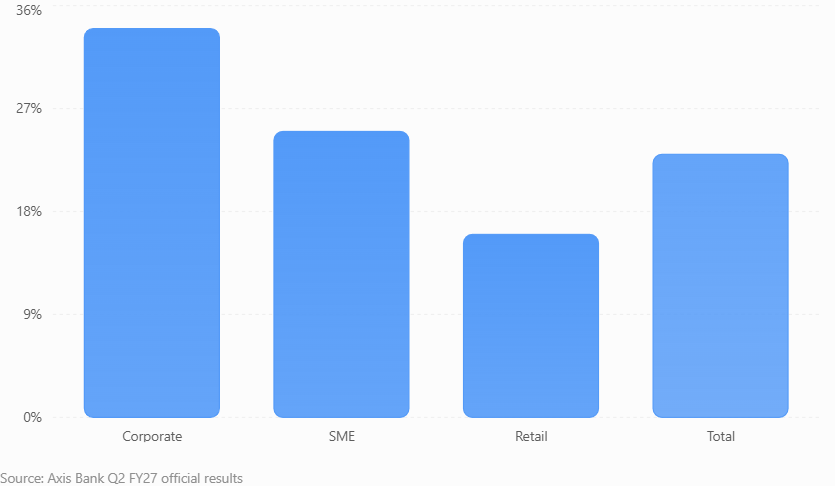
Corporate loans grew 34% year-on-year, while SME lending increased 25%.
Retail loans expanded 16%.
The bank’s small business banking, SME and mid-corporate portfolio represented approximately 24% of total loans.
Why Loan Growth Is Important
Higher lending volumes can increase future interest income.
However, rapid credit expansion also requires effective risk management.
Banks must assess borrowers’ repayment capacity and maintain adequate provisions for potential defaults.
Investors should therefore consider loan growth together with asset quality and capital adequacy.
Deposits Rise 21% to ₹14.52 Lakh Crore
Axis Bank reported total deposits of ₹14.52 lakh crore at the end of September 2026.
Deposit growth was supported by term deposits, savings accounts and FCNR(B) inflows.
The bank’s period-end CASA ratio stood at approximately 36%.
CASA refers to current account and savings account deposits.
These deposits can be an important source of relatively stable and lower-cost funding.
However, the actual funding cost depends on the rates paid and the overall deposit mix.
The bank reported that its cost of funds declined eight basis points year-on-year.
Asset Quality Improves: Gross NPA at 1.16%
Asset quality was another positive aspect of Axis Bank’s quarterly performance.
| Asset quality indicator | Q2 FY26 | Q2 FY27 |
|---|---|---|
| Gross NPA ratio | 1.46% | 1.16% |
| Net NPA ratio | 0.44% | 0.35% |
| Provision coverage ratio | — | 70% |
Gross non-performing assets are loans classified as non-performing under applicable banking regulations.
Net NPA reflects non-performing assets after specified adjustments and provisions.
Lower NPA ratios generally indicate an improvement in the reported quality of the loan portfolio.
However, these ratios should also be evaluated alongside fresh slippages, recoveries, write-offs and loan growth.
Axis Bank reported a gross slippage ratio of 1.48%, down 63 basis points year-on-year.
The bank also reported an annualised net slippage ratio of 0.75%.
Read Also: FPI Outflows October 2026: Foreign Investors Withdraw ₹52,100 Crore From Indian Stocks
Why Did Axis Bank Shares Fall After Strong Results?
Axis Bank shares declined more than 4% during trading on October 19, despite reporting a strong increase in profit.
The Economic Times reported that the stock fell to approximately ₹1,232 on the BSE during the session. This was an intraday observation, not a confirmed closing price.
Investors appeared to focus on several concerns.
1. Pressure on Net Interest Margins
Reported NIM declined from the year-ago period.
Investors closely monitor margins because they influence the profitability of lending operations.
2. Earnings Versus Expectations
Strong profit growth does not necessarily guarantee a positive stock-market reaction.
Share prices reflect expectations about future performance.
If investors anticipate stronger results, even a profitable quarter may lead to selling pressure.
3. Operating and Non-Interest Income
Fee income grew 6%, while operating expenses increased 9%.
Investors may examine whether operating revenue growth can continue to outpace expenses.
4. Banking-Sector Sentiment
Other major private-sector banks also experienced selling pressure during the October 19 session.
Market commentary identified margin pressure and the impact of FCNR(B) deposits among the issues attracting attention.
Capital Adequacy and Financial Stability
Axis Bank reported an overall capital adequacy ratio of 16.27%.
Its Common Equity Tier 1 ratio stood at 14.61%.
These ratios indicate the bank’s regulatory capital position relative to risk-weighted assets.
Adequate capital is essential because banks must maintain buffers against potential losses.
The bank also reported an average liquidity coverage ratio of approximately 119% during the quarter.
These figures provide additional context for evaluating financial resilience.
What Should Investors Watch Next?
Investors should monitor whether Axis Bank can maintain loan and deposit growth without further pressure on margins.
The next quarterly results will also provide information about fee income, credit costs and operating expenses.
Management commentary on FCNR(B) deposits will be particularly relevant.
Other important factors include RBI monetary policy, interest-rate movements and broader banking-sector credit demand.
The bank’s valuation should be assessed alongside its financial performance rather than on the basis of a single day’s share-price movement.
Frequently Asked Questions
What was Axis Bank’s Q2 FY27 net profit?
Axis Bank reported standalone net profit of approximately ₹7,003 crore, representing 38% year-on-year growth.
How much was Axis Bank’s net interest income?
Net interest income stood at ₹15,371 crore, up approximately 12%.
What was Axis Bank’s gross NPA ratio?
The gross NPA ratio improved to 1.16%, compared with 1.46% a year earlier.
Why did Axis Bank shares decline on October 19?
Investors assessed margin pressure, operating performance and earnings expectations despite strong reported profit growth.
What was Axis Bank’s deposit growth?
Period-end deposits grew 21% year-on-year to approximately ₹14.52 lakh crore.
Is Axis Bank a good stock to buy after the results?
The results alone are insufficient to determine whether the stock is attractively valued. Investors should consider financial performance, valuation, risks and their investment objectives.
Conclusion
Axis Bank delivered a strong financial performance for the September 2026 quarter, supported by higher net interest income, loan growth and improved asset quality.
However, the decline in its share price demonstrates that markets evaluate profitability alongside expectations, margins and future growth prospects.
For investors, the key question is whether Axis Bank can sustain its business expansion while maintaining healthy funding costs and credit quality.
The bank’s next quarterly disclosures will help determine whether the current margin pressure is temporary or more persistent.
Disclaimer: EduTaxTuber provides content for general educational and informational purposes only. While we make reasonable efforts to keep the information accurate and updated, laws, regulations, market conditions, software features, and other information may change. Some content may be created or assisted by AI tools and may contain errors or omissions. Readers should verify important information with official sources or qualified professionals before making any tax, legal, financial, investment, business, or other decisions. EduTaxTuber does not guarantee the completeness or accuracy of the information and does not provide professional advice.
