








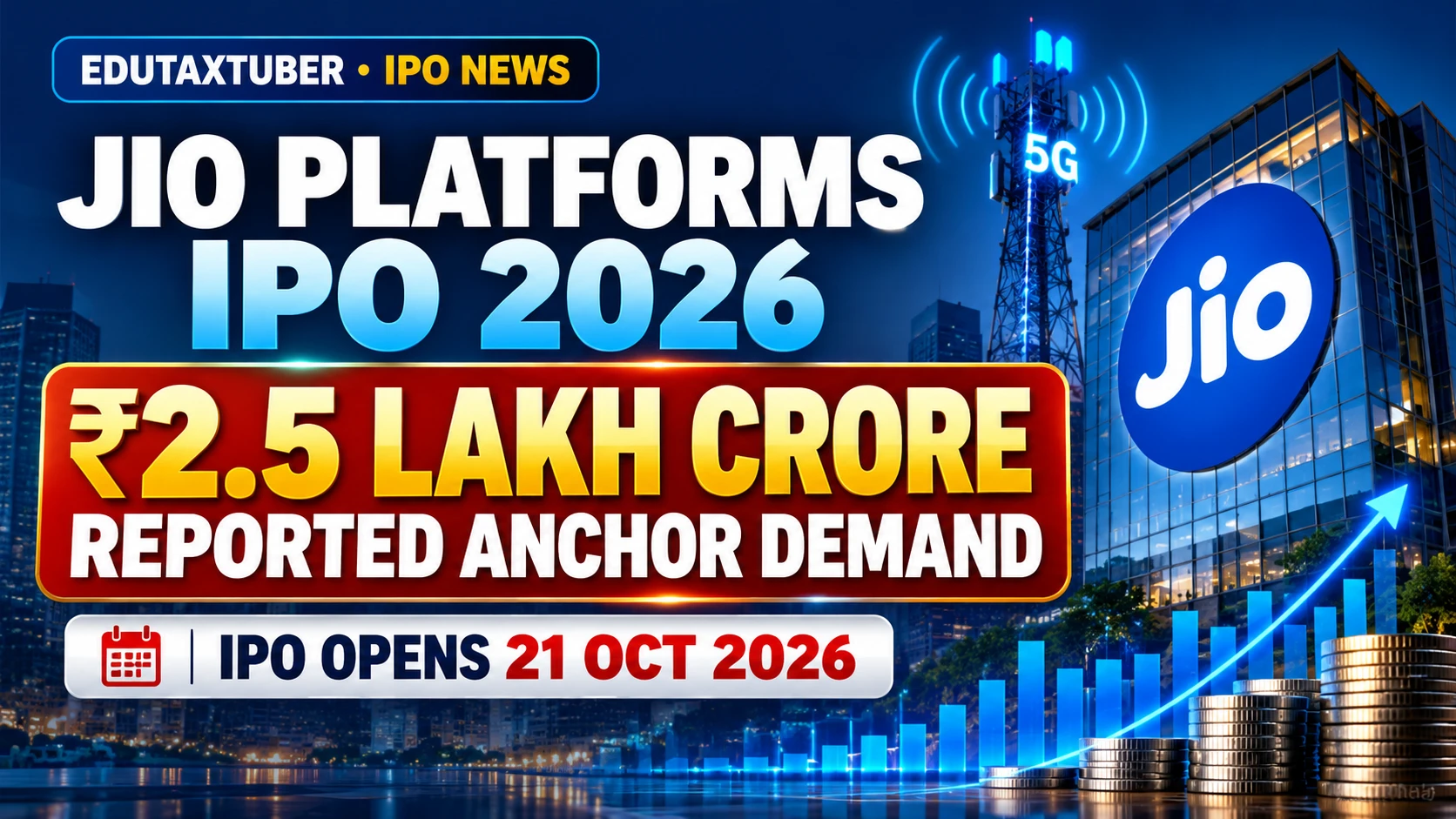
Jio Platforms IPO 2026: ₹2.5 Lakh Crore Anchor Demand Reported Ahead of October 21 Opening
Summary
- Jio Platforms’ anchor-investor book reportedly attracted bids worth approximately ₹2.5 lakh crore on 19 October 2026.
- The anchor portion was approximately ₹8,110 crore, indicating reported demand exceeding 30 times the amount available.
- Reuters and PTI attributed the bidding figures to people familiar with the transaction; a final official allocation list was not independently confirmed at the time of this report.
- The public IPO opens on 21 October and closes on 23 October 2026.
- The price band is ₹1,065–₹1,119 per share, with a retail lot size of 12 shares.
- A large anchor book does not guarantee retail allotment, listing gains or strong long-term investment returns.
Jio Platforms IPO: Major Anchor Investor Update
Jio Platforms Limited, the telecom and digital-services subsidiary of Reliance Industries, has reportedly attracted substantial demand from institutional investors ahead of its initial public offering.
On Monday, 19 October 2026, Reuters and Press Trust of India reported that bids for the anchor-investor portion reached approximately ₹2.5 lakh crore.

The anchor portion was estimated at ₹8,110 crore.
This implies demand exceeding 30 times the available portion, making the reported response an important development for India’s primary equity market.
The figures were attributed to sources involved in or familiar with the transaction.
They should not be confused with a final, officially disclosed list of shares allotted to anchor investors.
The development comes two days before the public subscription window opens.
Jio Platforms’ red herring prospectus, filed with the Registrar of Companies and available through SEBI, confirms that anchor bidding was scheduled for 19 October, followed by public bidding from 21 to 23 October.
Jio Platforms IPO 2026: Key Details
| Particulars | Details |
|---|---|
| Company | Jio Platforms Limited |
| Promoter | Reliance Industries Limited |
| Anchor bidding date | 19 October 2026 |
| Public IPO opens | 21 October 2026 |
| Public IPO closes | 23 October 2026 |
| Price band | ₹1,065–₹1,119 |
| Retail lot size | 12 shares |
| Minimum application at ₹1,119 | ₹13,428 |
| Maximum fresh issue | Up to 27 crore equity shares |
| Indicative gross issue size at upper band | ₹30,213 crore |
| Reported anchor-book size | Approximately ₹8,110 crore |
| Reported anchor demand | Approximately ₹2.5 lakh crore |
| Proposed listing | NSE and BSE |
The offer timetable and share structure are supported by the official prospectus. The reported anchor-demand amount comes from financial news organisations citing transaction sources.
What Does 30 Times Anchor Demand Mean?
Anchor investors are institutional investors permitted to bid for a specified portion of an IPO before the regular public subscription period.
These investors may include mutual funds, insurance companies, sovereign wealth funds and other eligible institutions.
Suppose an IPO reserves shares worth ₹8,110 crore for the anchor portion.
If eligible institutions submit bids worth ₹2.5 lakh crore, the demand-to-supply ratio is approximately:
₹2,50,000 crore ÷ ₹8,110 crore = 30.8 times.
This means the reported value of bids was far greater than the shares available in that portion.
However, it does not mean Jio Platforms has already collected ₹2.5 lakh crore.
The company can allot only the applicable number of shares under the offering rules.
An investor bidding for a certain amount may ultimately receive a much smaller allocation—or none.
Which Investors Reportedly Participated?
Reports identified interest from major international asset managers and sovereign wealth funds.
Names mentioned included BlackRock, Fidelity Investments, Singapore’s GIC and the Abu Dhabi Investment Authority.
Other reporting identified interest from Capital Group, T. Rowe Price, JPMorgan Asset Management and additional institutional investors.
Indian mutual funds, insurers and pension-related institutions were also reported among interested participants.
These reports identify bidders or institutions expressing interest, not necessarily final confirmed allottees.
The precise allocation to each institution should be checked against the formal anchor-allocation announcement when available.

Reuters reported that Reliance and several named institutions had not immediately responded to requests for comment.
Why Is the Jio IPO Attracting Attention?
Jio Platforms operates one of India’s largest digital-connectivity businesses.
Its principal operating subsidiary, Reliance Jio Infocomm Limited, reported approximately 533.3 million customers as of 30 June 2026, according to the official prospectus.
Jio’s operations extend beyond mobile connectivity to include fixed broadband, digital entertainment, enterprise connectivity, cloud-related services and technology products.
The company has also outlined opportunities associated with artificial intelligence and network technology.
For institutional investors, the offering provides a route to assess Jio Platforms as a separately listed company rather than solely through ownership of Reliance Industries.
However, prospective investors should distinguish existing operating earnings from expectations about future technology and AI businesses.
Not every growth initiative currently makes a separately disclosed material contribution to revenue.
Jio Platforms Financial Performance
Jio Platforms’ SEBI-filed abridged prospectus provides restated consolidated financial information.
| Financial indicator | FY2026 |
|---|---|
| Revenue from operations | ₹1,46,885.3 crore |
| EBITDA | ₹76,255.4 crore |
| Profit after tax | ₹30,049.1 crore |
For the three months ended 30 June 2026, the company reported revenue from operations of approximately ₹39,172.9 crore and profit after tax of ₹7,764.1 crore.
These are consolidated figures taken from the prospectus.
They demonstrate the scale of the existing business, but they do not alone determine whether the proposed IPO price represents an attractive valuation.
Investors should assess debt, cash flows, capital expenditure, earnings growth and the sustainability of the business.
How Will Jio Use Its IPO Proceeds?
The official prospectus states that the net proceeds are intended primarily for repayment or prepayment of certain outstanding borrowings of Reliance Jio Infocomm Limited, along with general corporate purposes.
Published reporting identifies a proposed debt-repayment allocation of up to approximately ₹27,500 crore.
Debt reduction can potentially lower financing costs and improve balance-sheet flexibility.
However, future borrowings may still be required for spectrum, network expansion or other business investments.
Read Also: Jio Platforms IPO: What It Means for RIL Share Price
The investment case should therefore consider both the proposed reduction in existing debt and the capital requirements of the business.
More Stories

India–New Zealand FTA Comes Into Force Today: Zero-Duty Exports, Jobs and Business Benefits Explained
Jio Platforms IPO 2026: ₹2.5 Lakh Crore Anchor Demand Reported Ahead of October 21 Opening
Union Bank Q2 FY27 Results: Profit Jumps 30% to ₹5,537 Crore, NPAs Decline
Axis Bank Q2 Results 2026: Profit Jumps 38% to ₹7,003 Crore, but Shares Fall

Is the IPO a Fresh Issue or Offer for Sale?
The official abridged prospectus specifies a fresh issue of up to 27 crore new equity shares.
It records no offer-for-sale component.
This is an important distinction.
In a fresh issue, the company raises new capital, whereas an offer for sale allows existing shareholders to sell their shares and receive the proceeds.
The present issue is designed to raise money for the company, subject to its stated objectives and applicable costs.
The final value raised will depend on the issue price and number of shares actually issued.
How Much Must a Retail Investor Apply For?
The announced price band is ₹1,065–₹1,119 per share.
The minimum lot size reported for retail applicants is 12 shares.
At the upper band:
12 shares × ₹1,119 = ₹13,428.
This is the minimum indicative application amount at the upper price band.
Applications are subject to the applicable retail-category limits and IPO bidding rules.
Investors should check the lot size and available categories in the official application interface before authorising payment.

- Maximum Spike Current: 13,000 Amps
- Grounds AC power with 3-line protection through all 6 sockets
- Delivers power through a 2-metre, heavyduty cables
Will Anchor Demand Guarantee Retail Allotment?
No.
The anchor-investor portion and retail-investor portion are separate categories within the IPO structure.
Demand from large institutions does not mean that a retail applicant automatically receives shares.
Retail allotment depends on valid applications, shares available in the category and the prescribed basis-of-allotment process.
If retail demand exceeds the shares allocated to retail investors, not every application may receive shares.
The final anchor subscription and allocation also should not be mistaken for public subscription data, which becomes available when the public bidding window opens.
What Are the Major Investment Risks?
Valuation
At the upper price band, the offering places a substantial implied valuation on Jio Platforms.
Investors should evaluate whether expected earnings and cash-flow growth support that valuation.
Dependence on Telecom Operations
The prospectus shows that Reliance Jio Infocomm accounted for approximately 87.74% of consolidated revenue in FY2026.
Despite the company’s broader technology ambitions, its financial performance remains closely linked to its core connectivity business.
Telecom Regulation and Spectrum
Telecommunications operations require licences, spectrum rights and regulatory compliance.
Renewal costs, policy changes and competitive conditions can affect profitability.
Network and Technology Expenditure
The company must maintain network quality and invest in technological upgrades.
Unexpected capital expenditure can affect free cash flow.
Cybersecurity and Data Privacy
Digital services businesses face security, privacy and operational-continuity risks.
The prospectus identifies these as material considerations.
Listing-Day Volatility
Even heavily subscribed IPOs can experience volatile trading after listing.
Reported anchor interest is not a guarantee of listing gains.
What Should Reliance Industries Shareholders Know?
Reliance Industries is Jio Platforms’ promoter and held approximately 66.43% of its pre-issue equity, according to the official prospectus.
The IPO may influence how investors value Jio Platforms separately within the wider Reliance group.
However, the public offering does not mean that every Reliance shareholder will automatically receive Jio shares.
Any shareholder-reservation category has specific eligibility and application requirements.
Investors should check the relevant prospectus provisions before assuming entitlement.
Read Also: Paras Healthcare IPO 2026: ₹1,450 Crore Issue, Price Band, Dates and Review
What Happens Next?
The public IPO is scheduled to open on 21 October and close on 23 October.
The next key developments include formal disclosure of anchor allocations, the start of public bidding, category-wise subscription data and the basis of allotment.
Investors should track the final prospectus and exchange disclosures.
They should not rely solely on unofficial grey-market prices or predictions of listing-day returns.
Conclusion
Jio Platforms’ reported ₹2.5 lakh crore anchor-investor demand is a significant new development ahead of its public IPO.
The reported response suggests substantial institutional interest in the offering, but it represents bids, not confirmed capital raised or guaranteed allocations.
The official prospectus confirms an established large-scale digital business and a fresh issue designed partly to reduce borrowings.
For retail investors, the next step is to assess the issue price, company fundamentals, risks and official subscription data—not assume that strong anchor demand guarantees a profitable investment.
Sources: SEBI — Jio Platforms RHP, SEBI — Official Abridged Prospectus, and Reuters/PTI reporting dated 19 October 2026.
Disclaimer: This article was prepared with AI assistance and editorial verification for educational purposes. The anchor-demand figure is based on attributed news reporting and may differ from final official allocation data. This content is not investment, financial, legal or tax advice. Readers should verify applicable offer terms and consult qualified advisers. EduTaxTuber disclaims responsibility for losses to the extent permitted by applicable Indian law.
Disclaimer: EduTaxTuber provides content for general educational and informational purposes only. While we make reasonable efforts to keep the information accurate and updated, laws, regulations, market conditions, software features, and other information may change. Some content may be created or assisted by AI tools and may contain errors or omissions. Readers should verify important information with official sources or qualified professionals before making any tax, legal, financial, investment, business, or other decisions. EduTaxTuber does not guarantee the completeness or accuracy of the information and does not provide professional advice.
