








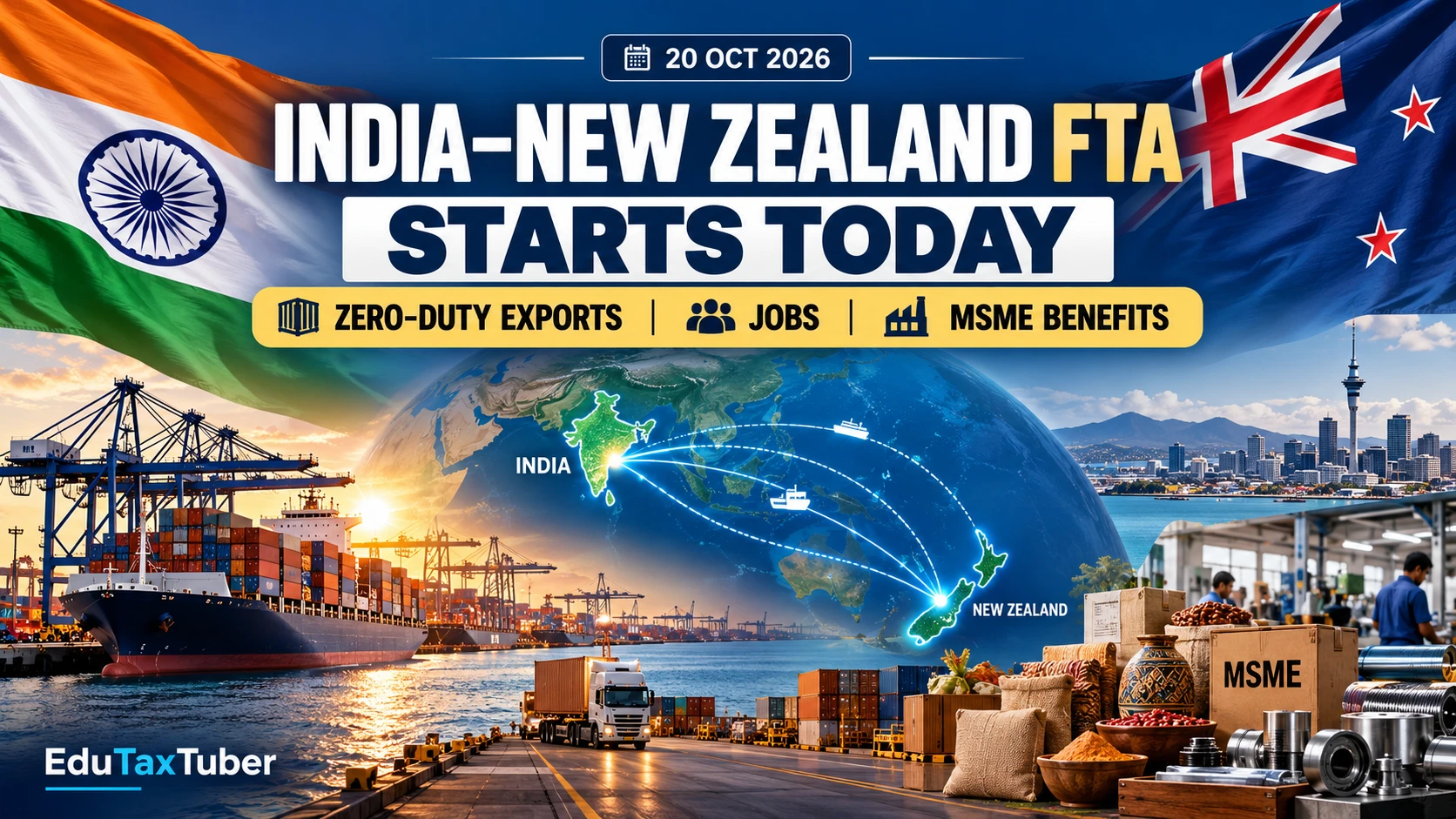
India–New Zealand FTA Comes Into Force Today: Zero-Duty Exports, Jobs and Business Benefits Explained
Summary
- The India–New Zealand Free Trade Agreement officially comes into force on 20 October 2026.
- New Zealand has eliminated customs duties on all tariff lines covering qualifying Indian exports.
- Indian textiles, apparel, leather, footwear, engineering goods, pharmaceuticals and agricultural products are among the sectors expected to benefit.
- India has maintained protections for sensitive sectors, including dairy, sugar and selected agricultural commodities.
- The agreement introduces professional mobility and student-related provisions, subject to eligibility and immigration rules.
- New Zealand has committed to facilitate up to US$20 billion of investment into India; this is a commitment, not money already received.
- Exporters must comply with rules of origin and other applicable regulations to claim benefits.
India–New Zealand Free Trade Agreement Begins on October 20
The Free Trade Agreement between India and New Zealand has officially entered into force on Tuesday, 20 October 2026, marking a new stage in trade and economic cooperation between the two countries.
The agreement provides zero customs-duty access to New Zealand’s market for qualifying Indian exports and introduces preferential arrangements for certain goods entering India from New Zealand.
India’s Ministry of Commerce and Industry confirmed the implementation date in an official statement issued on 19 October.
New Zealand Customs and the country’s implementing legislation also confirm that the agreement takes effect on 20 October.
The development is significant for Indian exporters, particularly small and medium-sized businesses seeking opportunities in overseas markets.
It also contains provisions relating to services, agriculture, professional mobility and investment cooperation.
However, the benefits will depend on businesses meeting the agreement’s eligibility conditions and successfully reaching customers in the other country.
India–New Zealand FTA: Important Details
| Particular | Details |
|---|---|
| Agreement | India–New Zealand Free Trade Agreement |
| Signed | 27 April 2026 |
| Ratification processes completed | September 2026 |
| Effective date | 20 October 2026 |
| Indian exports entering New Zealand | Zero customs duty on all qualifying tariff lines |
| New Zealand exports entering India | Selected tariff eliminations or reductions |
| Sensitive Indian sectors | Certain products remain protected |
| Bilateral trade target | NZ$7 billion by 2030 |
| Investment commitment | Facilitation of US$20 billion |
| Beneficiaries | Exporters, MSMEs, eligible professionals and other businesses |
The trade target is aspirational, while the investment commitment concerns facilitation over time. Neither should be presented as an amount already achieved.
What Does Zero-Duty Access Mean?
A customs duty is a tax imposed on eligible goods when they enter a country.
Under the new agreement, New Zealand has removed customs duties on tariff lines covering qualifying Indian exports.
Previously, certain Indian products faced import tariffs of up to 10%.
The removal of those tariffs can improve the price competitiveness of Indian products in New Zealand.
For example, suppose an eligible Indian product had an assessable import value of ₹1,00,000 and previously attracted a 10% customs tariff.
The illustrative customs duty would have been ₹10,000.
If the product now qualifies for zero customs duty under the FTA, that particular tariff would no longer apply.
However, this does not mean the product becomes exempt from every tax, charge or import regulation.
Businesses must still comply with rules of origin, product standards, applicable taxes and other requirements.
Which Indian Industries Could Benefit?
Textiles and Apparel
Indian textiles and garment manufacturers may benefit from improved market access.
Removing import tariffs can help Indian exporters compete on price with suppliers from other countries.
The opportunity may be particularly relevant to manufacturers producing garments, fabrics and home textiles.
Nevertheless, competitiveness also depends on product quality, logistics and buyer requirements.
Leather and Footwear
Leather products and footwear are among the sectors highlighted by the Commerce Ministry.
These industries include numerous small manufacturers and export-oriented businesses.
Lower tariffs may create opportunities for firms capable of meeting quality and delivery standards.


Engineering Goods
Engineering products, machinery, automotive components and related manufactured goods are also expected to benefit.
The government highlighted the first-ever export of a JCB machine from India to New Zealand during the events marking the agreement’s implementation.
This is a concrete example of the commercial opportunities being promoted under the new arrangement.
Pharmaceuticals and Chemicals
The agreement includes improved market-access opportunities for pharmaceutical and chemical products.
India’s Commerce Ministry has also referred to streamlined regulatory arrangements for pharmaceuticals and medical devices.
However, companies must still comply with the applicable product registration and safety requirements.
Zero customs duty does not eliminate regulatory approval obligations.
Gems, Jewellery and Processed Foods
Gems and jewellery, agricultural products and processed foods are included among the sectors expected to gain improved market access.
Actual export growth will depend on demand, price competitiveness, certification requirements and distribution networks.
What Does the FTA Mean for Indian MSMEs?
Micro, small and medium enterprises are a central focus of the agreement.
Many MSMEs face challenges when entering overseas markets, including import duties, unfamiliar regulations and limited access to international buyers.
The FTA can reduce certain tariff barriers.
For example, an Indian footwear manufacturer may become more competitive if the importing country removes duties that previously increased the product’s landed cost.
Read Also
However, reduced tariffs alone do not create purchase orders.
MSMEs must still identify buyers, meet quality standards, arrange shipping and comply with customs documentation.
Practical Steps for Exporters
Businesses considering exports to New Zealand should:
- Identify the product’s correct Harmonised System (HS) classification.
- Check the agreement’s applicable tariff schedule.
- Verify whether the product meets rules-of-origin requirements.
- Obtain the required origin documentation.
- Review New Zealand’s product, labelling and safety requirements.
- Calculate shipping, insurance, tax and compliance costs.
- Confirm commercial terms and payment safeguards with overseas buyers.
These steps help distinguish a genuine commercial opportunity from the assumption that zero tariffs automatically make exports profitable.
More Stories

India–New Zealand FTA Comes Into Force Today: Zero-Duty Exports, Jobs and Business Benefits Explained
Jio Platforms IPO 2026: ₹2.5 Lakh Crore Anchor Demand Reported Ahead of October 21 Opening
Union Bank Q2 FY27 Results: Profit Jumps 30% to ₹5,537 Crore, NPAs Decline
Axis Bank Q2 Results 2026: Profit Jumps 38% to ₹7,003 Crore, but Shares Fall



Are All New Zealand Imports Into India Duty-Free?
No.
This is an important distinction.
New Zealand has provided zero-duty treatment across the tariff lines covering qualifying Indian exports.
India, however, has offered selected duty eliminations and reductions for eligible New Zealand products.
New Zealand Customs states that the agreement reduces tariffs on approximately 95% of New Zealand’s current exports to India.
That does not mean all New Zealand goods can enter India without customs duty.
The precise tariff treatment depends on the product, origin and agreed schedule.
Some concessions are immediate, while others follow the agreement’s specific terms.
Which Indian Agricultural Sectors Remain Protected?
India has retained protections for sensitive agricultural products.
The Commerce Ministry identifies dairy, sugar, edible oils and several key agricultural commodities among the areas protected from concessions.
Reports also identify exclusions or safeguards covering products such as onions, chickpeas, peas, corn and almonds.
These protections are significant because India has a large farming and dairy sector.
Reducing duties on sensitive imported products without safeguards could affect domestic producers.
The agreement attempts to balance export opportunities with protections for certain domestic industries.
Apples, Kiwifruit and Honey
Some New Zealand agricultural products will receive controlled market access.
The agreement includes tariff-rate quota arrangements for selected products, including apples, kiwifruit and Mānuka honey.
A tariff-rate quota allows a specified quantity to receive a particular tariff treatment, subject to the relevant terms.
It should not be confused with unlimited duty-free import permission.
Read Also: Sugar Stocks Fall Up to 6% as India Halts Sugar-Based Ethanol Procurement for 2026–27
Agricultural Cooperation and Farmers
The agreement includes an Agricultural Productivity Partnership.
This initiative focuses on improving agricultural productivity through technology, training and cooperation.
The Ministry of Commerce has identified programmes covering apples, kiwifruit and honey.
It has also referred to Centres of Excellence.
Initial kiwifruit-related sites have been identified in Nagaland and Uttarakhand.
Apple-related facilities are proposed in Himachal Pradesh and Uttarakhand.
The honey programme envisages facilities in Uttar Pradesh and West Bengal.
These developments are relevant to farmers and agricultural businesses interested in modern production methods.
However, proposals for new facilities should not be described as projects already completed.
Opportunities for Indian Students
The agreement contains provisions related to education and student mobility.
According to the Indian government’s announcement, there will be no numerical cap on Indian students under the relevant framework.
Eligible STEM bachelor’s and master’s graduates may have access to post-study work rights of up to three years.
Doctoral graduates may be eligible for up to four years.
These provisions do not mean every student automatically receives a visa or a guaranteed job.
Applicants must satisfy New Zealand’s immigration, qualification and other applicable requirements.
Prospective students should check current official immigration guidance before making financial commitments.
Work Visa Opportunities for Indian Professionals
The agreement also includes a Temporary Employment Entry pathway for eligible Indian professionals.
The government has identified a quota of 5,000 places associated with this pathway.
Eligible occupations include certain skilled professions in areas such as information technology, engineering, healthcare and education, along with specified traditional-medicine and related occupations.
A separate Working Holiday arrangement provides for 1,000 visas annually under the stated framework.
The exact eligibility requirements, duration of stay, occupation conditions and application process depend on immigration rules.
An announced quota is not a promise that every interested applicant will receive approval.
New Zealand’s US$20 Billion Investment Commitment
India’s Commerce Ministry has stated that New Zealand has committed to facilitate US$20 billion in investment into India.
The intended areas include manufacturing, infrastructure, agriculture, start-ups and innovation.
Investment cooperation could support business partnerships and development projects.
However, the figure must be interpreted accurately.
It represents an investment-facilitation commitment, not confirmed capital already transferred into India.
Actual investments will depend on commercial decisions, project feasibility, regulatory clearances and implementation over time.
Bilateral Trade Target for 2030
India and New Zealand have set an aspirational goal of increasing bilateral trade in goods and services to NZ$7 billion by 2030.
The Indian government has cited an approximate equivalent of ₹35,000 crore.
The goal provides a measure of the countries’ trade ambitions.
However, it is not a forecast guaranteeing that exports and imports will reach the target.
Businesses must convert better market access into actual orders, investment and trade relationships.
Does the FTA Change GST Rules?
A customs-duty concession and a GST exemption are not the same thing.
Businesses importing goods into India must consider customs classification, applicable customs duties, integrated GST and other relevant charges.
A product qualifying for reduced basic customs duty does not automatically become exempt from IGST.
Likewise, Indian exporters must continue complying with applicable GST export procedures.
Businesses should consult the relevant customs and GST provisions before calculating their final transaction costs.
What Should Indian Businesses Do Next?
The new agreement creates potential opportunities, but execution matters.
Exporters should review product eligibility, tariff commitments and rules-of-origin requirements.
Manufacturers may need to adjust packaging, quality certification and delivery arrangements for New Zealand buyers.
Services businesses should assess market-access provisions and professional eligibility conditions.
Farmers and agricultural enterprises can monitor the proposed productivity programmes.
Investors assessing listed exporting companies should avoid assuming that every company will immediately benefit.
Any financial impact will depend on existing business relationships, production capacity and overseas demand.
Conclusion
The India–New Zealand Free Trade Agreement officially takes effect on 20 October 2026.
It offers significant tariff concessions for qualifying Indian exports and establishes new arrangements covering investment, services, agriculture and professional mobility.
The agreement also retains safeguards for sensitive Indian agricultural sectors.
For Indian MSMEs and exporters, reduced trade barriers create an opportunity—but future success will depend on competitiveness, compliance and commercial execution.
Bottom line: The FTA is now in force. Businesses should examine the specific benefits applicable to their products and services instead of assuming that every tax, restriction or commercial cost has been removed.
Official Sources
- Ministry of Commerce and Industry — 19 October 2026 Announcement
- New Zealand Customs — India–New Zealand FTA
- New Zealand Government — FTA Commencement Legislation
Disclaimer: This article was prepared with AI assistance and editorial research using official government sources. It is intended for general information and education. It does not constitute investment, tax, legal, immigration or professional advice. Rules, eligibility conditions and implementation procedures should be verified with the relevant authorities. EduTaxTuber disclaims responsibility for losses to the extent permitted by applicable Indian law.
Disclaimer: EduTaxTuber provides content for general educational and informational purposes only. While we make reasonable efforts to keep the information accurate and updated, laws, regulations, market conditions, software features, and other information may change. Some content may be created or assisted by AI tools and may contain errors or omissions. Readers should verify important information with official sources or qualified professionals before making any tax, legal, financial, investment, business, or other decisions. EduTaxTuber does not guarantee the completeness or accuracy of the information and does not provide professional advice.
