








Missed 31 August ITR Deadline? Know Your Options Now
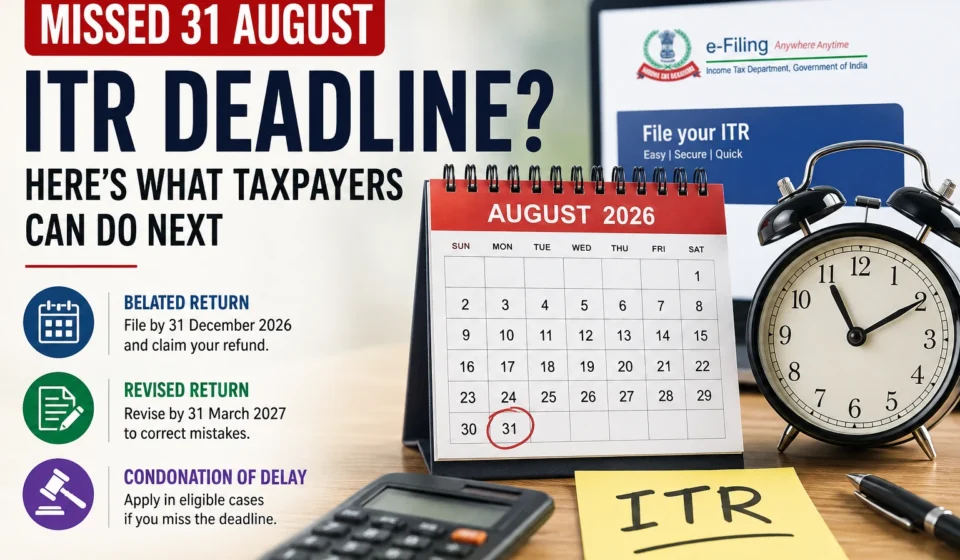
The 31 August 2026 deadline for filing income tax returns (ITRs) for AY 2026-27 for applicable non-audit taxpayers has passed. However, taxpayers who missed the deadline still have options, including filing a belated ITR by 31 December 2026, revising an already filed return, or seeking condonation of delay in eligible cases.
Missing the original due date does not automatically mean that a taxpayer can no longer file a return or claim an eligible refund. However, late filing can result in fees, interest and restrictions on carrying forward certain losses.
Missed the 31 August ITR deadline? File a belated return
Taxpayers who could not file their return within the original due date can generally file a belated return under Section 139(4).
For AY 2026-27, the last date for filing a belated return is 31 December 2026, or before completion of assessment, whichever is earlier. The Income Tax Department has specifically confirmed this deadline for AY 2026-27.
A taxpayer who is eligible for a refund can also claim that refund through a belated return, subject to the applicable provisions.
What happens when you file the ITR late?
Late filing can have several financial and tax consequences.
Late filing fee: Under Section 234F, the fee is ₹5,000 where total income exceeds ₹5 lakh, while it is ₹1,000 where total income does not exceed ₹5 lakh.
Interest on tax payable: If tax remains payable after taking into account TDS, TCS and advance tax, interest under the applicable provisions, including Section 234A where applicable, may arise for the delay.
Loss carry-forward: Filing a belated return can affect the ability to carry forward certain losses. Taxpayers with capital, business or other eligible losses should therefore pay particular attention to the filing timeline.
Already filed your ITR? You can revise it
Taxpayers who filed their ITR by the deadline but later discover an error can use the revised return facility.
For AY 2026-27, the revised return can be filed up to 31 March 2027, or before completion of assessment, whichever is earlier. The Income Tax Department has confirmed that the revised-return deadline has been extended to the end of the relevant assessment year from AY 2026-27.
A revised ITR may be useful when a taxpayer discovers incorrect income figures, missed disclosures, incorrect deductions or other genuine mistakes in the original return.
Additional fee for revised ITR after 31 December
A new fee under Section 234-I applies to revised returns filed after 31 December for AY 2026-27.
Therefore, taxpayers revising their AY 2026-27 return between 1 January 2027 and 31 March 2027 may have to pay:
- ₹1,000 if total income does not exceed ₹5 lakh
- ₹5,000 if total income exceeds ₹5 lakh
The Income Tax Department’s guidance confirms that this additional fee applies to revised returns filed after 31 December and up to 31 March of the relevant assessment year.
What if 31 December 2026 also passes?
The situation becomes more complicated if a taxpayer misses both the original due date and the 31 December 2026 belated-return deadline.
In eligible cases, taxpayers may seek condonation of delay under Section 119(2)(b) of the Income Tax Act, 1961, particularly where genuine hardship prevented timely filing.
The Income Tax Department says that condonation is a special relief and is not an automatic right. The application is considered by the competent tax authority on the basis of the circumstances and supporting evidence.
When can condonation of delay be rejected?
A condonation request may be rejected if the taxpayer cannot provide a valid and reasonable explanation for the delay.
Other factors that may work against the taxpayer include a history of repeated non-compliance, failure to make reasonable efforts to file the return within the prescribed period, or failure to submit appropriate supporting documents and evidence.
Taxpayers should therefore keep documentary evidence supporting the reason for the delay before submitting a condonation request.
What happens after condonation is approved?
Approval of the condonation request does not itself complete the ITR filing.
Once the competent Income Tax Authority approves the request, the taxpayer must file the return using the procedure prescribed for filing an ITR after condonation. The Income Tax Department’s current guidance states that the return must then be uploaded and e-verified.
The Department also states that, where a condonation request is accepted under the applicable provisions, the taxpayer may not have to bear the additional tax, interest or penalty arising from the delay, subject to the terms and scope of the relief granted.
What should taxpayers do now?
Taxpayers who missed the 31 August 2026 ITR deadline should not wait until the last moment.
If you have not filed your return, check your AIS, Form 26AS, TDS/TCS details, bank information, capital gains and other income records, calculate the tax liability and file the belated return as early as possible.
If you have already filed your ITR but subsequently identify an error, check whether a revised return is required and keep the 31 March 2027 outer deadline in mind. Those planning to revise after 31 December should also account for the Section 234-I fee.
For taxpayers who miss the belated-return deadline as well, condonation under Section 119(2)(b) may provide a possible route in cases covered by the applicable rules and where genuine hardship can be established.
The bottom line
Missing the 31 August 2026 ITR deadline does not mean taxpayers have lost every opportunity to comply. For AY 2026-27, the immediate option for eligible taxpayers who have not yet filed is a belated return by 31 December 2026, while taxpayers who have already filed can generally revise their return until 31 March 2027, subject to the applicable additional fee after 31 December.
Those who miss the belated-return deadline should examine whether they qualify for condonation of delay under Section 119(2)(b) rather than assuming that no remedy is available. Because tax consequences can vary depending on income, losses, refund claims and the reason for delay, taxpayers with complex cases should consider taking professional tax advice.
Disclaimer
Disclaimer: This article is intended for general informational and educational purposes only. Tax laws, rules, forms, deadlines and departmental procedures may change. The information above is based on publicly available guidance from the Income Tax Department and should not be treated as professional tax or legal advice. Taxpayers should verify the latest provisions on the official Income Tax Department portal or consult a qualified tax professional before taking any action.
