








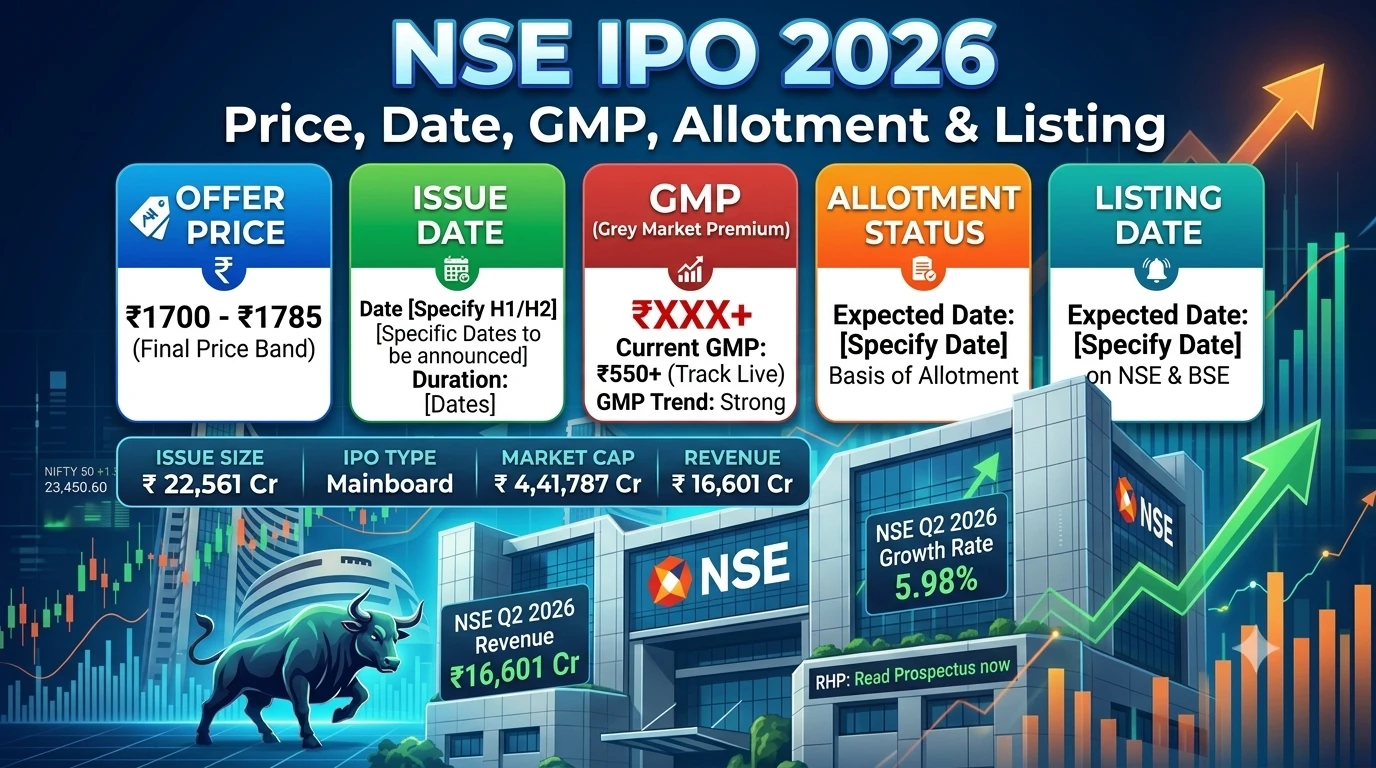
NSE IPO 2026: Price, Date, GMP, Allotment & Listing

₹ 13,600
Min. Investment
National Stock Exchange of India Ltd (NSE) IPO
Finance
Bookbuilding IPO | ₹22,562 Cr | Listing at BSE | Thu, Sep 17, 2026 – Mon, Sep 21, 2026
| Issue Size | ₹ 22,561 Cr |
| IPO Type | Mainboard |
| Market Cap | ₹ 4,41,787 Cr |
| Price Range | ₹1700-₹1785 |
| Listing Ex. | BSE, NSE |
| Revenue | ₹ 16,601 Cr |
| Lot Size | 8 Shares |
| RHP | Read |
| Growth Rate | 5.98% |
About National Stock Exchange of India Limited
National Stock Exchange of India Limited (NSE), incorporated in 1992, is one of the most important institutions in India’s financial market. It is India’s largest stock exchange and has built a strong position among global multi-asset exchange platforms.
NSE provides a vertically integrated market infrastructure covering trading, clearing, settlement, listing, market data, index services and market supervision. Its platform supports several asset classes, including equities, equity derivatives, currency derivatives, commodities, debt securities and mutual funds.
Strong Market Position
NSE has maintained a leading position across several segments of the Indian capital market. As of June 30, 2026, the exchange had more than 261.36 million registered investor accounts and around 129 million unique investors. It had 1,328 trading members and 3,005 listed companies, with total listed market capitalisation of approximately ₹474.08 trillion.
As of March 31, 2026, NSE accounted for 99.79% of cash market turnover, 74.71% of equity futures turnover, 99.48% of equity options turnover and 100% of exchange-traded currency options based on premium turnover.
The exchange's reach also extends across more than 99% of Indian postal codes, supporting wider participation in the country's capital markets.
Technology-Driven Market Infrastructure
Technology is at the core of NSE's operations. Its infrastructure is designed to handle large trading volumes while supporting real-time market data, high-frequency transactions, risk management, market surveillance and regulatory requirements.
The technology platform is built with a focus on scalability, resilience, speed and reliability, which are critical for an exchange handling millions of investors and large transaction volumes every day.
Diversified Business Ecosystem
NSE's business extends beyond its core trading platform through a number of subsidiaries and related businesses. This provides the group with multiple sources of revenue and allows it to serve different participants across the financial ecosystem.
- NSE Clearing Limited provides clearing and settlement services. In Fiscal 2026, it had a market share of 88.42% in the cash market, 91.04% in equity derivatives and 74.09% in exchange-traded derivatives.
- NSE Indices Limited develops and manages market indices used by investors, institutions and financial products.
- NSE Data & Analytics Limited provides real-time and historical market data, benchmark information, fixed-income valuations and analytical services to institutional investors, asset managers and regulators.
- NSE International Exchange provides trading services in foreign-currency-denominated products.
- The group also provides services such as mutual fund registry, back-office exchange support and e-corporate governance solutions.
This vertically integrated structure enables NSE to participate in several stages of the market infrastructure and reduces its dependence on a single business activity.
Key Strengths of NSE
NSE's major strengths include:
- Market leadership: A significant presence across India's cash, equity derivatives and currency derivatives markets.
- Strong brand and trust: NSE is widely associated with transparency, efficiency, technology and reliable market infrastructure.
- Vertically integrated business model: Trading, clearing, settlement, data, indices and related services operate within a broader integrated ecosystem.
- Technology infrastructure: A scalable and resilient platform capable of supporting high transaction volumes and real-time market operations.
- Diversified product portfolio: Presence across equities, derivatives, currencies, commodities, debt and other financial products.
- India's structural growth: NSE is positioned within the broader expansion of India's investor base, capital markets and financial participation.
- Financial performance: The business has a track record of profitability, cash generation and financial performance.
- Experienced management: The company benefits from experienced professionals with expertise in financial markets, technology, governance and regulatory requirements.
Overall, NSE has developed from a stock exchange into a broader financial market infrastructure platform, with businesses spanning trading, clearing, settlement, indices, market data and related services. Its scale, technology infrastructure, market presence and diversified ecosystem are among the key factors behind its position in India's capital markets.
| Application | Lots | Shares | Amount |
|---|---|---|---|
| Retail (Min) | 1 | 8 | ₹14,280 |
| Retail (Max) | 14 | 112 | ₹1,99,920 |
| S-HNI (Min) | 15 | 120 | ₹2,14,200 |
| S-HNI (Max) | 70 | 560 | ₹9,99,600 |
| B-HNI (Min) | 71 | 568 | ₹10,13,880 |



NSE IPO FAQs
What is NSE IPO?
NSE IPO is the initial public offering of National Stock Exchange of India Limited, one of India's leading stock exchanges and a major market infrastructure institution. The IPO is structured entirely as an Offer for Sale (OFS), meaning existing shareholders are offering their shares to the public rather than NSE issuing new shares.
When will NSE IPO open and close?
The NSE IPO is scheduled to open for subscription on September 17, 2026, and close on September 21, 2026. The IPO is expected to be listed on September 24, 2026, subject to the finalisation of the issue schedule.
What is the NSE IPO price band?
The NSE IPO price band has been fixed at ₹1,700 to ₹1,785 per equity share. Investors can place bids within this price range during the IPO period.
What is the NSE IPO lot size?
The lot size for the NSE IPO is 8 shares. Investors need to apply for a minimum of 8 shares and can bid in multiples of 8 shares thereafter.
What is the minimum investment required for NSE IPO?
At the upper price band of ₹1,785, one lot of 8 shares requires a minimum investment of ₹14,280, excluding applicable charges, if any
What is the total size of NSE IPO?
The NSE IPO has an issue size of approximately ₹22,561.5 crore at the upper price band. The offer comprises up to around 12.64 crore equity shares offered by existing shareholders.
Is NSE IPO a fresh issue or an OFS?
The NSE IPO is entirely an Offer for Sale (OFS). There is no fresh issue of shares, so NSE itself will not receive proceeds from the shares sold by the existing shareholders.
Why is NSE bringing an IPO?
The primary purpose of the IPO is to provide a mechanism for existing shareholders to sell their shares and to facilitate the listing of NSE's equity shares on a recognised stock exchange. Since there is no fresh issue, the IPO does not raise new capital for NSE.
What does National Stock Exchange of India Limited do?
NSE operates a major electronic marketplace for financial securities in India. Its business ecosystem covers trading, clearing, settlement, listing, market data, indices and related financial-market services across asset classes such as equities, derivatives, currencies, commodities, debt securities and mutual funds.
Is NSE IPO a Mainboard or SME IPO?
The NSE IPO is a Mainboard IPO. The shares are proposed to be listed on the BSE, with the listing scheduled for September 24, 2026 according to the current IPO schedule.
What is the face value of NSE IPO shares?
The equity shares offered in the NSE IPO have a face value of ₹1 per share.
When will NSE IPO allotment be finalised?
The current IPO schedule indicates that the NSE IPO allotment is expected to be finalised on September 22, 2026. The schedule may be subject to changes by the exchange or registrar.
When will NSE IPO shares be credited to the demat account?
According to the current schedule, shares are expected to be credited to successful applicants' demat accounts on September 23, 2026.
When will NSE shares be listed?
The NSE IPO shares are scheduled to be listed on September 24, 2026, subject to completion of the IPO process and applicable approvals.
Should I apply for NSE IPO?
Whether to apply for an IPO depends on an investor's individual financial situation, investment horizon, risk tolerance and assessment of the company's valuation and business prospects. Investors should review the NSE Red Herring Prospectus and official exchange/SEBI disclosures before making an investment decision. NSE has published its IPO offer documents, including the RHP and financial statements, on its investor-relations website.
Disclaimer: The information provided on this IPO page is for educational and informational purposes only and should not be considered investment advice, a recommendation, or an offer to buy or sell any securities. IPO details such as price, dates, GMP, subscription data, financial figures, and listing information may change and may contain errors or omissions. Investors should independently verify all information from official sources, including the company’s RHP/DRHP and stock exchange filings, and assess their own risk before making any investment decision. EduTaxTuber does not guarantee any profit or listing gains and shall not be responsible for any loss arising from decisions made based on this information.