









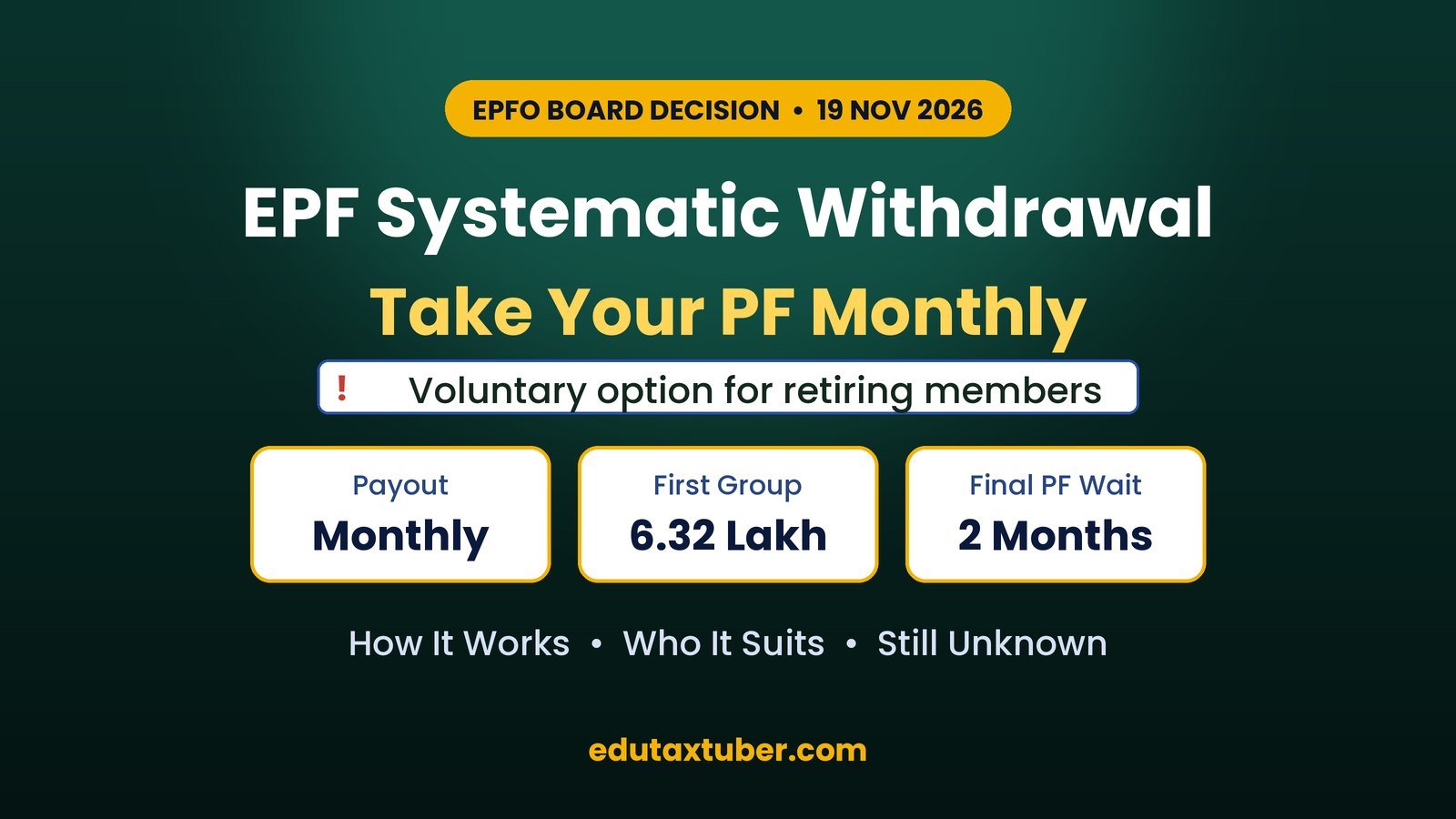
Until now, retiring from a job with EPF meant one thing: a single lump sum landing in your bank account, and then the question of what to do with it. That’s about to change. On 19 November 2026, EPFO’s Central Board of Trustees approved an EPF Systematic Withdrawal Plan, which lets retiring members take their PF in instalments: monthly, quarterly or half-yearly, whichever they prefer.
It got buried under the pension news that day, mostly because everyone was waiting for a minimum pension hike that didn’t come. But for a lot of retirees, this one may matter more.
How the EPF Systematic Withdrawal Plan works
Here is what the Labour Ministry’s release says:
- It is voluntary. If you want your full PF in one go, you can still take it.
- You choose the frequency: monthly, quarterly or half-yearly.
- The first group eligible is about 6.32 lakh EPF members who are above 55 and have more than ₹5 lakh in their PF account.
- If the member dies, the nominee or dependant can either take the remaining balance or keep receiving the periodic payments.
- The option may later be extended to eligible family members or beneficiaries.
If you’ve used an SWP in a mutual fund, the idea is the same: the money stays invested and a fixed amount comes out at regular intervals.
Who should actually consider it
The honest answer is: people who would otherwise leave their lump sum sitting in a savings account, or who worry they’ll spend it too fast. A regular credit every month works like a salary after retirement, and it takes away the pressure of deciding where to put ₹20 or ₹30 lakh in one go.
It’s less obviously useful if you already have a plan for the money, say clearing a home loan, or putting it into the Senior Citizens Savings Scheme, which currently pays 8.2%. Whether SWP beats those options depends on two things EPFO hasn’t told us yet, which brings me to the next part.
What we don’t know yet
The board’s approval is only the first step. The release says the EPF Scheme amendments will be notified after the Ministry approves them, and a matching change to the Income-tax Act is being taken up with the Finance Ministry. So a few important questions are still open:
- When it starts. No date has been given.
- Whether the remaining balance keeps earning EPF interest while you draw it down, and at what rate. This decides whether SWP is a good deal or just a convenient one.
- How the payouts will be taxed. The fact that an Income-tax Act change is needed suggests the government wants to set this out clearly, but until it’s notified, nobody can say for sure.
- How to apply, and whether you can switch back to a lump sum midway.
I’d be wary of anyone telling you exact interest or tax figures for SWP right now. They haven’t been announced.
The other change: easier final withdrawal
The same meeting also relaxed the rules for final PF withdrawal, and this one affects far more people than SWP does.
| Rule | Before | Now approved |
|---|---|---|
| Minimum balance that must stay in the account | 25% | 10% |
| Waiting period for final withdrawal | 12 months | 2 months |
In plain terms: if you lose your job, you won’t have to wait a year to settle your PF, and you can take out a bigger share of it. That’s a welcome correction. The 12-month wait was a real problem for people between jobs who needed the money. Here too, the effective date hasn’t been announced, so check before you apply.
What you can do now
If you’re close to retirement, use the waiting time to get your account in order: make sure your UAN is linked to Aadhaar and your bank account, your KYC is approved, your nomination is filed, and your date of birth and joining dates match your records. Whether you pick SWP or a lump sum later, a clean account is what gets the claim through without trouble.
Also read: No EPS pension hike yet: what the EPFO board decided on 19 November and EPFO wage ceiling ₹25,000: how it changes your PF deduction.
Quick answers
What is the EPF Systematic Withdrawal Plan?
An option approved by EPFO’s board on 19 November 2026 that lets retiring members take their PF in monthly, quarterly or half-yearly instalments instead of one lump sum.
Is it compulsory?
No. It is voluntary. You can still take your full PF at once.
When does it start?
Not yet announced. The scheme amendments will be notified after the Ministry approves them.
Source: Press Information Bureau, Ministry of Labour and Employment, release on the 240th meeting of the Central Board of Trustees, EPF, 19 November 2026. General information, not financial advice.
