









Jio Platforms IPO Day 1: Subscribed 3.16 Times, QIB Demand Hits 9.42 Times
Summary
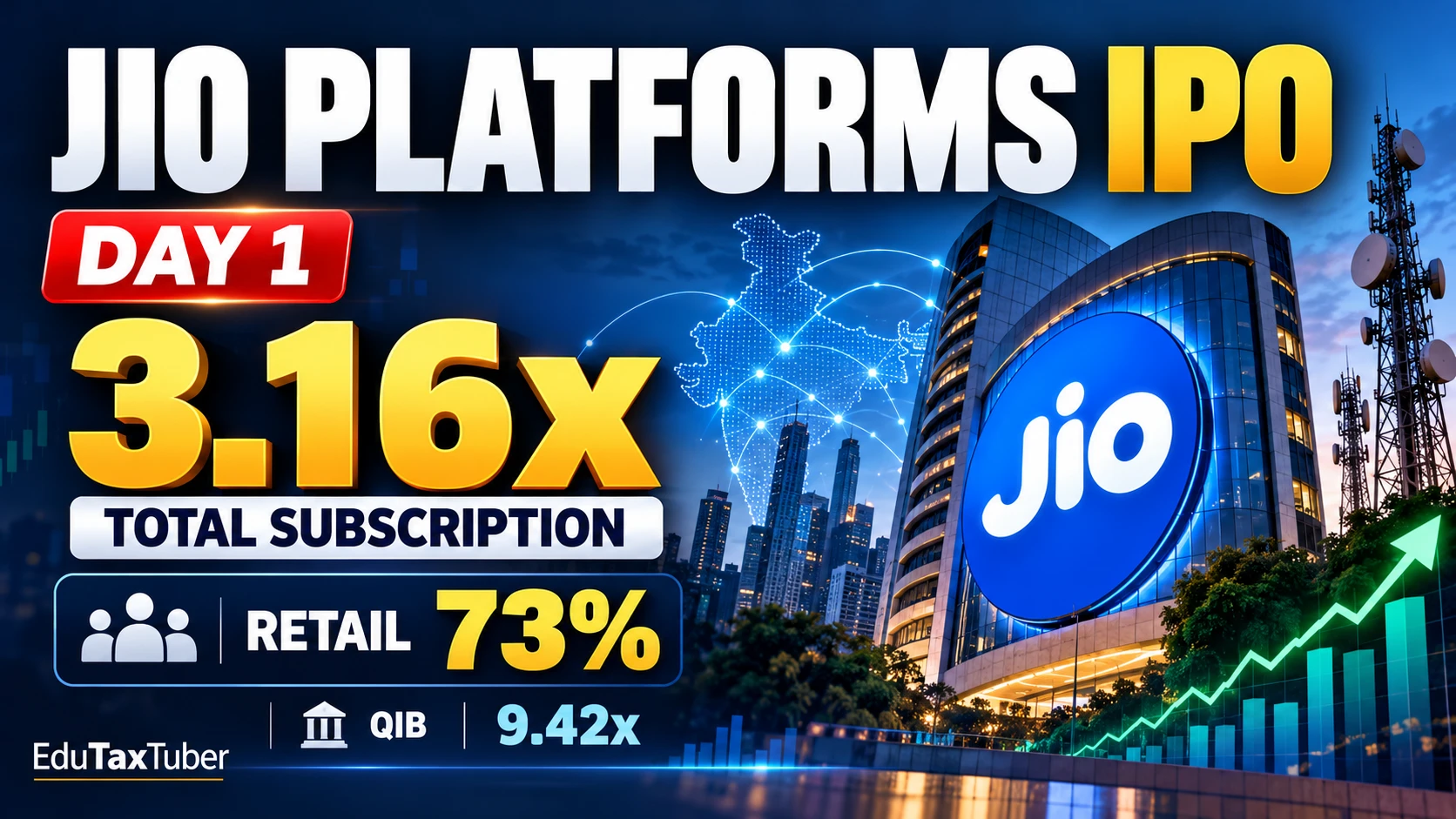
- Jio Platforms’ ₹30,213-crore IPO was subscribed 3.16 times on its opening day, 21 October 2026.
- The issue received bids worth approximately ₹69,800 crore against 19.75 crore shares available for public bidding.
- Qualified institutional buyers (QIBs) subscribed 9.42 times their reserved portion.
- Non-institutional investors (NIIs) subscribed 1.68 times, while the retail portion reached 0.73 times, or 73%.
- The IPO was fully subscribed overall within approximately 100 minutes of opening.
- The price band is ₹1,065–₹1,119 per share, and one lot contains 12 shares.
- Public bidding closes on 23 October. Allotment is expected on 26 October, with tentative NSE/BSE listing on 28 October.
- Strong subscription does not guarantee allotment or listing gains.
Jio Platforms IPO Makes a Strong Day 1 Debut
Jio Platforms Limited’s initial public offering recorded strong investor participation on Wednesday, 21 October 2026, becoming fully subscribed within approximately 100 minutes of opening.
By the close of the first day, the issue was subscribed 3.16 times, according to exchange-based bidding figures reported by Reuters, NDTV Profit and other financial publications.



Investors submitted bids for approximately 62.4 crore shares against about 19.75 crore shares available in the public bidding portion.
At the upper price band, the bids were worth approximately ₹69,800 crore.
The response was led primarily by institutional investors.
Qualified institutional buyers subscribed to their allocation 9.42 times, considerably higher than the 0.73-times subscription recorded in the retail category.
This difference matters because overall oversubscription can conceal significant variations in demand across investor categories.
The public issue remains open until Friday, 23 October.
Jio IPO Subscription Status: Day 1
| Investor category | Subscription on October 21 |
|---|---|
| Qualified institutional buyers (QIBs) | 9.42 times |
| Non-institutional investors (NIIs) | 1.68 times |
| Retail individual investors | 0.73 times |
| Employees | Approximately 1.36–1.37 times |
| Eligible Reliance shareholders | 1.46 times |
| Overall public subscription | 3.16 times |
Sources: Exchange-based closing figures reported by NDTV Profit, Reuters, Mint and Financial Express on 21 October 2026. Small differences in employee-category data reflect reporting snapshots.
The figures describe bids received as of Day 1. They are not final subscription numbers for the entire IPO.
Demand can increase, and valid bid information can be updated, during the remaining application period.
Jio IPO 2026: Key Details
| Particular | Details |
|---|---|
| Company | Jio Platforms Limited |
| Parent and promoter | Reliance Industries Limited |
| IPO size at upper band | ₹30,213 crore |
| Issue structure | Fresh issue of up to 27 crore shares |
| Price band | ₹1,065–₹1,119 |
| Lot size | 12 shares |
| Minimum application at upper band | ₹13,428 |
| Public IPO opens | 21 October 2026 |
| Public IPO closes | 23 October 2026 |
| Expected allotment | 26 October 2026 |
| Tentative listing | 28 October 2026 |
| Proposed exchanges | NSE and BSE |
These offer terms are supported by Jio Platforms’ SEBI-filed red herring prospectus and contemporary issue reporting.
Why Was the IPO Fully Subscribed So Quickly?
Jio Platforms attracted strong demand from large institutional investors shortly after public bidding opened.
According to Reuters, institutional investors covered their reserved allocation within around 10 minutes.
The entire issue reached full subscription in approximately 100 minutes.
Jio operates one of India’s largest telecom and digital-services businesses and has more than 500 million subscribers through its principal telecom operations.
Read Also: Jio Platforms IPO: What It Means for RIL Share Price
The company also has investments and partnerships involving international technology and investment groups, including Meta and Google.
These factors help explain the considerable market attention surrounding the offering.
However, institutional demand should not be treated as proof that the shares will deliver positive returns after listing.
What Does 3.16 Times Subscription Mean?
IPO subscription shows the amount of investor demand relative to the shares available for bidding.
For example, if an issue offers 100 shares and investors bid for 316 shares, the subscription multiple is 3.16 times.
Jio Platforms offered approximately 19.75 crore shares in the public bidding portion.
By the end of Day 1, bids covered roughly 3.16 times that quantity.
This does not mean the company has already issued three times the available shares.
The final number of shares allotted cannot exceed the applicable offer size.
It also does not mean that the reported bid value has already been transferred to the company.
IPO application money is generally blocked or handled through the prescribed banking mechanism, while allotment and settlement follow the issue process.
More Stories

Swiggy Q2 Results 2026: Net Loss Narrows to ₹922 Crore, Instamart Loss at ₹895 Crore

RBI Rejects All 224 Treasury Bill Bids in ₹23,000 Crore Auction: Why It Matters for Investors
Persistent Systems Opens ₹4,265 Crore QIP: Floor Price Clarified at ₹5,761, What Investors Should Know
Mahindra Finance Q2 Results 2026: Profit Jumps 55% to ₹882 Crore, Loan Disbursements Rise 22%
QIB Subscription Reaches 9.42 Times
Qualified institutional buyers recorded the strongest category-wise response.
The QIB portion attracted bids for more than 46 crore shares against approximately 4.91 crore shares available.
Institutional investors can include eligible mutual funds, insurers, foreign institutional investors and other qualifying entities.
Their substantial participation has been one of the defining features of the Jio issue.
However, even when institutional investors submit large bids, actual allotment depends on the final basis of allocation and applicable rules.
Institutional investors may also make incorrect investment decisions.
Strong demand should therefore be evaluated alongside the company’s fundamentals and the price being paid.
Why Was Retail Subscription Only 73%?
The retail investor category was subscribed approximately 0.73 times on the first day.
That means applications covered roughly 73% of the shares reserved for that category as of the closing snapshot.
It does not mean retail investors rejected the IPO.
Some retail applicants may choose to apply closer to the closing date, especially when they want to review demand and market conditions.
The retail portion remains open for valid applications until the issue closes.
A category being below one-times subscription on Day 1 also does not guarantee allotment to every person who applies.
The final valid application count, demand, allocation rules and cut-off-price requirements will determine allotment.
How Much Money Is Required to Apply?
Jio Platforms has fixed a price band of ₹1,065 to ₹1,119 per share.
Each lot contains 12 shares.
At the upper price band, the minimum application amount is:
₹1,119 × 12 = ₹13,428.
A retail investor should check the final bid amount in the broker or bank application interface.
Applicants should also verify the UPI mandate, blocked amount and application status.
Placing a bid does not automatically mean it is valid.
The application must meet the applicable issue requirements, including payment-authorisation procedures.
What Happened to the Anchor Investor Portion?
Before the public subscription opened, Jio Platforms completed its anchor-investor allocation.
The company raised approximately ₹8,109.85 crore from 212 anchor investors, according to stock-exchange-filing-based reports.
Earlier reporting indicated that the anchor book attracted bids worth roughly ₹2.5 lakh crore.
That was separate from the public issue’s Day 1 subscription data.
The distinction is essential.
Anchor demand on October 19 and public subscription on October 21 are two different stages of the IPO.
The previously reported ₹2.5 lakh crore reflects demand submitted for anchor shares; it is not the amount allotted or raised.
The new 3.16-times figure reflects bidding in the public portion on the first day.
Is the IPO Entirely a Fresh Issue?
The offer comprises a fresh issue of up to 27 crore equity shares.
It does not include an offer-for-sale component in the official prospectus.
A fresh issue raises money for the company by creating new shares.
An offer for sale, by contrast, allows existing shareholders to sell shares and receive the sale proceeds.
According to the prospectus, Jio Platforms intends to use a substantial portion of the net proceeds to repay or prepay specified outstanding borrowings of its telecom subsidiary, Reliance Jio Infocomm Limited.
The remainder is allocated towards general corporate purposes, subject to the offer’s detailed terms.
Reducing borrowings may improve balance-sheet flexibility, although future capital expenditure and funding requirements remain important.
What Are the Major Risks?
IPO Valuation
At the upper price band, Jio Platforms would command a substantial equity valuation.
Investors must consider whether earnings growth, cash flows and long-term business prospects justify the price.
Telecom Business Concentration
A significant majority of the company’s revenue continues to come from its telecom operations.
This creates exposure to telecom competition, regulation and network-investment requirements.
Capital Expenditure
Telecom infrastructure, spectrum and new technology initiatives may require considerable future spending.
AI and Cloud Expectations
Jio’s plans in artificial intelligence, cloud and digital services offer possible growth opportunities.
However, the financial returns from new ventures remain uncertain.
Read Also: Paras Healthcare IPO 2026: ₹1,450 Crore Issue, Price Band, Dates and Review
Listing-Day Volatility
Even a heavily subscribed IPO can list below the issue price.
Stock prices are influenced by investor expectations, market conditions and valuation.
Does Grey Market Premium Guarantee Listing Gains?
No.
Grey market premium, commonly called GMP, is an unofficial indicator of market sentiment.
It is not an official price discovered on NSE or BSE.
Figures can change quickly and may differ across data providers.
Therefore, any GMP-based listing-price projection is speculative.
Investors should not rely on unofficial grey-market quotations as a guarantee of profit.
The actual listing price will be determined through the exchange process when trading begins.
What Happens After Day 1?
Jio Platforms’ public subscription period is scheduled to continue on 22 and 23 October.
The final subscription data will be available after the issue closes.
The tentative allotment date is 26 October, followed by the relevant refund and share-credit processes.
The proposed stock-market listing is on 28 October.
Investors should confirm these dates through official exchange and registrar communications because IPO timetables may be revised.
Conclusion
Jio Platforms’ IPO received a strong response on its opening day, with 3.16-times overall subscription and 9.42-times demand in the QIB category.
Retail participation was more subdued at 0.73 times, illustrating the difference between institutional and individual investor interest.
The offering will remain open until 23 October.
The key takeaway for investors is that subscription demand demonstrates interest, but it does not establish that the IPO is attractively valued or that shares will deliver listing gains.
Sources
- SEBI — Jio Platforms Red Herring Prospectus
- Reuters — Jio IPO Day 1 Demand, 21 October 2026
- NDTV Profit — Day 1 Subscription Closing Data
- Financial Express — Jio IPO Fully Subscribed in 100 Minutes
Editorial disclaimer: This article was prepared with AI assistance and reviewed against official issue documents and exchange-data-based financial reporting. Subscription figures are dated and may change during the issue period. It is intended for general educational information and is not an investment, financial, legal or tax recommendation. EduTaxTuber disclaims liability for losses to the extent permitted by applicable Indian law.
Disclaimer: EduTaxTuber provides content for general educational and informational purposes only. While we make reasonable efforts to keep the information accurate and updated, laws, regulations, market conditions, software features, and other information may change. Some content may be created or assisted by AI tools and may contain errors or omissions. Readers should verify important information with official sources or qualified professionals before making any tax, legal, financial, investment, business, or other decisions. EduTaxTuber does not guarantee the completeness or accuracy of the information and does not provide professional advice.
