









Summary
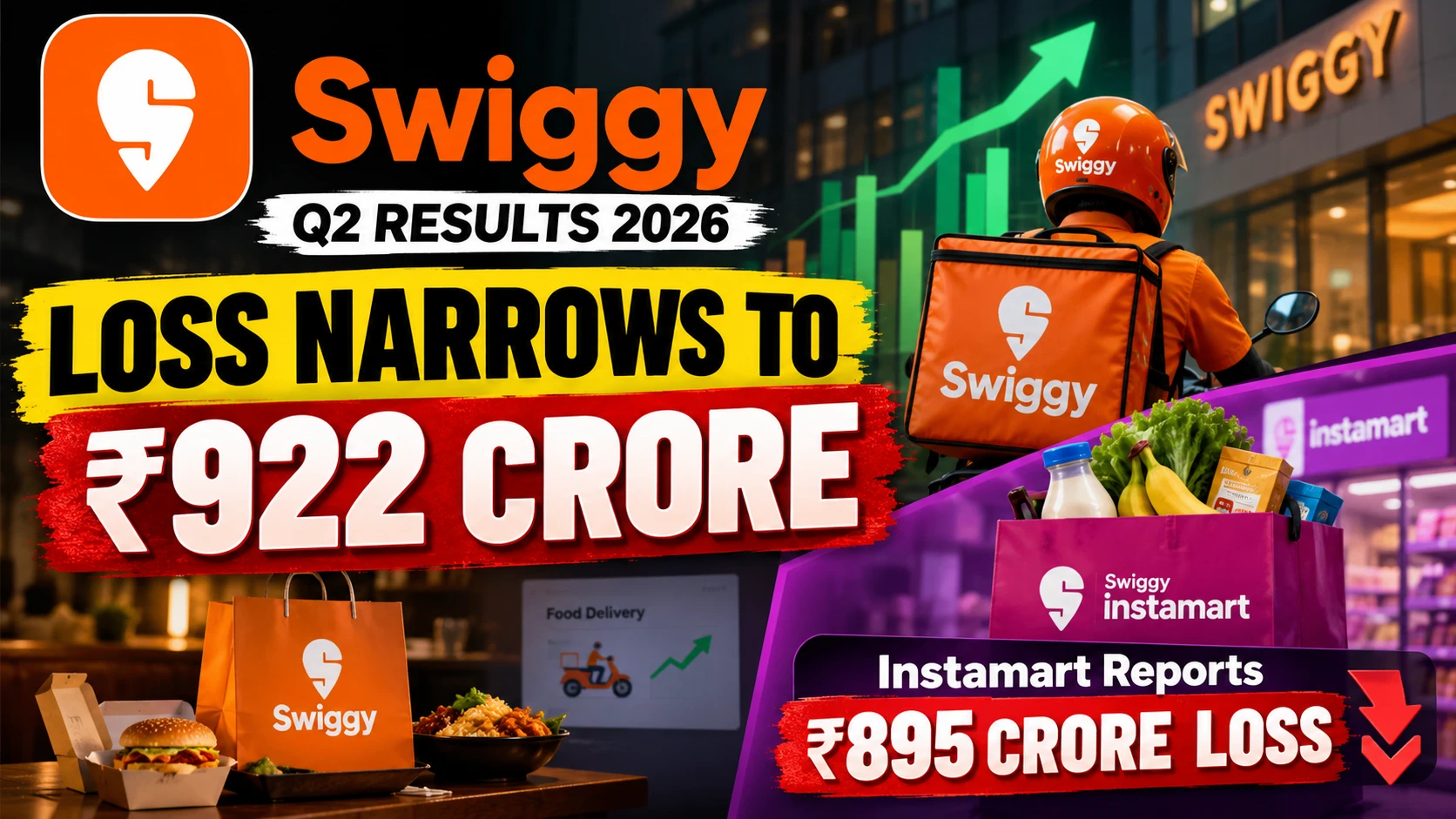
- Swiggy reported a consolidated net loss of ₹922 crore in Q2 FY27, compared with a loss of ₹1,092 crore a year earlier.
- Revenue from operations increased approximately 36.1% to ₹7,571 crore.
- The net loss narrowed year-on-year but widened from approximately ₹791 crore in the June quarter.
- Swiggy’s food-delivery business recorded ₹341 crore in adjusted EBITDA, its highest reported level.
- Instamart reported an adjusted EBITDA loss of ₹895 crore, reflecting the continued cost of quick-commerce expansion.
- Instamart added 69 net dark stores, bringing its network to 1,240 stores across 133 cities.
- The company’s quarterly loss exceeded analysts’ expectations, despite revenue surpassing forecasts.
- Swiggy shares closed approximately 5% lower on 22 October, although the day’s share-price decline should not be attributed solely to the results.
Swiggy Announces Q2 FY27 Financial Results
Swiggy Limited reported its financial results for the quarter ended 30 September 2026 on Thursday, 22 October.
The food-delivery and quick-commerce company recorded a consolidated net loss of ₹922 crore, compared with ₹1,092 crore in the same period last year.
This represents an improvement of approximately 15.6% in the year-on-year loss.


However, compared with the preceding June quarter, the loss widened from approximately ₹791 crore.
Revenue from operations increased 36.1% year-on-year to ₹7,571 crore.
The results highlight two contrasting developments within Swiggy’s business.
Its core food-delivery operations are generating stronger operating profits, supported by higher order value and improving efficiency.
Meanwhile, Instamart continues investing in quick-commerce expansion, contributing to significant consolidated losses.
The central question for investors is whether growth in Instamart can eventually translate into sustainable profitability without requiring consistently high spending.
Swiggy Q2 FY27 Financial Highlights
| Consolidated metric | Q2 FY26 | Q2 FY27 |
|---|---|---|
| Revenue from operations | ₹5,561 crore | ₹7,571 crore |
| Net loss | ₹1,092 crore | ₹922 crore |
| Total expenses | ₹6,711 crore | ₹8,703 crore |
| Food-delivery adjusted EBITDA | ₹240 crore | ₹341 crore |
| Instamart adjusted EBITDA | Loss of ₹849 crore | Loss of ₹895 crore |
Sources: Swiggy’s stock-exchange filing dated 22 October 2026 and Reuters/Moneycontrol earnings coverage. Financial figures are rounded.
Swiggy’s company press release separately reports an overall revenue measure of ₹7,909 crore, growing 33.8%.
The consolidated statutory revenue-from-operations figure of ₹7,571 crore reported in financial-results coverage is used in this article’s headline and table. The two disclosed measures should not be treated as identical.
The distinction between statutory earnings and company-defined operating metrics matters when analysing technology and delivery-platform companies.
Why Did Swiggy’s Loss Narrow Year-on-Year?
Swiggy’s consolidated net loss decreased by approximately ₹170 crore compared with Q2 FY26.
The company’s food-delivery operations were a major source of improvement.
Food-delivery adjusted EBITDA rose to ₹341 crore from ₹240 crore a year earlier.
Higher advertising revenue and improvements in delivery efficiency supported operating performance.
Swiggy has also expanded its services and worked on increasing customer engagement.
However, the improvement in its food-delivery business was partly offset by losses in quick commerce.
Instamart continues to spend on customer acquisition, pricing, store operations and network expansion.
As a result, Swiggy remains loss-making at the consolidated level.
A smaller annual loss is a positive development, but it is not the same as achieving net profitability.
Why Did Swiggy Miss Analysts’ Expectations?
According to Reuters, analysts surveyed by LSEG had expected a quarterly loss of approximately ₹792 crore.
Swiggy instead reported a loss of ₹922 crore.
The reported loss was therefore approximately ₹130 crore larger than the consensus estimate.
Revenue performed better than anticipated.
Reuters reported that analysts expected revenue of approximately ₹7,281 crore, while actual revenue reached ₹7,571 crore.
This difference highlights an important financial principle.
Stronger-than-expected sales do not automatically produce stronger-than-expected profits.
Companies expanding rapidly may face increased operating expenses, depreciation and marketing costs.
Investors should assess how efficiently additional sales are converted into sustainable earnings.
Food-Delivery Business Reports Record Adjusted EBITDA
Swiggy’s core food-delivery business delivered one of the strongest components of its quarterly performance.
Gross Order Value, or GOV, increased 17.7% year-on-year to ₹10,054 crore.
Adjusted EBITDA rose ₹101 crore to ₹341 crore.
The adjusted EBITDA margin improved to 3.4% of GOV, an increase of 58 basis points from the year-earlier period.
A basis point equals one-hundredth of a percentage point.
Thus, 58 basis points represent 0.58 percentage points.
The improvement suggests that Swiggy’s food-delivery operations are becoming more efficient as order volumes and related revenue streams expand.
However, adjusted EBITDA excludes certain expenses and accounting items.
It is not the same as net profit available to shareholders.
Food-Delivery Customer Growth
The company reported approximately 19.8 million monthly transacting users in food delivery.
This represents growth of 15.2% year-on-year.
A larger customer base can help support order frequency, restaurant engagement and platform advertising.
Nevertheless, customer acquisition must be balanced against retention and the cost of incentives.
More Stories

Swiggy Q2 Results 2026: Net Loss Narrows to ₹922 Crore, Instamart Loss at ₹895 Crore

RBI Rejects All 224 Treasury Bill Bids in ₹23,000 Crore Auction: Why It Matters for Investors
Persistent Systems Opens ₹4,265 Crore QIP: Floor Price Clarified at ₹5,761, What Investors Should Know
Mahindra Finance Q2 Results 2026: Profit Jumps 55% to ₹882 Crore, Loan Disbursements Rise 22%

Toing Expands Affordable Food Delivery
Swiggy is also expanding Toing, its separate platform focused on more affordable meals.
According to the company’s official press release, Toing is available in more than 50 cities.
Management stated that approximately two-thirds of new Toing users were new to the food-delivery category.
This could help Swiggy reach customers who consider conventional food-delivery pricing relatively expensive.
The strategy may increase order volumes and help participating restaurants achieve operational efficiencies.
Swiggy has indicated that Toing could support faster growth in its combined food-delivery marketplace.
However, such expectations are forward-looking, not guaranteed future performance.
The profitability of lower-priced orders will depend on delivery costs, average order value and customer behaviour.
Instamart Adjusted EBITDA Loss Widens to ₹895 Crore
Instamart, Swiggy’s quick-commerce business, remains a major area of investment.
The segment reported an adjusted EBITDA loss of ₹895 crore for the September quarter.
Reuters reported a year-earlier loss of approximately ₹849 crore.
The increase reflects continued expenses related to pricing, customer acquisition and warehouse expansion.
Despite the loss, Instamart continued growing its order activity and physical delivery infrastructure.
The company is positioning Instamart to compete in a market where rapid delivery, product selection and customer loyalty are increasingly important.
Instamart Operating Metrics
| Metric | Q2 FY27 |
|---|---|
| Adjusted EBITDA | Loss of ₹895 crore |
| Dark stores added | 69 |
| Total dark stores | 1,240 |
| Cities served | 133 |
| Total dark-store area | 5.2 million square feet |
| Contribution margin | −1.0% of GOV |
| Adjusted EBITDA margin | −9.7% of GOV |
Source: Swiggy’s official 22 October press release.
The company’s press release contains inconsistent Instamart net order value figures between its summary and detailed paragraph. This article therefore does not use a definitive NOV amount pending clarification from the company’s detailed investor materials.
What Does the Contribution Margin Tell Us?
Instamart reported a contribution margin of negative 1.0% of Gross Order Value.
The company indicated that this represented an improvement of 157 basis points year-on-year.
However, it was weaker than the preceding quarter by 82 basis points.
This mixed movement illustrates the challenges of evaluating a fast-growing business.
Year-on-year efficiency may improve even when competitive spending temporarily weakens margins from one quarter to the next.
A contribution margin captures certain operating economics but does not include every cost required to calculate consolidated profit.
Similarly, the adjusted EBITDA margin of negative 9.7% does not mean the company loses exactly ₹9.70 of statutory profit on every ₹100 of customer spending.
The measure is company-defined and should be interpreted within its reported methodology.
Why Is Swiggy Opening More Dark Stores?
Dark stores are small fulfilment facilities designed for online orders rather than conventional walk-in customers.
They allow quick-commerce platforms to position inventory closer to consumers.
This can shorten delivery distances and improve product availability.
Swiggy added 69 net dark stores during Q2, bringing Instamart’s network to 1,240.
The facilities together covered approximately 5.2 million square feet.
Expansion may improve consumer reach but also requires investment in rent, equipment, employees, inventory systems and delivery operations.
New stores may take time to reach sufficient order density.
Consequently, faster store expansion can create near-term losses even when management expects long-term benefits.
Swiggy vs Blinkit: What Do the Results Show?
The quarterly results offer an opportunity to compare the different directions of India’s two major listed food-delivery and quick-commerce businesses.
| Metric | Swiggy | Eternal (Zomato/Blinkit) |
|---|---|---|
| Q2 FY27 consolidated result | ₹922 crore loss | ₹125 crore profit |
| Revenue growth YoY | Approximately 36% | Approximately 78% |
| Quick-commerce network | Instamart: 1,240 stores | Blinkit: 2,751 stores |
| Net stores added in Q2 | 69 | 308 |
Sources: The respective companies’ Q2 FY27 releases and financial reporting.
These comparisons require caution.
The companies use different quick-commerce business models and accounting treatments.
For example, revenue recognition can differ depending on whether a platform acts as the principal seller or as an agent.
Therefore, the difference in reported revenue growth should not automatically be interpreted as the same difference in underlying customer demand.
Likewise, the consolidated profitability of one company is not directly comparable with a single operating segment’s adjusted EBITDA.
Both companies face questions about the sustainability of expansion and competition.
What Is Swiggy Management’s Strategy?
Managing Director and Group CEO Sriharsha Majety highlighted two priorities in the company’s official announcement.
The first is continuing to improve the profitability and accessibility of food delivery.
The second is differentiating Instamart through product selection and customer experience rather than competing exclusively on delivery speed.
Swiggy also stated that it had obtained the necessary approvals to qualify as an Indian-owned and controlled company, with the related transition underway.
Management expects this development to support its quick-commerce strategy.
However, regulatory classification and business-model changes should be assessed through final company disclosures before assuming any specific financial benefit.
What Happened to Swiggy Share Price?
Swiggy shares closed at approximately ₹211.30 on 22 October 2026, down about 5.01%, according to Moneycontrol’s market report.
The share-price movement occurred during the same trading session in which the results were announced.
It would be misleading to attribute the entire decline to the financial figures because the stock was already under pressure before the earnings announcement.
Market sentiment, valuation concerns and expectations about quick-commerce losses can also influence trading.
Investors should evaluate closing prices using exchange records and avoid drawing conclusions from isolated intraday movements.
What Are the Key Risks for Swiggy Investors?
Continued Quick-Commerce Losses
Instamart’s adjusted EBITDA loss remains substantial.
If competitive spending remains elevated, achieving profitability could take longer than expected.
Rising Operating Expenses
Swiggy’s total expenses increased to ₹8,703 crore during the quarter.
Operating-cost growth must eventually be supported by sufficient revenue and margin improvement.
Strong Competition
Swiggy competes with Eternal’s Blinkit and Zomato operations, along with other delivery platforms.
Competition can influence discounts, advertising spending and customer retention.
Read Also: LTTS Share Price Jumps Nearly 15% After Q2 Results: ₹548 Crore Profit, ₹20 Dividend and AI Deals
Business-Model Changes
Changes in inventory ownership, operating structure or accounting treatment can affect reported metrics.
Investors should compare like-for-like figures wherever possible.
Valuation and Cash Requirements
Loss-making growth businesses can experience significant share-price volatility.
Investors should monitor cash consumption, funding capacity and future capital requirements.
What Should Investors Monitor Next?
The next quarterly results will help determine whether Swiggy can continue improving food-delivery profitability.
Investors should monitor the trend in Instamart’s adjusted EBITDA loss, store-level efficiency, customer demand and contribution margins.
The pace of dark-store expansion will also be important.
Opening more stores may improve geographic coverage, but profitability depends on demand, utilisation and cost discipline.
Another factor is whether Swiggy’s newer offerings, including Toing, generate sustainable incremental demand.
Finally, investors should monitor any clarifications regarding the reported quick-commerce operating figures.
Conclusion
Swiggy’s Q2 FY27 results reveal encouraging growth in revenue and stronger profitability in food delivery.
The company’s consolidated net loss narrowed to ₹922 crore from ₹1,092 crore a year earlier.
Revenue increased approximately 36%, and the food-delivery business reported record adjusted EBITDA of ₹341 crore.
However, Instamart’s ₹895 crore adjusted EBITDA loss highlights the continued financial cost of quick-commerce expansion.
The main takeaway: Swiggy is improving in food delivery, but investors should focus on the cost and sustainability of Instamart’s growth before assuming a rapid turnaround in consolidated profitability.
Official and Supporting Sources
- Swiggy — Official Q2 FY27 Press Release, 22 October 2026
- Swiggy — Official Corporate Announcements
- Reuters — Swiggy Q2 Earnings and Instamart Losses
- Moneycontrol — Swiggy Q2 Net Loss and Revenue
- Financial Express — Food Delivery and Instamart Performance
Editorial Disclaimer: This article was prepared with AI assistance using the company’s official disclosures and reliable financial reporting. It is intended for general information and education, not personalised investment, financial, banking, tax or legal advice. Financial results, operating metrics and market prices may change. EduTaxTuber disclaims liability for losses arising from reliance on inaccurate or outdated information to the extent permitted by applicable Indian law.
Disclaimer: EduTaxTuber provides content for general educational and informational purposes only. While we make reasonable efforts to keep the information accurate and updated, laws, regulations, market conditions, software features, and other information may change. Some content may be created or assisted by AI tools and may contain errors or omissions. Readers should verify important information with official sources or qualified professionals before making any tax, legal, financial, investment, business, or other decisions. EduTaxTuber does not guarantee the completeness or accuracy of the information and does not provide professional advice.
