









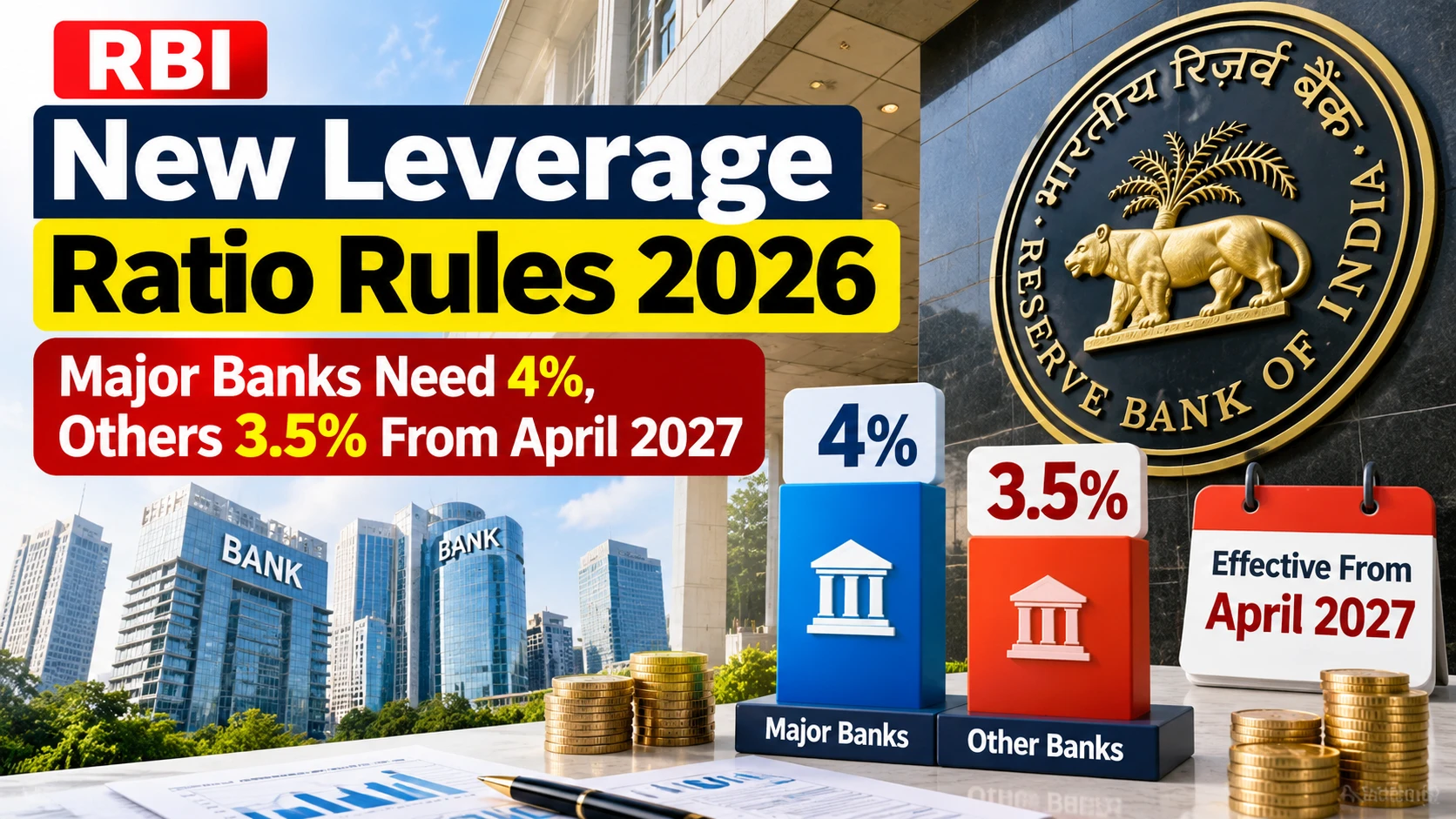
RBI New Leverage Ratio Rules 2026: Major Banks Need 4%, Others 3.5% From April 2027
Summary
- RBI released its final leverage ratio directions on October 23, 2026.
- The new framework will apply from April 1, 2027.
- Domestic systemically important banks must maintain a minimum leverage ratio of 4%.
- Other covered commercial banks must maintain at least 3.5%.
- Indian branches of global systemically important banks face a 3.5% minimum plus the applicable additional buffer.
- The revised directions align India’s regulatory calculations with the Basel Committee’s Leverage Ratio 2017 Standard.
RBI Announces New Leverage Ratio Rules for Banks
The Reserve Bank of India (RBI) has announced changes to the regulatory framework used to measure leverage in commercial banks.
In directions issued on October 23, 2026, the central bank introduced updated requirements for calculating banks’ exposure and assessing capital strength.



The changes will come into effect on April 1, 2027.
Although the term leverage ratio may sound technical, its purpose is relatively simple: to ensure that banks maintain an adequate capital cushion relative to their overall financial exposure.
The announcement is important for banking institutions because it changes how certain exposures must be calculated and reported.
It is also relevant to investors who assess banks’ financial strength.
For ordinary depositors and borrowers, however, the new directions do not automatically change existing deposit interest rates, loan EMIs or account conditions.
What Is a Bank’s Leverage Ratio?
A bank’s leverage ratio compares its Tier 1 capital with its total leverage exposure.
The basic formula is:
Leverage Ratio = Tier 1 Capital ÷ Total Exposure × 100
Tier 1 capital primarily represents a bank’s core loss-absorbing capital under the applicable prudential framework.
Total exposure is a broader regulatory measure that may include on-balance-sheet assets, derivatives and certain off-balance-sheet commitments.
For example, suppose a bank has:
- Tier 1 capital: ₹4,000 crore
- Total leverage exposure: ₹1,00,000 crore
Read Also: RBI Updates Daily CRR Rule for Banks in October 2026
Its leverage ratio would be:
₹4,000 crore ÷ ₹1,00,000 crore × 100 = 4%
This simplified example shows the concept. Banks must use the actual regulatory calculation methodology, which is more detailed.
The leverage ratio operates alongside risk-weighted capital adequacy rules. It is designed to provide an additional safeguard rather than replace existing capital requirements.
RBI Leverage Ratio Rules 2026: Key Requirements
The revised framework specifies different minimum ratios for various banking categories.
| Bank category | Minimum leverage ratio |
|---|---|
| Domestic Systemically Important Banks (D-SIBs) | 4% |
| Other covered commercial banks | 3.5% |
| Indian branches of Global Systemically Important Banks (G-SIBs) | 3.5% plus applicable leverage ratio buffer |
These minimum thresholds are not a newly announced across-the-board increase. The principal changes concern the leverage exposure framework and related measurement requirements.
Why Do Major Banks Need a 4% Ratio?
Some banks are considered especially important to the stability of the financial system because of their size, interconnectedness and role in the economy.
They are classified as Domestic Systemically Important Banks, or D-SIBs.
Financial difficulties at such an institution could have wider consequences for customers, markets and other banks.
Maintaining stronger safeguards is therefore important.
However, a 4% leverage ratio should not be confused with the overall regulatory capital adequacy ratio, which follows a separate risk-weighted framework.
What Changes Under the New RBI Directions?
1. Updated Exposure Calculations
The revised framework aligns leverage measurement with the Basel Committee’s Leverage Ratio 2017 Standard.
Banks must calculate exposure using the prescribed treatment of assets, derivatives, securities financing transactions and relevant off-balance-sheet items.
This is designed to improve the consistency of leverage measurement.
2. Treatment of Derivatives
Derivatives can create financial exposures beyond the immediate accounting value of a transaction.
The revised framework specifies how these exposures must be included when calculating the leverage ratio.
For banks with large derivatives portfolios, the calculation methodology can be significant.
3. Off-Balance-Sheet Exposures
Banks may have commitments and financial obligations that do not appear as ordinary outstanding loans on their balance sheets.
Relevant exposures must be included according to the applicable regulatory conversion methodology.
This helps avoid understating a bank’s overall leverage.
4. Capital Buffer Requirements for Global Banks
Indian branches of global systemically important banks must comply with the prescribed minimum leverage ratio and any applicable G-SIB leverage buffer.
Additional capital distribution constraints may arise when the relevant regulatory buffer requirements are not met.
When Will the New Rules Become Effective?
The implementation date is April 1, 2027.
RBI had published draft directions on August 7, 2026, and invited stakeholder feedback until August 28.
After considering the feedback, the central bank issued its final directions on October 23, 2026.
Banks have a transition period to prepare their systems, policies and calculations before the effective date.
Will the New RBI Rules Affect Bank Customers?
For most retail banking customers, the announcement does not require immediate action.
Will FD Interest Rates Change?
The directions do not directly prescribe new fixed-deposit interest rates.
Banks will continue to determine deposit pricing according to their funding needs, market conditions and other relevant factors.
Will Home Loan EMIs Increase?
Not automatically.
The new leverage ratio framework is different from RBI’s monetary policy repo rate.
A change in prudential capital calculation requirements does not directly alter an existing borrower’s contracted interest rate or EMI.
Is Money in Bank Accounts Safe?
The leverage ratio is one of several prudential safeguards intended to strengthen banking resilience.
It should not, however, be treated as a guarantee that any bank can never experience financial difficulties.
Depositors should continue to consider the applicable deposit insurance arrangements and bank-specific terms.
What Does This Mean for Banking Stocks?
Bank investors generally assess multiple indicators, including capital adequacy, asset quality, profitability, deposit growth and credit costs.
The leverage ratio provides an additional view of financial strength.
Under the revised measurement framework, a bank’s reported exposure could change even without an equivalent change in its ordinary lending activity.
Read Also: RBI MPC Minutes October 2026: More Repo Rate Hikes Possible, but Two Members Warn of Growth Risks
Banks with different business models, derivatives exposures and capital buffers may experience different impacts.
Therefore, investors should not assume that the announcement will automatically increase or decrease banking share prices.
A meaningful assessment requires the bank’s regulatory disclosures and the final implementation methodology.
More Stories

MCA Extends AOC-4 and MGT-7 Due Dates for FY 2025-26: New Deadlines and Filing Rules
EPFO ₹25,000 Crore Reserve Plan: Will Your PF Interest Become More Stable?
Budget 2027 LTCG Tax Cut: Government Weighs Relief From 12.5% Rate for Investors
Bihar Manufacturing City 2026: ₹4,200 Crore Investment MoUs Signed, Over 16,000 Jobs Expected




RBI Leverage Ratio vs Capital Adequacy Ratio
| Feature | Leverage ratio | Capital adequacy ratio |
|---|---|---|
| Main purpose | Limit excessive overall leverage | Maintain capital against risk-weighted assets |
| Exposure treatment | Largely non-risk-weighted regulatory exposure | Risk-weighted assets |
| Core calculation | Tier 1 capital divided by leverage exposure | Regulatory capital divided by risk-weighted assets |
| Regulatory role | Additional prudential safeguard | Principal risk-based capital framework |
Both measures matter because neither tells the complete story of a bank’s financial position.
What Should Banks Do Before April 2027?
Banks should review their existing calculation systems, map relevant financial exposures, assess data quality and test their capacity to meet the revised reporting requirements.
Institutions with complex derivatives or off-balance-sheet activities may require more detailed implementation work.
The objective is not merely to meet a headline percentage, but to calculate and monitor the ratio in accordance with RBI’s prescribed methodology.
Conclusion
RBI’s October 23, 2026 announcement marks an important step in aligning India’s banking leverage framework with updated international standards.
The revised directions retain minimum leverage ratio thresholds of 4% for domestic systemically important banks and 3.5% for other banks, while refining the way banks calculate their total regulatory exposures.
The framework will become effective on April 1, 2027.
For customers, the key takeaway is that this is a banking stability measure, not a direct change to FD rates, home-loan EMIs or the policy repo rate.
Read Also: RBI Injects ₹1 Lakh Crore Into Banks: Will Loan EMIs Fall? October 2026 Liquidity Update
Frequently Asked Questions
Q1. What are the new RBI leverage ratio rules?
RBI has revised its framework for calculating bank leverage exposures and related requirements, effective April 1, 2027.
Q2. What is the minimum leverage ratio for major Indian banks?
Domestic systemically important banks must maintain a minimum leverage ratio of 4%.
Q3. What ratio applies to other banks?
The minimum for other covered commercial banks is 3.5%, subject to the applicable regulatory directions.
Q4. Will home loan EMIs increase from April 2027?
There is no automatic EMI increase under these leverage ratio directions.
Q5. Is the leverage ratio the same as CRR?
No. The leverage ratio concerns capital relative to exposure. The Cash Reserve Ratio concerns required reserves maintained with RBI.
Q6. When did RBI announce these changes?
The final directions were issued on October 23, 2026.
Official Sources
- Reserve Bank of India — Press Release 2026-2027/1376, dated October 23, 2026.
- RBI Circular RBI/2026-27/297 — Reserve Bank of India (Commercial Banks – Prudential Norms on Capital Adequacy) Eleventh Amendment Directions, 2026, dated October 23, 2026.
Disclaimer
This article was prepared with AI assistance and editorial research using regulatory announcements and publicly available financial information. It is intended for educational and informational purposes only and should not be treated as financial, investment, banking or legal advice.
Readers should independently verify RBI directions, applicable bank disclosures and any subsequent regulatory amendments before making financial decisions.
EduTaxTuber is not responsible for financial or other losses arising from reliance on this material to the extent permitted by applicable Indian law, including the Information Technology Act, 2000 where relevant. This disclaimer does not exclude any liability that cannot lawfully be excluded.
Disclaimer: EduTaxTuber provides content for general educational and informational purposes only. While we make reasonable efforts to keep the information accurate and updated, laws, regulations, market conditions, software features, and other information may change. Some content may be created or assisted by AI tools and may contain errors or omissions. Readers should verify important information with official sources or qualified professionals before making any tax, legal, financial, investment, business, or other decisions. EduTaxTuber does not guarantee the completeness or accuracy of the information and does not provide professional advice.
