









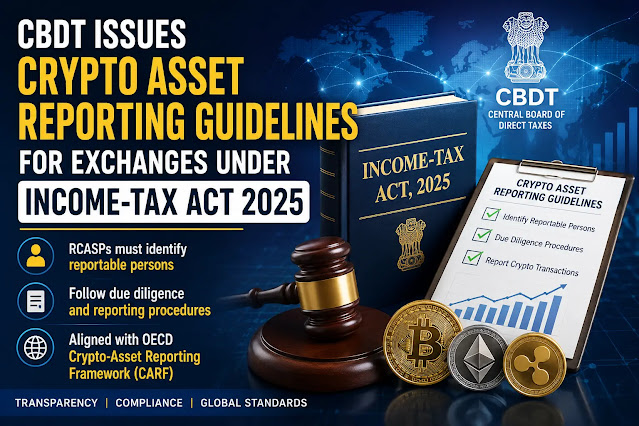
CBDT Issues Crypto Asset Reporting Guidelines for Exchanges Under Income-tax Act 2025: RCASPs Must Report Eligible

CBDT Issues Crypto Asset
Reporting Guidelines for Exchanges Under Income-tax Act 2025: What Crypto Users
and Exchanges Need to Know
The Central Board of Direct Taxes
(CBDT) has released a detailed guidance note explaining how crypto-asset
service providers should comply with the reporting requirements under the Income-tax
Act, 2025. The guidance does not introduce any new tax on virtual digital
assets. Instead, it explains the reporting obligations that crypto exchanges
and other intermediaries must follow while sharing information with tax
authorities.
The move is a significant step in
implementing India’s commitment to the Organisation for Economic
Co-operation and Development’s (OECD) Crypto-Asset Reporting Framework (CARF).
The framework aims to improve global tax transparency by enabling participating
countries to automatically exchange information related to crypto-assets and
cross-border transactions.
With crypto adoption growing
rapidly across the world, governments are strengthening reporting mechanisms to
prevent tax evasion and improve compliance. The latest CBDT guidance provides
clarity to Reporting Crypto-Asset Service Providers (RCASPs) regarding their
legal obligations under the Income-tax Act and the Income-tax Rules.
CBDT Introduces Crypto Asset
Reporting Framework Under Income-tax Act 2025
According to the CBDT, India’s
adoption of the Crypto-Asset Reporting Framework (CARF) reflects its
commitment to global tax transparency standards endorsed by the G20.
CBDT Chairman Ravi Agarwal stated
that crypto-assets can be issued, held and transferred outside the traditional
financial system, making them difficult to monitor under existing reporting
mechanisms. Recognising this challenge, the G20 requested the OECD to develop a
dedicated framework for the automatic exchange of tax information relating to
crypto-assets.
The CBDT clarified that the newly
issued guidance note is intended to help Reporting Crypto-Asset Service
Providers understand and fulfil their reporting responsibilities in a practical
and consistent manner.
What Is a Crypto-Asset Under
CBDT Guidelines?
Definition of Crypto-Asset
The guidance defines a
crypto-asset as a digital representation of value secured using
cryptography and distributed ledger technology or similar systems. These assets
represent economic value or rights that can be digitally transferred, traded,
or stored between individuals or organisations.
Importantly, the classification
depends on the functional characteristics of the asset rather than its label.
Whether it is described as a cryptocurrency, utility token, security token or
non-fungible token (NFT), it may still qualify as a crypto-asset if it
satisfies the prescribed conditions.
Which Crypto-Assets Are
Excluded?
Not every digital asset falls
within the reporting framework.
The CBDT has specifically
excluded:
- Central Bank Digital Currencies (CBDCs)
- Certain specified electronic money products
- Crypto-assets that cannot reasonably be used for
investment or payment purposes
Only relevant crypto-assets
are covered under the reporting and due diligence requirements applicable to
Reporting Crypto-Asset Service Providers.
Reporting Obligations for
Reporting Crypto-Asset Service Providers (RCASPs)
RCASPs Must Identify
Reportable Persons
One of the most important
provisions in the guidance relates to the responsibilities of Reporting
Crypto-Asset Service Providers (RCASPs).
To determine who must be
reported, RCASPs are required to examine their customer base, identify users
eligible for exclusions, and follow the due diligence procedures prescribed
under the Income-tax Rules.
This due diligence process helps
ensure that only eligible reportable users are included while exempt users are
correctly identified.
Reportable persons generally
include:
- Crypto users who are tax residents outside India.
- Controlling persons of certain entities that do not
qualify for exemptions. - Other persons covered under the reporting
provisions of the Income-tax Rules.
What Information Must Crypto
Exchanges Report to Tax Authorities?
Details Required Under CBDT
Crypto Reporting Guidelines
Once an individual or entity is
identified as reportable, the reporting obligations become mandatory.
Once an individual or entity
is classified as reportable, the service provider must furnish relevant
information to the tax authorities. This includes details needed to identify
the reportable person as well as information relating to crypto transactions
carried out by that individual or entity.
The information submitted helps
tax authorities exchange financial information with participating jurisdictions
under international tax cooperation agreements.
The guidance focuses on improving
transparency while ensuring uniform implementation across all Reporting
Crypto-Asset Service Providers operating in India.
Reportable Retail Payment
Transactions Explained
Transactions Above $50,000
Will Be Reported
The CBDT guidance also introduces
the concept of a reportable retail payment transaction.
The guidance further defines a
“reportable retail payment transaction” as a transfer of relevant
crypto-assets used to purchase goods or services where the value exceeds
$50,000. Such transactions, where a customer uses crypto-assets through an
RCASP to pay for goods or services, will also fall within the reporting
framework.
This means certain high-value
purchases made using crypto-assets will be subject to reporting requirements if
they satisfy the prescribed conditions under the Income-tax Rules.
Why the CBDT Issued Crypto
Asset Reporting Guidelines
India’s Commitment to Global
Tax Transparency
The CBDT stated that the guidance
has been prepared to ensure consistent implementation of reporting obligations
across all crypto intermediaries.
The objective is to support
India’s participation in the global exchange of tax-related information while
reducing opportunities for tax evasion involving crypto-assets.
By aligning with the OECD’s
Crypto-Asset Reporting Framework, India joins several jurisdictions that are
strengthening international cooperation for monitoring digital asset
transactions.
Impact of CBDT Crypto
Reporting Guidelines on Crypto Exchanges and Investors
For crypto exchanges and other
intermediaries, the guidance provides much-needed clarity regarding reporting
procedures, customer due diligence and compliance obligations.
Crypto investors should note that
the guidance does not introduce any new tax on virtual digital assets. Instead,
it establishes a structured reporting mechanism that enables tax authorities to
obtain information regarding reportable crypto transactions.
Exchanges may need to strengthen
their customer verification processes, update compliance systems and maintain
detailed records to ensure timely reporting under the Income-tax Act, 2025.
Conclusion
The CBDT issues crypto asset
reporting guidelines for exchanges under Income-tax Act 2025 marks another
important milestone in India’s evolving digital asset regulatory framework.
Rather than creating new taxation rules, the guidance explains how Reporting
Crypto-Asset Service Providers should identify reportable persons, carry out
due diligence and report relevant crypto transactions.
With the implementation of the
OECD’s Crypto-Asset Reporting Framework, India aims to improve transparency,
strengthen international tax cooperation and ensure consistent reporting
standards across the crypto ecosystem. Crypto exchanges and service providers
should carefully review the guidance and update their compliance processes to
meet the reporting obligations prescribed under the Income-tax Act and
Income-tax Rules.
Disclaimer
Some portions of this article
were generated with the assistance of Artificial Intelligence (AI) and have
been reviewed and edited by the EduTaxTuber editorial team for accuracy,
clarity, and compliance with publicly available information. Readers are advised
to refer to the official CBDT notification and consult a qualified tax
professional before making any financial or tax-related decisions.