








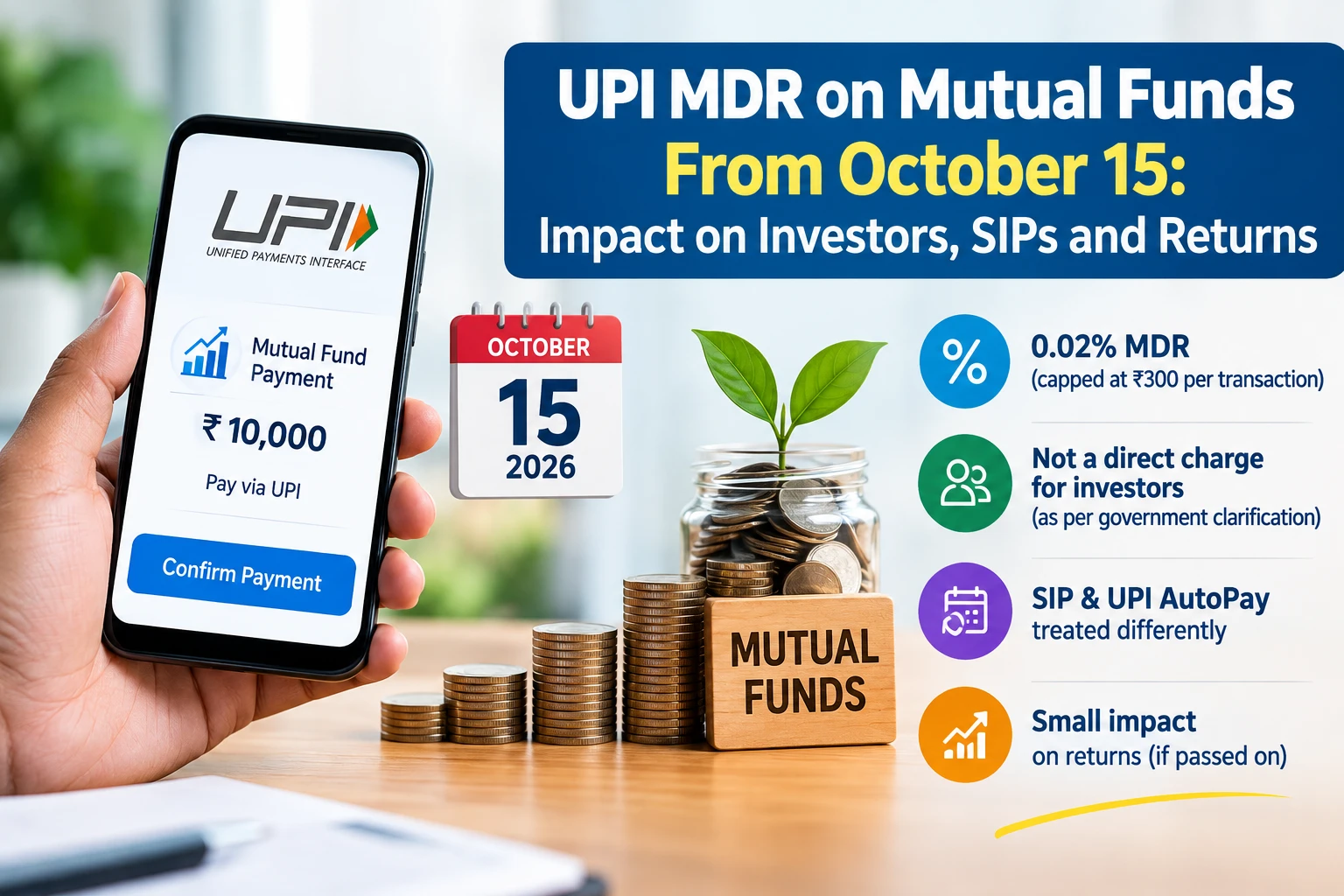
UPI MDR on Mutual Funds from October 15: Impact on Investors, SIPs and Returns
Summary
- UPI MDR of 0.02% will apply to eligible mutual fund and other capital-market payments from October 15, 2026.
- The MDR will be capped at ₹300 per transaction.
- For a ₹10,000 investment, 0.02% MDR equals ₹2.
UPI MDR on Mutual Funds: What Changes From October 15, 2026?
Investors using UPI to make payments towards mutual funds and other capital-market transactions will see a change from October 15, 2026.
Under the revised UPI Merchant Discount Rate framework, eligible payments relating to mutual funds, securities, stockbrokers and dealers will attract an MDR of 0.02%, subject to a maximum of ₹300 per transaction.
For example, an eligible UPI payment of ₹10,000 would generate an MDR of ₹2, while a ₹1 lakh transaction would generate ₹20 at the 0.02% rate.
Importantly, this does not mean that investors will automatically see ₹2 or ₹20 added to their UPI payment. The government has specifically clarified that MDR is a charge within the merchant-payment ecosystem and is not a transaction fee payable by customers.
This distinction is important because the actual impact on investors depends on how AMCs, brokers and investment platforms account for the cost.
How Will UPI MDR Affect Mutual Fund Investors?
The immediate position is relatively straightforward: MDR is intended to be a merchant-side cost, not a direct charge on the investor.
Eshaan Lazarus, Founder and CEO of 021 Trade, explained that under the announced framework, investors should not bear the MDR directly because it is deducted by the acquiring bank while settling funds with the AMC or investment platform.
However, the question investors are asking is what happens if intermediaries eventually recover this cost through another mechanism.
Harsh Vardhan Dawar, ACA, CFA and FRM, Founder of Wealth Cafe, said the industry is expected to clarify how the MDR will ultimately be accounted for.
One possible comparison is with other transaction-related deductions. For example, when stamp duty is deducted from an investment amount, the amount actually invested becomes slightly lower.
If a similar approach were adopted for MDR, the amount invested could be reduced.
Another possibility is that the investment platform could collect the MDR separately, allowing the investor’s entire intended investment amount to go into the mutual fund.


Two Possible Ways UPI MDR Could Affect the Investment Amount
There are broadly two theoretical scenarios.
Scenario 1: MDR Is Deducted From the Investment
Suppose an investor wants to invest ₹10,000 through UPI.
At 0.02%, the MDR would be:
₹10,000 × 0.02% = ₹2
If that ₹2 were deducted from the investment amount, only ₹9,998 would actually be invested.
Scenario 2: MDR Is Collected Separately
Under the second approach, the investor could pay:
- Mutual fund investment: ₹10,000
- UPI MDR: ₹2
- Total payment: ₹10,002
In this case, the entire ₹10,000 would remain invested.
The difference may look insignificant for a single transaction. However, investors making frequent transactions may want to understand how the charge is handled.
UPI MDR Impact on a ₹10,000 Mutual Fund Investment
| Particulars | MDR Deducted From Investment | MDR Paid Separately |
|---|---|---|
| Intended investment | ₹10,000 | ₹10,000 |
| UPI MDR @ 0.02% | ₹2 | ₹2 |
| Amount invested | ₹9,998 | ₹10,000 |
| Assumed annual return | 10% | 10% |
| Investment period | 5 years | 5 years |
| Approx. value after 5 years | ₹16,102 | ₹16,105 |
| Estimated gain | ₹6,104 | ₹6,105 |
Illustration assumes a 10% annual return over five years. It is only an example and does not represent a guaranteed mutual fund return. Stamp duty, taxes and other applicable charges are excluded.
The difference is only a few rupees in this example because the initial MDR is just ₹2.
For a ₹1 lakh investment, 0.02% MDR would be ₹20. If the charge reduced the amount invested rather than being collected separately, the difference in the final value would similarly remain relatively small for a single transaction.
When Does the ₹300 UPI MDR Cap Apply?
The capital-market MDR is capped at ₹300 per transaction.
At a rate of 0.02%, the ₹300 maximum is reached when the transaction value reaches:
₹300 ÷ 0.02% = ₹15 lakh
Therefore:
- ₹10,000 → ₹2 MDR
- ₹50,000 → ₹10 MDR
- ₹1 lakh → ₹20 MDR
- ₹5 lakh → ₹100 MDR
- ₹10 lakh → ₹200 MDR
- ₹15 lakh → ₹300 MDR
- Above ₹15 lakh → Maximum ₹300 MDR
This ₹300 cap limits the MDR on very high-value eligible capital-market transactions.
Can UPI MDR Increase the Mutual Fund Expense Ratio?
This is another important distinction for investors.
The expense ratio represents the expenses charged to a mutual fund scheme and reflected through its NAV. The UPI MDR, however, is associated with the payment transaction.
Harsh Vardhan Dawar said the MDR would have to be treated as a transaction-level cost and would not ordinarily increase the fund’s expense ratio merely because an investor chooses UPI.
The reasoning is that if the cost were charged to the scheme’s assets, it could effectively affect investors using other payment methods as well.
Eshaan Lazarus similarly noted that charging the MDR to scheme assets would need to comply with applicable SEBI expense-related rules. The announcement of the MDR itself does not establish that the charge can simply be added to scheme expenses.
For investors, the key point is this: a UPI MDR should not automatically be interpreted as an increase in a mutual fund’s published expense ratio.
Will UPI MDR Apply to Mutual Fund SIPs?
This is one of the most important questions for SIP investors.
The treatment of a SIP depends on how the payment is processed.
According to the current framework and reporting around the NPCI FAQ, UPI AutoPay and recurring UPI mandates are treated separately from one-time merchant payments. Mutual fund SIPs processed through an eligible UPI AutoPay mandate are not subject to the prescribed MDR.
Therefore, investors should distinguish between:
One-Time UPI Investment
A one-time UPI payment for an eligible capital-market transaction can fall under the 0.02% MDR category.
UPI AutoPay SIP
A recurring SIP collected through an eligible UPI AutoPay mandate is treated differently and remains outside the prescribed MDR framework.
This distinction means that investors should not assume that every UPI-based SIP payment will attract 0.02% MDR.
The exact treatment of a particular SIP can also depend on how the AMC, bank and payment platform process the mandate.
What Other Costs Do Mutual Fund Investors Pay?
UPI MDR is not the only cost investors may encounter.
Depending on the investment route and product, investors may already encounter costs such as:
- Stamp duty on mutual fund purchases
- Brokerage or platform charges, where applicable
- Depository-related charges when applicable
- Taxes and statutory charges
- Exit load on certain mutual fund schemes
- Other platform-specific fees
The important point is that these charges have different purposes and are governed by different rules.
A UPI MDR should therefore be considered separately from the mutual fund expense ratio and other scheme-level expenses.
Could Brokers and Mutual Fund Platforms Pass the Cost to Investors?
This is where the situation becomes more relevant for retail investors.
Although the government says customers will not pay MDR directly, intermediaries could potentially adjust their own pricing structures to account for payment-related costs.
Possible mechanisms could include:
- A separate checkout or transaction fee
- Changes to platform fees
- Higher subscription or service fees
- Other disclosed charges associated with a particular payment method
Lazarus said that if the cost eventually reaches investors, it could potentially appear through a checkout fee or higher platform or subscription charges.
That would be different from saying that UPI itself is charging investors an MDR.
Investors should therefore check the final payment amount shown by their AMC, broker or investment platform.
More Stories

ixigo Q2 Results: Profit Reaches ₹63.42 Crore, Revenue Rises 13% as Hotels Business Expands
FPI Outflows October 2026: Foreign Investors Withdraw ₹52,100 Crore From Indian Stocks

Paras Healthcare IPO 2026: ₹1,450 Crore Issue, Price Band, Dates and Review
57th GST Council Meeting 2026: Major Reforms Proposed for Taxpayers and Businesses



How Much Does 0.02% MDR Actually Cost an Investor?
The percentage can sound larger or more complicated than it actually is.
Here are some examples:
| Investment Amount | MDR @ 0.02% |
|---|---|
| ₹5,000 | ₹1 |
| ₹10,000 | ₹2 |
| ₹25,000 | ₹5 |
| ₹50,000 | ₹10 |
| ₹1 lakh | ₹20 |
| ₹2 lakh | ₹40 |
| ₹5 lakh | ₹100 |
| ₹10 lakh | ₹200 |
| ₹15 lakh | ₹300 |
| ₹20 lakh | ₹300* |
The capital-market MDR is capped at ₹300 per transaction.
So, for a typical retail mutual fund investment, the absolute amount involved is relatively small.
The more important issue is who ultimately bears the cost and how frequently the investor makes eligible UPI transactions.
What Should Mutual Fund Investors Do From October 15?
Investors do not need to stop using UPI simply because the MDR framework changes.
Instead, consider these practical steps:
1. Check the Final Payment Amount
Before completing a transaction, check the amount displayed by your AMC, broker or investment platform.
2. Understand Whether It Is a One-Time Payment or AutoPay
A one-time UPI payment and a recurring UPI AutoPay mandate are treated differently under the new framework.
3. Check Platform Fees
If a platform introduces a new fee, look at whether it is a UPI-specific fee or part of the platform’s broader pricing structure.
4. Don’t Confuse MDR With Expense Ratio
A payment-related MDR and the mutual fund’s expense ratio are different costs.
5. Consider the Frequency of Transactions
For occasional investments, a small transaction-level cost may have limited financial impact. Investors making frequent payments should pay closer attention to cumulative charges.
UPI MDR vs Mutual Fund Expense Ratio: What’s the Difference?
These two terms should not be confused.
UPI MDR is associated with the payment transaction and operates within the merchant-payment ecosystem.
Mutual fund expense ratio represents the recurring expenses of operating and managing a mutual fund scheme and is reflected in the NAV.
The current government framework specifically places eligible capital-market UPI payments at 0.02% MDR, capped at ₹300, while also stating that customers do not pay MDR as a direct UPI transaction fee.
Therefore, an investor seeing a UPI-related charge should not automatically assume that the mutual fund’s expense ratio has increased.
What Does the New UPI MDR Mean for Mutual Fund Returns?
For most individual transactions, the direct mathematical impact is small.
For example, a ₹10,000 investment attracting ₹2 at 0.02% represents only 0.02% of the transaction value.
If the ₹2 were deducted from the amount invested, the investor would start with ₹9,998 instead of ₹10,000. Over a long period, the difference would compound, but it would still be small for a single transaction.
The bigger consideration is whether similar charges are applied repeatedly across many transactions and whether intermediaries introduce additional fees.
Investors should therefore focus less on the headline percentage alone and more on the actual amount charged at checkout and the frequency of eligible transactions.
UPI MDR on Mutual Funds: What Investors Need to Remember
The new UPI MDR framework creates an additional payment-system cost for eligible capital-market transactions, but it does not mean that mutual fund investors will automatically be charged a separate UPI fee.
The government has clarified that customers will not pay MDR directly, while capital-market payments have been assigned a concessional 0.02% MDR with a ₹300 transaction cap.
For SIP investors, the distinction between a one-time UPI payment and a recurring UPI AutoPay mandate is particularly important.
If AMCs, brokers or investment platforms introduce any customer-facing charge to recover their costs, investors should check the applicable fee before confirming the transaction.
For most retail investors, the numerical impact of 0.02% on an individual investment is small. However, understanding how the charge is accounted for, whether it is paid separately and how often it applies will help investors understand the real cost of using UPI for mutual fund transactions.
Disclaimer: EduTaxTuber provides content for general educational and informational purposes only. While we make reasonable efforts to keep the information accurate and updated, laws, regulations, market conditions, software features, and other information may change. Some content may be created or assisted by AI tools and may contain errors or omissions. Readers should verify important information with official sources or qualified professionals before making any tax, legal, financial, investment, business, or other decisions. EduTaxTuber does not guarantee the completeness or accuracy of the information and does not provide professional advice.