









RVNL Q1 Results: Net Profit Rises 18.5% to ₹159 Crore, Revenue Up 10.6%
Rail Vikas Nigam Ltd (RVNL) Q1 results: Rail Vikas Nigam Ltd reported a year-on-year rise in consolidated net profit for the June quarter of FY27, while revenue from operations also recorded double-digit growth. However, profit and revenue declined sequentially compared with the March quarter.
Rail Vikas Nigam Ltd, a Central Public Sector Enterprise (CPSE) operating in the railway infrastructure space, reported its RVNL Q1FY27 results on Tuesday, August 11, 2026.
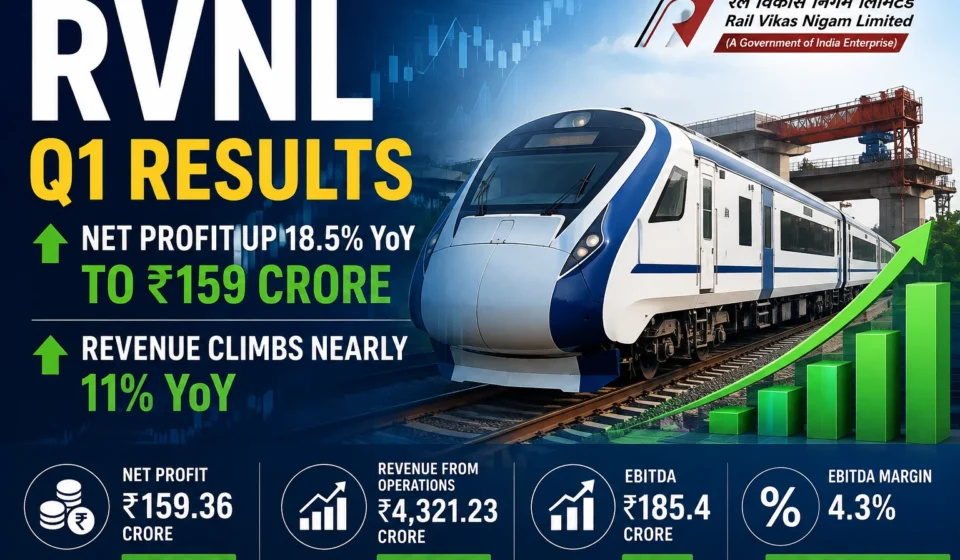
The company posted a consolidated net profit of ₹159.36 crore in Q1FY27, marking an increase of 18.5% year-on-year (YoY) compared with ₹134.53 crore in the same quarter last year.
The result comes against a backdrop of continued investor focus on railway and infrastructure stocks, particularly companies linked to government capital expenditure and large public infrastructure projects.
RVNL Q1 Results: Net Profit Rises 18.5% YoY
RVNL’s consolidated net profit increased to ₹159.36 crore in Q1FY27, compared with ₹134.53 crore in Q1FY26.
On a year-on-year basis, this translates into an 18.5% increase in net profit, indicating that the company started the new financial year with improved profitability despite a significant sequential decline from the previous quarter.
However, the quarter-on-quarter picture was weaker.
RVNL had reported a consolidated net profit of ₹187.07 crore in Q4FY26. Compared with that figure, Q1FY27 profit declined by approximately 14.8%.
This difference between the YoY and QoQ numbers is important for investors. While the annual comparison shows improvement over the same period last year, the sequential decline reflects the typically uneven nature of project execution and revenue recognition in the infrastructure sector.
RVNL Revenue in Q1FY27 Increases 10.6%
Revenue from operations was another positive feature of the RVNL Q1FY27 results.
The company reported revenue from operations of ₹4,321.23 crore during the June quarter, compared with ₹3,908.77 crore in Q1FY26.
That represents a 10.6% YoY increase.
However, revenue declined sharply compared with Q4FY26. RVNL’s revenue from operations stood at ₹6,695.91 crore in the March quarter, meaning Q1FY27 revenue was approximately 35.5% lower sequentially.
The sharp QoQ movement should be viewed in the context of the company’s project-driven business. Infrastructure companies can experience substantial quarter-to-quarter fluctuations depending on project execution, billing and recognition of revenue.
RVNL EBITDA Jumps, Margin Improves Sharply
One of the stronger points in the RVNL Q1 results was the improvement in EBITDA.
RVNL reported EBITDA of ₹185.4 crore in Q1FY27, compared with ₹56 crore in the corresponding quarter of the previous financial year.
That represents a substantial year-on-year improvement.
The company’s EBITDA margin consequently increased to approximately 4.3%, compared with 1.43% in Q1FY26.
The improvement in EBITDA and margin is particularly relevant because revenue growth alone does not necessarily translate into stronger profitability. Higher operating profitability suggests that the company was able to generate better earnings before interest, tax, depreciation and amortisation relative to its operating revenue during the quarter.
At the same time, investors should avoid reading too much into a single quarter’s margin because infrastructure-sector profitability can fluctuate depending on project mix and execution stages.
RVNL Total Expenses Rise Nearly 7% YoY
RVNL’s total expenses stood at ₹4,244.91 crore during Q1FY27.
On a year-on-year basis, total expenses increased by nearly 7%. However, expenses declined by around 35% sequentially compared with Q4FY26.
The increase in expenses needs to be considered alongside the company’s revenue growth and improvement in EBITDA.
With revenue from operations increasing 10.6% YoY while total expenses rose at a slower rate, the operating performance showed improvement compared with the year-ago quarter.
This was reflected in the significant expansion in EBITDA during the quarter.
RVNL Share Price: Stock Trades in a Volatile Range
The RVNL share price remained volatile during Tuesday’s trading session as investors tracked the company’s Q1FY27 performance.
RVNL shares touched an intraday high of ₹231.75 and an intraday low of ₹227.75 during the session.
The stock has remained under pressure from its previous highs. RVNL recorded a 52-week high of ₹400.90 on December 29, 2025, while its 52-week low stands at ₹220.25, recorded on July 28, 2026.
The wide gap between the 52-week high and low highlights the significant volatility that has been witnessed in the stock.
For investors tracking RVNL share price today, the quarterly results are therefore likely to be assessed alongside the broader railway-stock trend, project execution, order inflows and future earnings visibility rather than on quarterly profit alone.
What Do RVNL Q1FY27 Results Mean for Investors?
The RVNL Q1FY27 results present a mixed but broadly constructive picture.
On the positive side, the company delivered:
- 18.5% YoY growth in consolidated net profit
- 10.6% YoY growth in revenue from operations
- Strong improvement in EBITDA
- EBITDA margin expansion from 1.43% to 4.3%
However, the sequential numbers remain a point investors may watch closely.
Both revenue and net profit declined compared with Q4FY26. The magnitude of the sequential revenue decline was particularly significant, although quarter-to-quarter fluctuations are common in project-oriented infrastructure businesses.
The next few quarters will therefore be important for determining whether the improvement in operating profitability can be sustained while revenue growth continues.
RVNL Q1 Results: Key Numbers at a Glance
| Particulars | Q1FY27 | Q1FY26 | YoY Change |
|---|---|---|---|
| Net Profit | ₹159.36 crore | ₹134.53 crore | +18.5% |
| Revenue from Operations | ₹4,321.23 crore | ₹3,908.77 crore | +10.6% |
| EBITDA | ₹185.4 crore | ₹56 crore | Strong increase |
| EBITDA Margin | 4.3% | 1.43% | Improved |
| Total Expenses | ₹4,244.91 crore | — | ~7% YoY increase |
Figures are consolidated and based on the Q1FY27 results information available for the June quarter.
RVNL Share Price Outlook: What Investors Should Watch
The immediate focus for investors following the RVNL Q1 results is likely to shift toward future project execution and earnings visibility.
The company operates in an infrastructure environment where government spending, railway modernisation, new project awards and execution timelines can influence financial performance.
Investors should therefore track upcoming order wins, order-book developments, revenue execution and operating margins in subsequent quarters.
The stock’s significant movement from its 52-week high of ₹400.90 to the recent low of ₹220.25 also demonstrates that strong long-term infrastructure themes do not eliminate short-term market volatility.
Consequently, the Q1FY27 numbers should be considered as one part of the broader investment picture rather than as a standalone buy or sell signal.
Bottom Line: RVNL Q1 Results Show Better Yearly Profitability
The RVNL Q1 results show that Rail Vikas Nigam Ltd began FY27 with an improvement in both profit and operating revenue on a year-on-year basis.
Net profit rose 18.5% to ₹159.36 crore, while revenue from operations increased 10.6% to ₹4,321.23 crore. The sharp improvement in EBITDA and expansion in EBITDA margin were among the notable positives of the quarter.
At the same time, the sequential decline in revenue and profit means investors will be watching the company’s execution and profitability in the coming quarters.
For the RVNL stock, the key question now is whether the improvement in operating performance can translate into sustained earnings growth while the company continues to execute its infrastructure project pipeline.
Disclaimer: This article is for informational and educational purposes only and should not be considered investment advice, a recommendation to buy or sell RVNL shares, or a substitute for professional financial advice. Stock-market investments are subject to market risks. Readers should conduct their own research and consult a SEBI-registered investment adviser before making investment decisions. Some portions of this article may have been generated or assisted by artificial intelligence (AI) and have been reviewed and edited for clarity, accuracy and readability.