








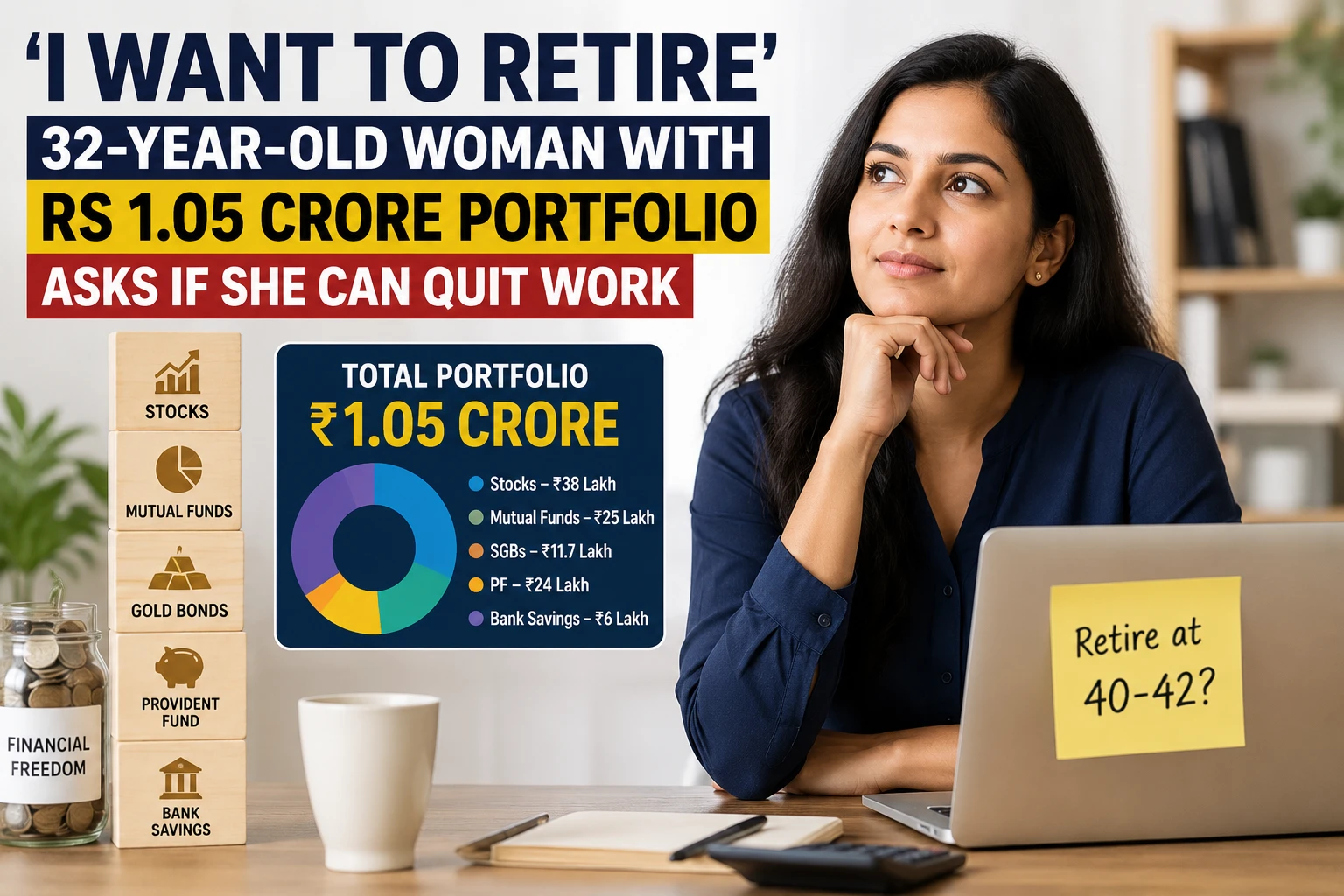
I want to retire: A 32-year-old woman from Chennai says she has built an investment portfolio worth around Rs 1.05 crore through stocks, mutual funds, Sovereign Gold Bonds, Provident Fund and bank savings. Despite earning Rs 1.20 lakh a month, she wants to know whether she can achieve financial independence and retire from full-time work by the age of 40-42.
The woman shared details of her finances online, triggering a debate about early retirement, investment discipline and whether a Rs 1 crore-plus portfolio at age 32 is enough to stop working. The portfolio figures are based on information shared by the investor and were not independently verified for this report.
How the Rs 1.05 crore portfolio is invested
The investor said she started investing in mutual funds in 2019 and has gradually built a substantial portfolio across multiple asset classes.
Her mutual fund investments are currently worth around Rs 25 lakh, while her stock holdings are valued at approximately Rs 38 lakh.
She also has significant exposure to gold and retirement-linked savings. According to the information she shared, she invested about Rs 11.7 lakh in Sovereign Gold Bonds (SGBs) in 2023.
Her Provident Fund corpus stands at around Rs 24 lakh, while another Rs 6 lakh is held in bank savings.
Taken together, the reported holdings are:
- Stocks: Rs 38 lakh
- Mutual funds: Rs 25 lakh
- Sovereign Gold Bonds: Rs 11.7 lakh
- Provident Fund: Rs 24 lakh
- Bank savings: Rs 6 lakh
- Total: Approximately Rs 1.05 crore
Woman invests Rs 86,000 every month
The investor is also continuing to save and invest a large portion of her monthly income.
She said she earns approximately Rs 1.20 lakh per month and invests Rs 60,000 every month in mutual funds. Another Rs 26,000 goes towards EPF and CPF contributions.
That puts her reported monthly investment at around Rs 86,000, equivalent to nearly 72% of her monthly income.
Her high savings rate has been a key factor in helping her accumulate a portfolio of more than Rs 1 crore at just 32.
Read Also: Karnataka IAS Officer Gyanendra Kumar Goes Missing Amid KPSC Row
Can she retire at 40-42? I want to retire
The biggest question, however, is whether a Rs 1.05 crore portfolio today can support an early retirement eight to 10 years from now.
The answer depends on several factors, including her future expenses, inflation, investment returns, taxation, healthcare costs and whether she plans to earn any income after leaving her job.
Simply reaching a particular portfolio number does not automatically make someone financially independent. A person planning to retire at 40 needs to account for a potentially much longer retirement period than someone retiring in their 60s.
Her continuing investments could significantly increase the portfolio over the next eight to 10 years if she maintains her current savings rate and earns reasonable long-term market returns. However, market-linked investments can also fall substantially, particularly over shorter periods.
Why expenses matter more than the portfolio size
For an early-retirement plan, the critical question is not just “How much have I saved?” but also “How much do I need every year?”
Someone with relatively low annual expenses may be able to achieve financial independence with a smaller corpus, while a person with high lifestyle expenses may need substantially more wealth.
Inflation is another important consideration. Expenses that appear manageable at 32 can become significantly higher over the following decades, meaning an early-retirement corpus must be designed to last for a much longer period.
The allocation of the portfolio also matters. Stocks and equity mutual funds can provide long-term growth but are subject to market volatility, while PF, bank deposits and gold have different risk and return characteristics.
Social media users debate early retirement plan
The woman’s post sparked a discussion online, with users questioning both the feasibility of her retirement goal and how she manages her living expenses while investing such a large share of her income.
One user questioned whether living in Chennai could make the retirement calculation more challenging because of the city’s cost of living.
Another user questioned how she manages her day-to-day expenses if she is investing around Rs 86,000 every month from a reported salary of Rs 1.20 lakh.
Others were more optimistic, arguing that her combination of a high savings rate and a sizeable existing corpus could make financial independence possible if the figures are accurate and her investments continue to grow.
What her case highlights about FIRE planning
The discussion reflects the broader FIRE (Financial Independence, Retire Early) movement, in which individuals aim to build enough assets to make employment optional.
Her reported savings rate is particularly notable. Investing nearly three-fourths of monthly income while building a diversified portfolio at a relatively young age can accelerate wealth accumulation.
However, early retirement requires more than a large investment corpus. Investors typically need to establish a realistic annual spending target, maintain an emergency fund, consider healthcare and insurance costs, account for taxes and build a withdrawal strategy that can withstand periods of poor market performance.
The bottom line: I want to retire
A Rs 1.05 crore portfolio at age 32 provides a strong financial foundation, but it does not by itself establish whether the investor can retire at 40-42. Her current savings rate and eight to 10 additional years of investing could materially increase her wealth, but the feasibility of early retirement ultimately depends on her future expenses and the returns generated by her portfolio.
For anyone pursuing early retirement, the key lesson is that corpus size, savings rate, asset allocation and annual expenses must be considered together. A retirement decision should be based on a detailed financial plan rather than a single portfolio milestone.
Disclaimer: This article is based on financial information shared by the investor and is intended for informational purposes only. Some portions of the article may have been assisted by AI tools for drafting, editing or structuring. The content should not be treated as personalised financial, investment or retirement advice. Readers should independently verify financial information and consult a qualified financial adviser before making investment or retirement decisions.