








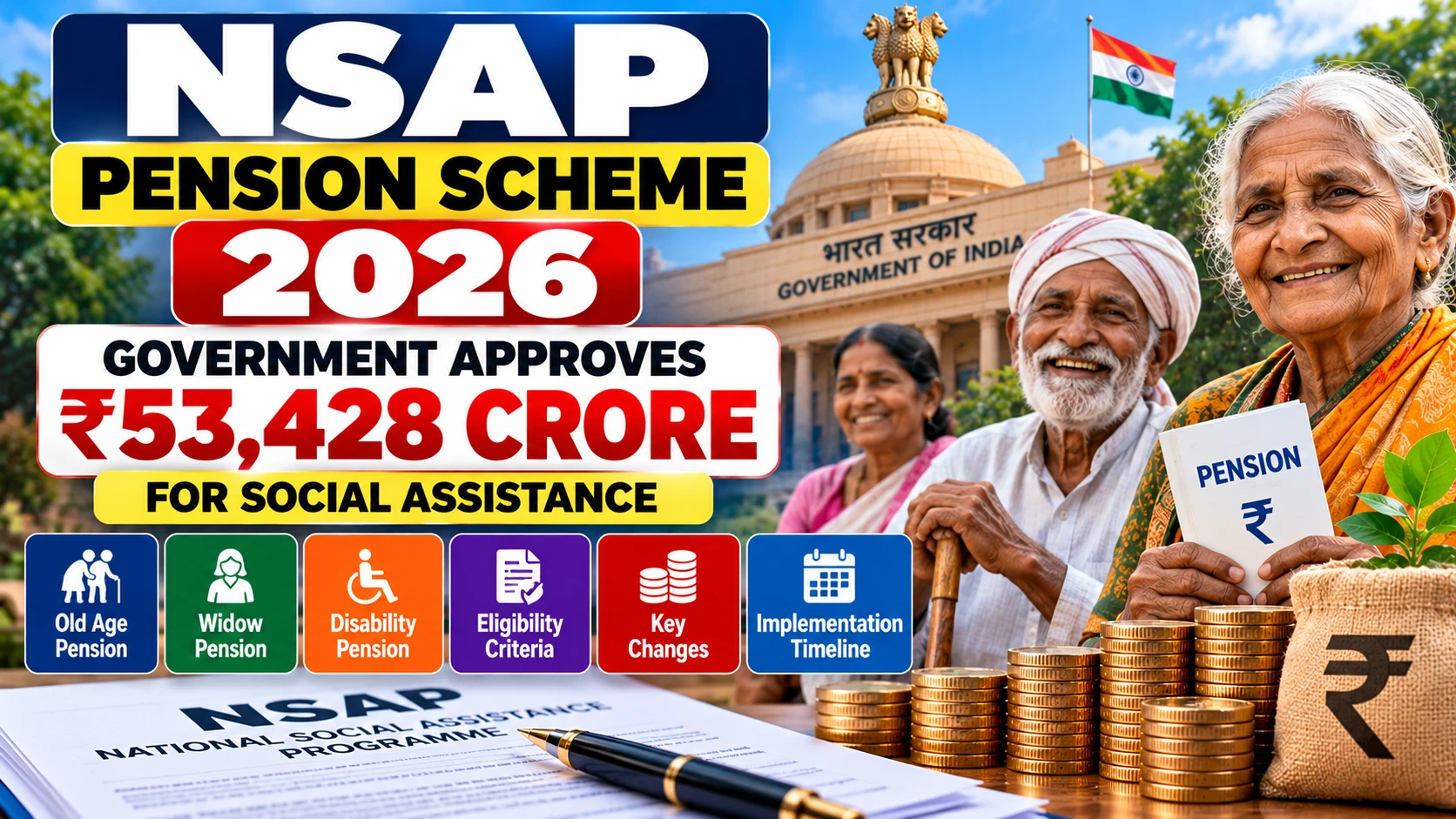
Cabinet Extends Social Assistance Scheme to 2031: ₹53,428 Crore Approved
Summary
- The Union Cabinet approved continuation of the National Social Assistance Programme (NSAP) for 2026–27 to 2030–31 with an outlay of ₹53,428 crore.
- The programme is being renamed Pradhan Mantri Samajik Sahayata Yojana, with new names for its component schemes.
- The central disability-pension assistance is set at ₹375 for ages 0–79 and ₹625 for those aged 80 and above, with eligibility criteria revised.
- Old-age pension, widow pension and family-benefit schemes are to continue in their existing form; detailed implementation guidelines are expected within three months.
Cabinet approves five-year continuation
The Union Cabinet approved a five-year continuation of the National Social Assistance Programme on 14 October 2026. The Ministry of Rural Development says the programme will have a total outlay of ₹53,428 crore across the financial years 2026–27 to 2030–31. It is designed to support vulnerable households through social assistance rather than through an employment-linked retirement plan.



The decision has two parts that should be kept separate. First, the government has committed to continue the broader social assistance architecture and rename its schemes. Second, it has approved substantive changes specifically to the disability pension component. Headlines suggesting that every old-age or widow pension has received an across-the-board increase would be inaccurate on the basis of this announcement.
What is the new name of NSAP?
Programme and component names
The umbrella programme National Social Assistance Programme is being renamed Pradhan Mantri Samajik Sahayata Yojana. The old-age component will be called Pradhan Mantri Vridhavastha Pension Yojana, the widow component Pradhan Mantri Vidhawa Pension Yojana, the disability component Pradhan Mantri Divyangjan Pension Yojana, and the family benefit component Pradhan Mantri Parivar Labh Yojana.
A change in name does not automatically require an existing beneficiary to file a new application, change bank accounts or pay a fee. The Cabinet release does not announce such a universal re-registration requirement. Beneficiaries should wait for official state or district instructions, particularly where state governments administer delivery and top-up payments.
What changes for disability pension beneficiaries?
New assistance amounts
The Cabinet decision states that central assistance under the disability pension component will be ₹375 for beneficiaries aged 0 to 79 years and ₹625 for those aged 80 years and above. These are the announced assistance amounts for the relevant component; they should not be confused with the total pension received in every state, because state additions and administrative arrangements may differ.
For a household relying on a modest pension, even a limited change in assistance can matter. But the precise payment received by an individual depends on eligibility, implementation and any applicable state contribution. It would be misleading to promise a specific bank-credit date or universal total monthly pension based only on the central announcement.
Disability benchmark falls from 80% to 40%
The eligibility criterion for benchmark disability is being revised from 80% to 40%, according to the Ministry. That potentially expands the population that can qualify, subject to the detailed guidelines and other scheme conditions. A medical or disability certificate and official eligibility verification may still be required. The announcement does not mean that every person with a 40% disability is automatically enrolled today.
Minimum age criterion changes
The Cabinet also approved a change so that the minimum age for the disability pension is since birth. This is a significant policy shift from a system that previously applied an age threshold. The practical application process, guardian arrangements and documentation for minors will depend on the implementation guidelines. Families should not assume that payments have already begun before those instructions are issued.
What about old-age pension and widow pension?
The government says the old-age pension and widow pension components will continue in their existing form. The family-benefit scheme will also continue without a newly announced structural change. In other words, this particular Cabinet release does not support a claim that old-age or widow pension rates have been increased nationwide. Separate state schemes may provide additional support, but those are not part of this central announcement.
Readers should distinguish three things: the scheme’s official name, its central eligibility conditions and the final amount deposited by the state-administered system. Confusion among these can create false expectations and misleading viral posts. For exact personal eligibility, local welfare departments and official state portals remain the appropriate channels.
How many people may benefit?
The Ministry of Rural Development says the approval will benefit 3.20 crore beneficiaries across all 36 states and Union territories. That is the stated programme-wide beneficiary figure, not a count of newly eligible people under the revised disability rules. The ministry has not provided, in this release, a state-by-state breakdown of additional beneficiaries who will qualify because of the lower disability threshold.
The broader programme dates to 15 August 1995 and reflects the central government’s role in supporting poor households under the Directive Principles of State Policy. Over time, social pensions have become an important layer of household income support, particularly where formal-sector retirement savings are unavailable.
More Stories

ixigo Q2 Results: Profit Reaches ₹63.42 Crore, Revenue Rises 13% as Hotels Business Expands
FPI Outflows October 2026: Foreign Investors Withdraw ₹52,100 Crore From Indian Stocks

Paras Healthcare IPO 2026: ₹1,450 Crore Issue, Price Band, Dates and Review
57th GST Council Meeting 2026: Major Reforms Proposed for Taxpayers and Businesses



When will the changes take effect?
The Cabinet announcement says detailed guidelines covering disability eligibility, beneficiary numbers and assistance rates will be issued and implemented within three months. That is an implementation target, not proof that all state systems already reflect the new rules on 15 October. Readers should monitor the Ministry of Rural Development and the relevant state welfare department for notified instructions.
If a beneficiary is currently receiving assistance, it is sensible to keep bank and identity information up to date through official channels. However, never share an OTP, PIN or password with someone claiming to offer ‘instant pension approval’. Government benefit announcements are frequently used in phishing messages and fraudulent payment requests.
How should families check eligibility?
Start with the local social-welfare office or the state’s official pension portal. Ask which scheme applies, whether the person meets the income and residency requirements, what disability documentation is accepted, and whether an application is already active. Keep copies of acknowledgements and application numbers. Do not assume that a central headline overrides state-specific processing rules.
Where an applicant has been denied assistance, seek a written reason and use the prescribed grievance process. Eligibility decisions should be based on notified criteria, not social-media summaries. The expected guidelines may clarify transitional treatment of existing applicants and newly eligible groups.
Frequently asked questions
Has NSAP been discontinued?
No. The Cabinet approved its continuation for five more years and renamed the umbrella programme.
Will every pensioner get ₹625?
No. ₹625 is the announced central disability-pension amount for beneficiaries aged 80 or above. Other categories have separate rules.
Can a child qualify for the disability pension?
The Cabinet approved a minimum-age criterion from birth, subject to implementation guidelines and other eligibility conditions.
Official sources and editorial note
Primary source: Ministry of Rural Development / PIB Cabinet announcement dated 14 October 2026. Disclaimer: This article is informational, may include AI-assisted drafting reviewed against the government release, and does not replace official eligibility decisions. EduTaxTuber cannot guarantee individual benefits or payment dates and is not responsible for losses resulting from reliance on unverified intermediaries.
Official sources
Disclaimer: EduTaxTuber provides content for general educational and informational purposes only. While we make reasonable efforts to keep the information accurate and updated, laws, regulations, market conditions, software features, and other information may change. Some content may be created or assisted by AI tools and may contain errors or omissions. Readers should verify important information with official sources or qualified professionals before making any tax, legal, financial, investment, business, or other decisions. EduTaxTuber does not guarantee the completeness or accuracy of the information and does not provide professional advice.
