








DA Hike for Central Government Employees: July 2026 Update, Expected Rate, Salary Impact and Pensioner Details
Summary
- The July 2026 Dearness Allowance (DA) revision for central government employees and pensioners is still awaiting the formal government announcement.
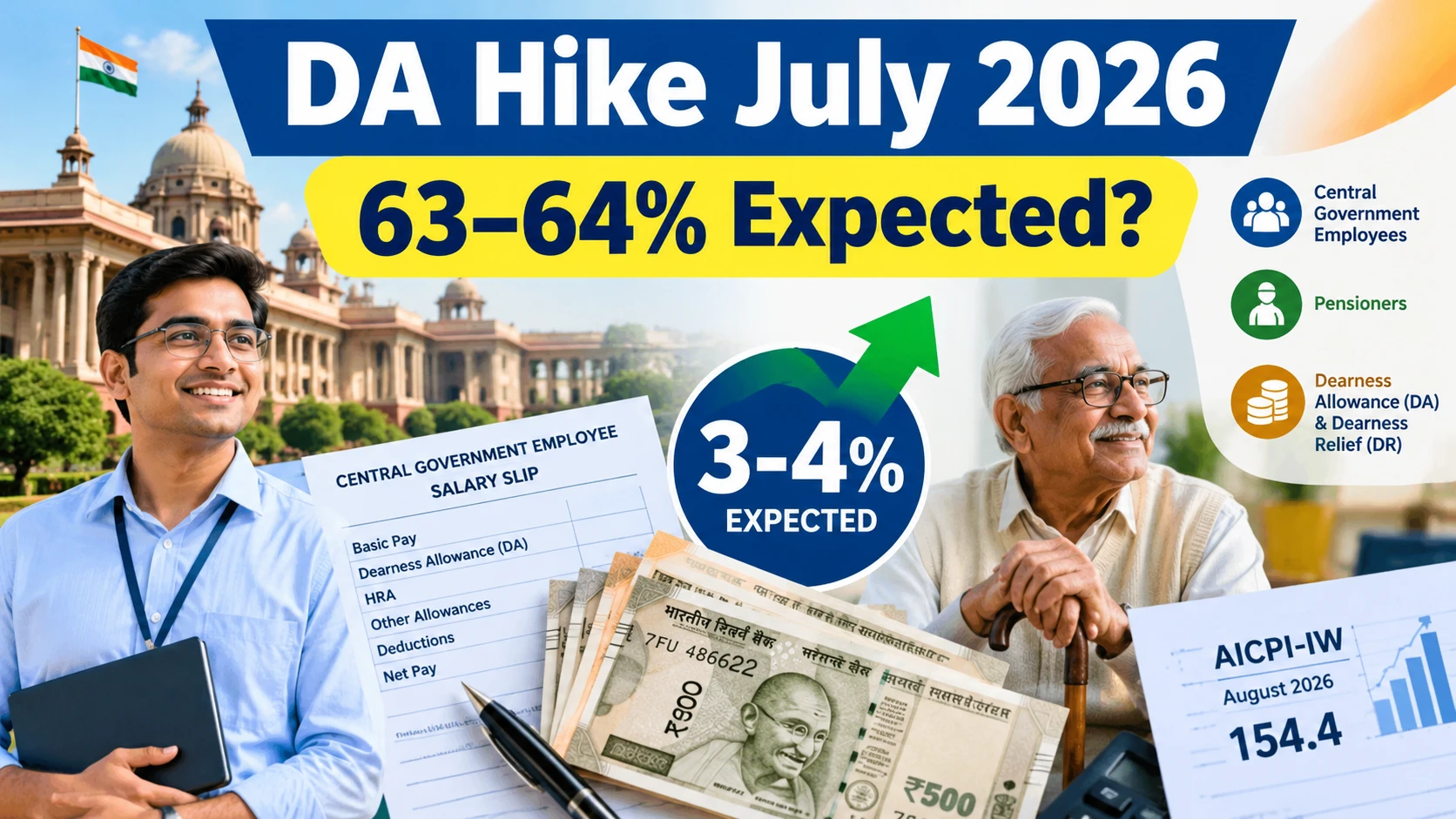
- The current DA rate is 60% of basic pay, and the July 2026 revision is expected to increase it by around 3–4 percentage points, taking it to approximately 63%–64%.
- Employee organisations have been seeking an early announcement, with expectations that the July cycle could be announced around the festive season and potentially before Dussehra 2026.
- The revised DA is applicable retrospectively from July 1, 2026, once officially approved, meaning eligible employees could receive arrears for the period since July.
DA Hike for Central Government Employees: July 2026 Update
Central government employees and pensioners are waiting for the next revision of Dearness Allowance (DA) and Dearness Relief (DR) for the July 2026 cycle.
The current DA rate for central government employees is 60% of basic pay. The July instalment is expected to result in another increase, although the exact percentage will be known only after the government formally approves and announces the revised rate.
Recent reports have put the expected increase at around 3–4 percentage points, which would take DA to approximately 63% or 64%. However, these figures should be treated as estimates until the government issues the official notification.
The Labour Bureau’s latest data shows that the All-India Consumer Price Index for Industrial Workers (CPI-IW) increased from 153.2 in July 2026 to 154.4 in August 2026.
The August figure is particularly relevant for the January 2027 DA cycle rather than determining the already-completed July 2026 cycle.
Will the July 2026 DA Hike Be Announced Before Dussehra?
The timing of the announcement is one of the biggest questions for central government employees and pensioners.
According to a recent report, employee representatives expect the government to announce the July DA instalment around the festive season, potentially before Dussehra. Moneycontrol reported that the July-cycle announcement could come before the festival period.
However, an important distinction needs to be made:
An expectation of an announcement before Dussehra is not the same as an official government confirmation.
Therefore, employees should wait for the formal order from the competent government authority before treating any particular percentage or payment date as final.
Dussehra in 2026 falls on October 20, although the date can vary by region according to local observance.
How Much DA Hike Is Expected in July 2026?
The July 2026 DA hike is being estimated at around 3–4 percentage points.
If the government approves a 3% increase:
60% + 3% = 63% DA
If the increase is 4%:
60% + 4% = 64% DA
Therefore, employees may see the DA rate move to somewhere around 63%–64% of basic pay, based on current estimates.
The final percentage will depend on the government’s calculation and approval. The government notification will be the definitive source for the revised DA rate.
Some recent media estimates have also differed from the 63%–64% range, which is another reason employees should not treat media projections as the final rate.
Who Will Benefit From the DA Hike?
The revision is relevant to eligible:
- Central government employees
- Central government pensioners
- Family pensioners receiving Dearness Relief
- Other categories covered by the applicable DA/DR orders
The employee receives Dearness Allowance (DA), while eligible pensioners receive the corresponding Dearness Relief (DR).
The actual financial benefit depends on the individual’s basic pay or pension and the final percentage approved by the government.
What Does 64% DA Mean for Central Government Employees?
To understand the impact, consider a simple example.
Suppose an employee has a basic pay of ₹18,000.
At the current 60% DA:
₹18,000 × 60% = ₹10,800
If DA becomes 64%:
₹18,000 × 64% = ₹11,520
The difference is:
₹11,520 − ₹10,800 = ₹720 per month
Therefore, a 4-percentage-point increase would add ₹720 per month to the DA component for an employee with ₹18,000 basic pay.
Example: Basic Pay of ₹44,900
For an employee with basic pay of ₹44,900:
At 60% DA:
₹44,900 × 60% = ₹26,940
At 64% DA:
₹44,900 × 64% = ₹28,736
Increase:
₹28,736 − ₹26,940 = ₹1,796 per month
So, the increase in the DA component would be ₹1,796 per month if the rate moves from 60% to 64%.
These examples relate only to the DA component. The employee’s actual gross salary and take-home salary can be different because other allowances, deductions, taxes, NPS contributions and other salary components may also change or apply.
Will Employees Get DA Arrears From July 2026?
The July 2026 DA revision is applicable from July 1, 2026 once approved.
This means that if the government announces a higher DA rate after July, eligible employees could receive arrears for the period between the effective date and the date from which the revised DA is actually paid.
For example, if the revised rate is eventually approved at 64% and becomes effective from July 1, the difference between the old and revised DA can be calculated for the eligible months covered by the government order.
The exact arrear calculation will depend on the final DA percentage, the employee’s basic pay during the relevant period and the implementation instructions issued by the government.
What Is AICPI-IW and Why Is It Important for DA?
The All-India Consumer Price Index for Industrial Workers (AICPI-IW) is an important input used in the calculation of DA for central government employees.
The index tracks changes in the prices of goods and services relevant to industrial workers and is published by the Labour Bureau under the Ministry of Labour and Employment.
The latest official figures available show:
- July 2026: 153.2
- August 2026: 154.4
- Increase: 1.2 points
The Labour Bureau has officially published the August 2026 CPI-IW figure of 154.4.
A rising CPI-IW generally indicates increasing prices and therefore becomes an important factor in determining the DA calculation.
More Stories

ixigo Q2 Results: Profit Reaches ₹63.42 Crore, Revenue Rises 13% as Hotels Business Expands
FPI Outflows October 2026: Foreign Investors Withdraw ₹52,100 Crore From Indian Stocks

Paras Healthcare IPO 2026: ₹1,450 Crore Issue, Price Band, Dates and Review
57th GST Council Meeting 2026: Major Reforms Proposed for Taxpayers and Businesses



How Does the DA Calculation Work?
Under the DA calculation framework associated with the 7th Central Pay Commission, the relevant CPI-IW figures over the prescribed period are used to arrive at the DA percentage.
The six-monthly DA revisions are applicable from:
- January 1
- July 1
The government subsequently announces the revised rate.
Read Also: Samsung Galaxy Tab S12 Series Launched in India: Price, Specifications and Sale Date
This is why employees often watch every monthly AICPI-IW release closely. However, an individual month’s CPI-IW number does not by itself determine the final DA percentage.
For the July 2026 DA cycle, the relevant data period has already been completed. The newer August 2026 CPI-IW number is more relevant to the calculation of the January 2027 revision.
What Does the August 2026 AICPI-IW Figure Mean for January 2027 DA?
The August 2026 CPI-IW reading is important for the next DA cycle.
The Labour Bureau reported an All-India CPI-IW of 154.4 for August 2026, compared with 153.2 in July.
However, the January 2027 DA calculation will require the subsequent monthly CPI-IW readings as they are released.
Therefore, it is too early to determine the final January 2027 DA percentage solely from the August figure.
Employees should watch the CPI-IW releases for the remaining months of 2026 before drawing conclusions about the January 2027 revision.
DA Hike vs Salary Increase: What Employees Should Understand
A DA hike does not mean that the employee’s entire salary increases by the same percentage.
DA is calculated as a percentage of basic pay.
For example, if basic pay is ₹30,000 and DA increases by 4 percentage points, the increase in DA is:
₹30,000 × 4% = ₹1,200
That does not necessarily mean the employee’s final take-home salary will rise by exactly ₹1,200.
Other factors can affect the final amount credited to the employee’s bank account, including:
- NPS contribution
- Income tax
- Other deductions
- Existing allowances
- Changes linked to other salary components
Therefore, the DA increase should primarily be understood as an increase in the DA component of salary.
What About Central Government Pensioners?
Central government pensioners are also closely watching the July 2026 revision.
For pensioners, the corresponding benefit is generally referred to as Dearness Relief (DR) rather than Dearness Allowance.
If the applicable DR rate is revised along with DA, eligible pensioners would receive the revised DR according to the government order.
For example, if a pensioner’s eligible basic pension is ₹20,000 and the rate increases by 4 percentage points:
₹20,000 × 4% = ₹800
The DR component would therefore increase by ₹800 per month, subject to the applicable rules and the final rate notified by the government.
When Can Employees Expect the Revised DA in Salary?
The timing depends on when the government issues the official order and when the revised rate is implemented through the respective payroll systems.
If the July 2026 DA revision is announced during October, employees could potentially receive the revised amount through a subsequent salary payment along with applicable arrears.
However, the exact payment date should not be assumed until the government issues the formal DA/DR order.
The important points are:
Effective date: July 1, 2026
Current DA: 60%
Expected increase: Around 3–4 percentage points based on current reports
Indicative revised DA: Around 63%–64%
Final rate: To be confirmed by the government
Why the DA Announcement Matters During the Festive Season
For many employees and pensioners, the timing of the DA announcement matters because the revision can result in additional monthly income as well as arrears.
The festive season also brings additional household expenses, making any increase in salary or pension an important financial consideration for beneficiaries.
Employee organisations have therefore been pressing for the July instalment to be processed and announced without further delay. Recent reporting indicates that the Confederation of Central Government Employees and Workers has urged the Department of Expenditure to expedite the DA and DR process.
DA Hike 2026: What Employees Should Watch Next
Central government employees and pensioners should watch for three important developments:
1. Official DA Notification
The most important development will be the government’s formal announcement of the revised DA and DR rates.
2. Arrear Calculation
Once the rate is announced, employees can calculate the difference between the existing and revised DA from the applicable effective date.
3. January 2027 DA Calculation
The monthly AICPI-IW figures released during the remainder of 2026 will provide the data needed for the next DA revision.
The August 2026 reading of 154.4 is therefore an early indicator for the January 2027 cycle, but it is not enough by itself to establish the final January rate.
DA Hike July 2026: Bottom Line
The July 2026 DA revision remains an important pending update for central government employees and pensioners.
Based on current reports, a 3–4 percentage-point increase is being anticipated, which could take DA from 60% to approximately 63%–64%. However, employees should wait for the official government notification before treating the projected rate as final.
The latest AICPI-IW data has also moved higher, with the August 2026 index reaching 154.4 from 153.2 in July. This latest figure will be relevant to the calculation of the January 2027 DA cycle, along with the subsequent CPI-IW readings.
For now, the key question is not only how much DA will increase, but also when the government will formally announce and implement the July 2026 revision.
Disclaimer: EduTaxTuber provides content for general educational and informational purposes only. While we make reasonable efforts to keep the information accurate and updated, laws, regulations, market conditions, software features, and other information may change. Some content may be created or assisted by AI tools and may contain errors or omissions. Readers should verify important information with official sources or qualified professionals before making any tax, legal, financial, investment, business, or other decisions. EduTaxTuber does not guarantee the completeness or accuracy of the information and does not provide professional advice.