







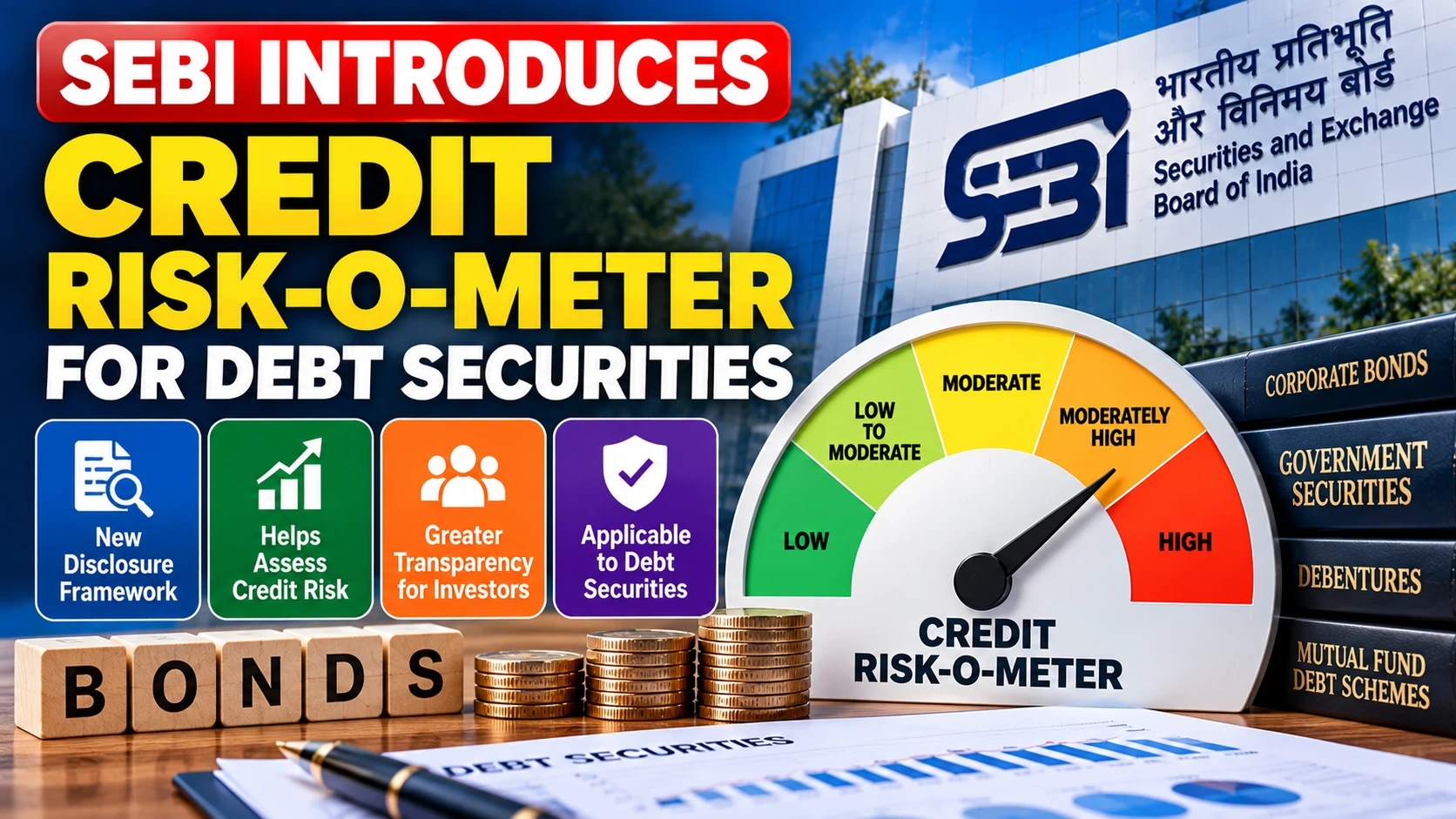
Mumbai, October 13, 2026: The Securities and Exchange Board of India has introduced a mandatory, colour-coded Credit Risk-o-Meter for specified debt securities. Its October 7 circular requires issuers and online bond platforms to show a visual indication of credit risk in offer documents, advertisements and relevant online interfaces. The requirements take effect 45 days after the circular’s issue date. The measure is intended to improve investor understanding, not guarantee the safety of any bond.
Key Takeaways
- SEBI introduced a Credit Risk-o-Meter for specified debt instruments.
- The meter translates ratings into six colour-coded risk levels.
- It must appear in offer documents, relevant advertisements and bond platforms.
- Where multiple ratings exist, the lowest rating drives the meter.
- Market and liquidity risks remain separate from credit risk.
What the October 7 Circular Says
SEBI Circular HO/17/11/22(1)2026-DDHS-POD1/I/23092/2026 sets out the framework in an annexure. It amends the existing master circular for issue and listing of non-convertible and related debt securities. The regulator says the purpose is to help investors assess credit risk before investing through a colour-coded display. The rule covers disclosure in the offer document, abridged prospectus, private placement memorandum, issuer and platform advertisements, and web or mobile interfaces of online bond platform providers. The meter complements the actual credit rating; it does not replace a full reading of the investment documents.
Which Securities Are Covered?
The annexure applies to listed and proposed-to-be-listed non-convertible securities, commercial papers, securitised debt instruments, security receipts, and structured or market-linked debentures. It covers qualifying public issues and private placements. That broad scope matters because many retail investors encounter bonds through digital distribution channels rather than reading a complete prospectus first. A consistent visual can make products easier to compare at a glance. However, investors must still check maturity, issuer financial strength, security, covenants and the ability to sell the instrument before maturity.
Read Also: Foreign Investors Put $9.2 Billion Into IPOs but Sell $39 Billion in Shares
How the Six Colour Bands Work
The framework maps recognized credit ratings into six categories. AAA corresponds to the lowest credit risk and green; AA-range ratings are very low risk, while A-range ratings are low risk. BBB-range ratings are moderate credit risk. BB-range ratings indicate a moderate risk of default. Ratings in the B, C and D ranges fall into the high-to-very-high default-risk band, shown in red. The circular specifies exact colour codes and short-term rating equivalents. Investors should read the written rating as well as the colour because two instruments within a broad band may still have different credit characteristics.
Why the Lowest Rating Matters
A debt instrument can be rated by more than one SEBI-registered credit rating agency. Under the new rule, its visual meter must reflect the lowest of those ratings, although all ratings may also be displayed. This reduces the risk of a promotional graphic highlighting only the most favourable opinion. The circular also requires the agency name and actual rating to appear in text below the meter. For an unsecured instrument, the word ‘unsecured’ must be displayed prominently in bold red text. These requirements help investors identify important differences that a simplified icon could otherwise conceal.
What About Unsecured Perpetual Bonds?
SEBI includes an additional warning for unsecured perpetual bonds such as Additional Tier 1 instruments. Their structural features can create risks beyond the issuer’s ordinary credit rating, including the possibility of a total loss of invested capital under relevant terms. The credit meter therefore cannot capture every risk embedded in the instrument. Investors should study the information memorandum and contractual provisions carefully, including write-down or conversion triggers where applicable. A green or yellow colour must never be interpreted as a promise of principal protection or a substitute for understanding complex bond terms.



What Online Bond Platforms Must Change
Online Bond Platform Providers must place the meter prominently on bond listing and details pages, before investment action buttons. They must display it in advertisements that explicitly refer to a debt security’s rating. When a credit rating changes, platforms must update the display within 24 hours of receiving the relevant notification from the depositories. The circular also requires an automated system, audit trails and a prohibition on manual overrides of classifications. These safeguards matter because a stale rating graphic can mislead investors even if the original display was accurate when first published.
What the Meter Does Not Measure
Credit risk concerns the issuer’s capacity and willingness to meet obligations. Market risk concerns changes in bond value as yields and conditions change; liquidity risk concerns how easily the security can be sold without a large price concession. SEBI explicitly warns that the new meter addresses credit risk alone. An AAA-rated bond may still fall in market value if interest rates rise, while a less liquid issue may be difficult to exit before maturity. Investors should therefore compare yield, maturity, call provisions, collateral, taxation and trading volumes as well as the displayed credit category.
When Does the Requirement Start?
The circular states that its provisions come into force 45 days after October 7, 2026. Market participants should calculate the implementation date from the circular and monitor any later clarifications rather than assuming that the rule was fully operational on announcement day. Stock exchanges and depositories have been instructed to make the necessary systems and regulatory changes. Issuers and platforms should test how the visual appears on desktop, mobile and printed materials. A compliant design should preserve the full risk spectrum and display the arrow at the instrument’s correct rating level.
What Bond Investors Should Check
Before placing an order, confirm the issuer name, ISIN, actual credit rating, rating agency, secured or unsecured status, yield, maturity and any embedded options. Look for rating-watch announcements and financial results. Read the prospectus or placement memorandum and ask how an early exit would work. Do not rely on a single coloured symbol or promotional yield figure. Where a product is complex, professional advice may be appropriate. The risk meter improves the presentation of information but cannot remove default risk, liquidity constraints or the possibility of losing money.
Official Sources and Related Reading
Read the SEBI circular dated October 7, 2026. Related coverage: EduTaxTuber’s Market, Money and IPO sections.
Editorial Disclosure and Disclaimer
Some content was prepared with AI assistance and editorial review. This is educational information, not a recommendation to buy any security. Investors can lose capital. EduTaxTuber is not responsible for losses arising from reliance on this article to the extent permitted by law. Verify the official circular and current issuer documents.