







Summary
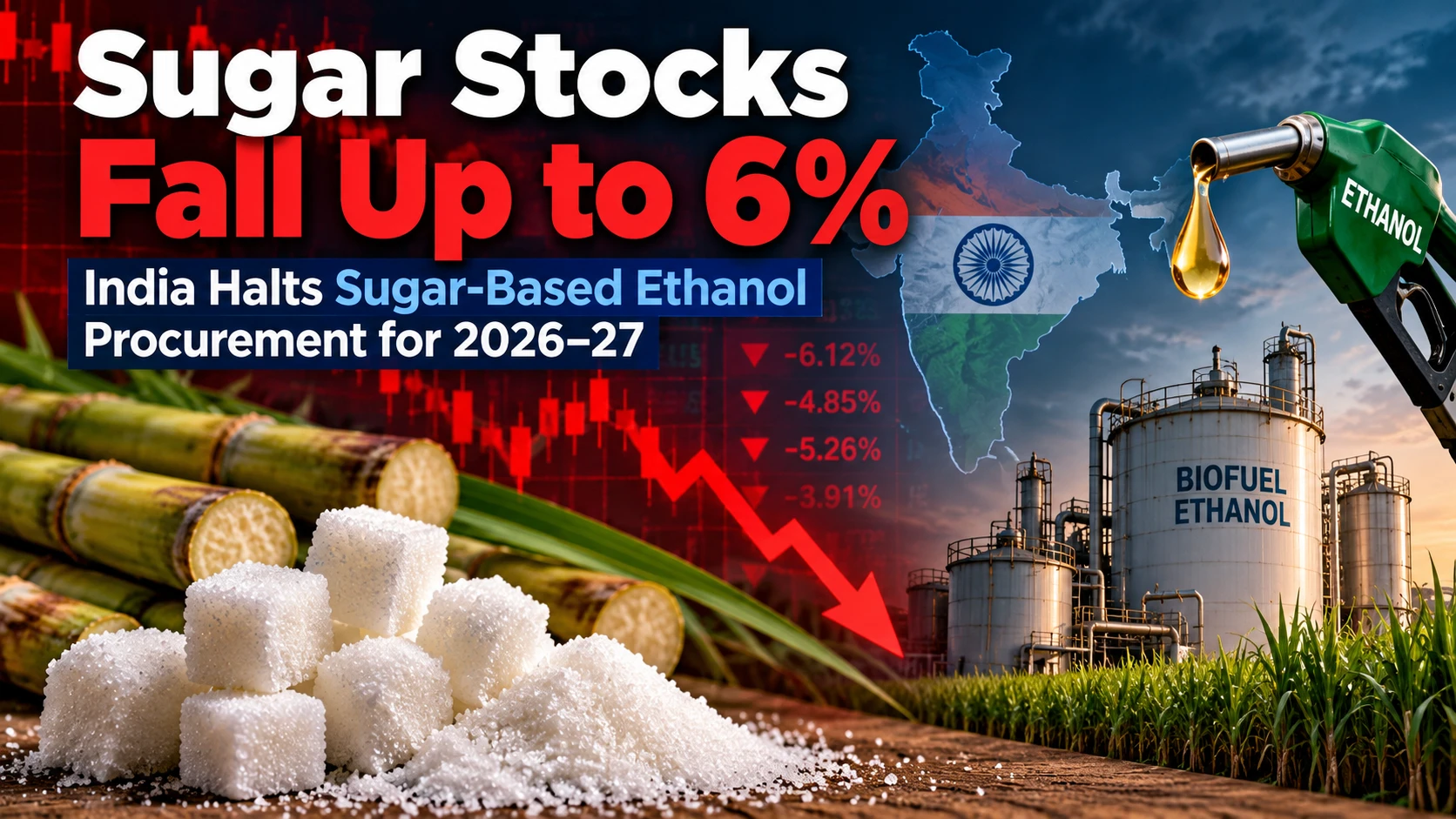
- Sugar stocks declined by up to 6% in Monday’s trading session.
- The 2026–27 ethanol tender excludes sugarcane juice, sugar syrup, sugar and B-heavy molasses.
- Oil marketing companies are seeking approximately 11 billion litres of ethanol.
- Grain-based ethanol and ethanol from C-heavy molasses remain eligible under the reported tender.
- The government aims to protect domestic sugar availability amid supply concerns.
- Investors are assessing the potential impact on distillery profitability and future expansion.
Why Are Sugar Stocks Falling Today?
Sugar companies faced selling pressure after investors assessed the implications of the latest ethanol procurement policy.
The tender was issued on October 16, 2026, by Bharat Petroleum Corporation Limited on behalf of state-run oil marketing companies. It covers the ethanol supply year beginning in November 2026.
The restriction affects ethanol produced from feedstocks that can otherwise contribute to sugar production.



Integrated sugar manufacturers have developed ethanol operations to diversify revenue and reduce dependence on fluctuating sugar prices.
With important sugar-derived feedstocks excluded from the procurement tender, investors are concerned about capacity utilisation, revenue and operating margins.
Reuters reported that the affected shares included Balrampur Chini Mills, EID Parry, Triveni Engineering, Bajaj Hindusthan Sugar, Shree Renuka Sugars and Dhampur Sugar Mills.
Sugar Stocks: Market Reaction on October 19
| Company | Reported market reaction |
|---|---|
| Balrampur Chini Mills | Declined |
| EID Parry | Declined |
| Triveni Engineering | Declined |
| Bajaj Hindusthan Sugar | Declined |
| Shree Renuka Sugars | Down 5.9% at 11:30 AM |
| Dhampur Sugar Mills | Declined |
Source: Reuters and Business Standard, October 19. Shree Renuka Sugars traded at ₹20.85 at the reported observation time. These are intraday observations, not closing prices.
The decline reflects expectations about future profitability rather than a confirmed reduction in each company’s earnings.
What Has Changed in India’s Ethanol Procurement Policy?
The latest tender seeks approximately 11 billion litres of ethanol for the 2026–27 supply year.
The government has directed that sugar diversion for ethanol be reduced to zero for the supply year.
Feedstocks Excluded From Procurement
The reported tender excludes ethanol produced from:
- Sugarcane juice
- Sugar or sugar syrup
- B-heavy molasses
These materials can be associated with the production of recoverable sugar.
Feedstocks That Remain Eligible
The reported tender continues to permit bids for ethanol manufactured from maize, broken rice, surplus rice procured through the Food Corporation of India and C-heavy molasses.
C-heavy molasses is produced after a greater proportion of recoverable sugar has been extracted.
This distinction is important because the policy does not mean that India’s ethanol blending programme has been discontinued.
Why Has the Government Taken This Decision?
The central concern is domestic sugar availability.
India is one of the world’s largest sugar producers and the largest sugar consumer. Sugar supplies can be affected by rainfall, crop yields, crushing schedules and diversion of sugarcane-based material to ethanol.
Concerns about reduced rainfall in Maharashtra and Karnataka have increased uncertainty over sugar production.
At the same time, festive demand has added pressure to domestic sugar prices.
Reuters reported that sugar prices had increased by more than 10% amid the festive season.
Restricting the diversion of sugar-producing feedstocks to ethanol is intended to preserve material for sugar manufacturing.
However, whether retail prices decline will depend on actual output, stocks, consumption and distribution conditions.
How Does the Decision Affect Ethanol Manufacturers?
Ethanol has become an important revenue stream for integrated sugar companies.
Sugar mills can use eligible feedstocks to manufacture ethanol and supply it to oil marketing companies under procurement arrangements.
This diversification can improve revenue stability when sugar prices are weak.
The latest tender changes the commercial opportunity for producers dependent on excluded feedstocks.
Impact on Revenue
Companies with substantial sugar-based ethanol operations may experience reduced procurement opportunities under the tender.
The actual revenue impact will depend on existing arrangements, feedstock flexibility and future procurement policy.
Read Also: FPI Outflows October 2026: Foreign Investors Withdraw ₹52,100 Crore From Indian Stocks
Impact on Profit Margins
Ethanol operations may contribute meaningfully to profitability.
Lower capacity utilisation could increase fixed costs per unit and affect margins.
However, the effect cannot be quantified without company-specific information.
Impact on Existing Distilleries
Manufacturers have invested in ethanol production facilities.
Some plants may be capable of processing alternative feedstocks, while others could require technical modifications.
Investors should not assume that all facilities can switch immediately to grain-based production.
Maize-Based Ethanol Procurement Price Reduced
The latest tender also changes the commercial terms for maize-based ethanol.
The reported procurement price has been reduced from ₹71.86 per litre to ₹68.86 per litre.
The maize incentive has declined from ₹5.79 to ₹2.79 per litre.
| Particulars | Earlier | Revised |
|---|---|---|
| Maize ethanol procurement price | ₹71.86/litre | ₹68.86/litre |
| Maize incentive | ₹5.79/litre | ₹2.79/litre |
| Reduction | — | ₹3/litre |
These figures are drawn from reporting on the tender, not an independently retrieved official price schedule.
The reduction means that even eligible grain-based ethanol producers must consider the implications of revised procurement economics.
Will India’s E20 Petrol Programme Be Affected?
India’s ethanol blending programme seeks to reduce reliance on conventional petroleum fuels by blending ethanol with petrol.
E20 petrol contains 20% ethanol by volume.
The latest procurement restriction changes the eligible feedstock mix rather than ending ethanol blending.
Grain-based ethanol and eligible C-heavy molasses ethanol can continue to contribute to procurement.
Nevertheless, adequate raw-material availability, processing capacity and procurement pricing will remain important.
The long-term effect on the blending programme cannot be determined solely from the October tender.
What Does This Mean for Sugar Prices?
The government aims to improve domestic sugar availability.
When more sugarcane-derived material is available for sugar production, the supply position may improve.
But sugar prices are influenced by several factors:
- Actual sugarcane production and recovery rates
- Opening sugar inventories
- Domestic consumption
- Import and export arrangements
- Crushing schedules and distribution
Therefore, consumers should not expect an immediate or uniform reduction in retail sugar prices.
More Stories

Sugar Stocks Fall Up to 6% as India Halts Sugar-Based Ethanol Procurement for 2026–27
ixigo Q2 Results: Profit Reaches ₹63.42 Crore, Revenue Rises 13% as Hotels Business Expands
FPI Outflows October 2026: Foreign Investors Withdraw ₹52,100 Crore From Indian Stocks

Paras Healthcare IPO 2026: ₹1,450 Crore Issue, Price Band, Dates and Review



What Should Stock Market Investors Monitor?
Investors should examine the exposure of individual companies to ethanol operations.
Annual reports and quarterly results can help identify revenue contribution, distillery capacity and capital expenditure.
Company announcements may clarify whether production facilities can use alternative feedstocks.
Investors should also monitor sugar production estimates, government procurement revisions and management commentary.
A share-price decline may reflect reduced earnings expectations, but the magnitude of the eventual impact remains uncertain.
For broader market context, readers can also review EduTaxTuber’s recent coverage of foreign portfolio investor outflows.
Frequently Asked Questions
Why did sugar stocks fall on October 19, 2026?
Shares declined after oil marketing companies excluded specified sugar-based ethanol feedstocks from their latest procurement tender.
Has the government banned all ethanol production?
No. The reported restriction concerns procurement under the latest tender, not a comprehensive ban on ethanol production.
Is C-heavy molasses ethanol permitted?
Yes. C-heavy molasses is among the eligible feedstocks identified in reporting on the tender.
Will sugar prices fall immediately?
Not necessarily. Prices depend on production, inventories, demand and market conditions.
Which sugar companies were affected?
The reported market reaction included Balrampur Chini Mills, EID Parry, Triveni Engineering, Bajaj Hindusthan Sugar, Shree Renuka Sugars and Dhampur Sugar Mills.
Conclusion
India’s latest ethanol procurement arrangements mark an important change for the sugar industry.
The exclusion of sugarcane juice, sugar syrup and B-heavy molasses from the 2026–27 tender is intended to protect domestic sugar availability.
For listed sugar companies, the development raises questions about ethanol revenue, distillery utilisation and future profitability.
Investors should monitor official company disclosures and subsequent procurement announcements before drawing conclusions about the longer-term financial impact.
Disclaimer: EduTaxTuber provides content for general educational and informational purposes only. While we make reasonable efforts to keep the information accurate and updated, laws, regulations, market conditions, software features, and other information may change. Some content may be created or assisted by AI tools and may contain errors or omissions. Readers should verify important information with official sources or qualified professionals before making any tax, legal, financial, investment, business, or other decisions. EduTaxTuber does not guarantee the completeness or accuracy of the information and does not provide professional advice.
