









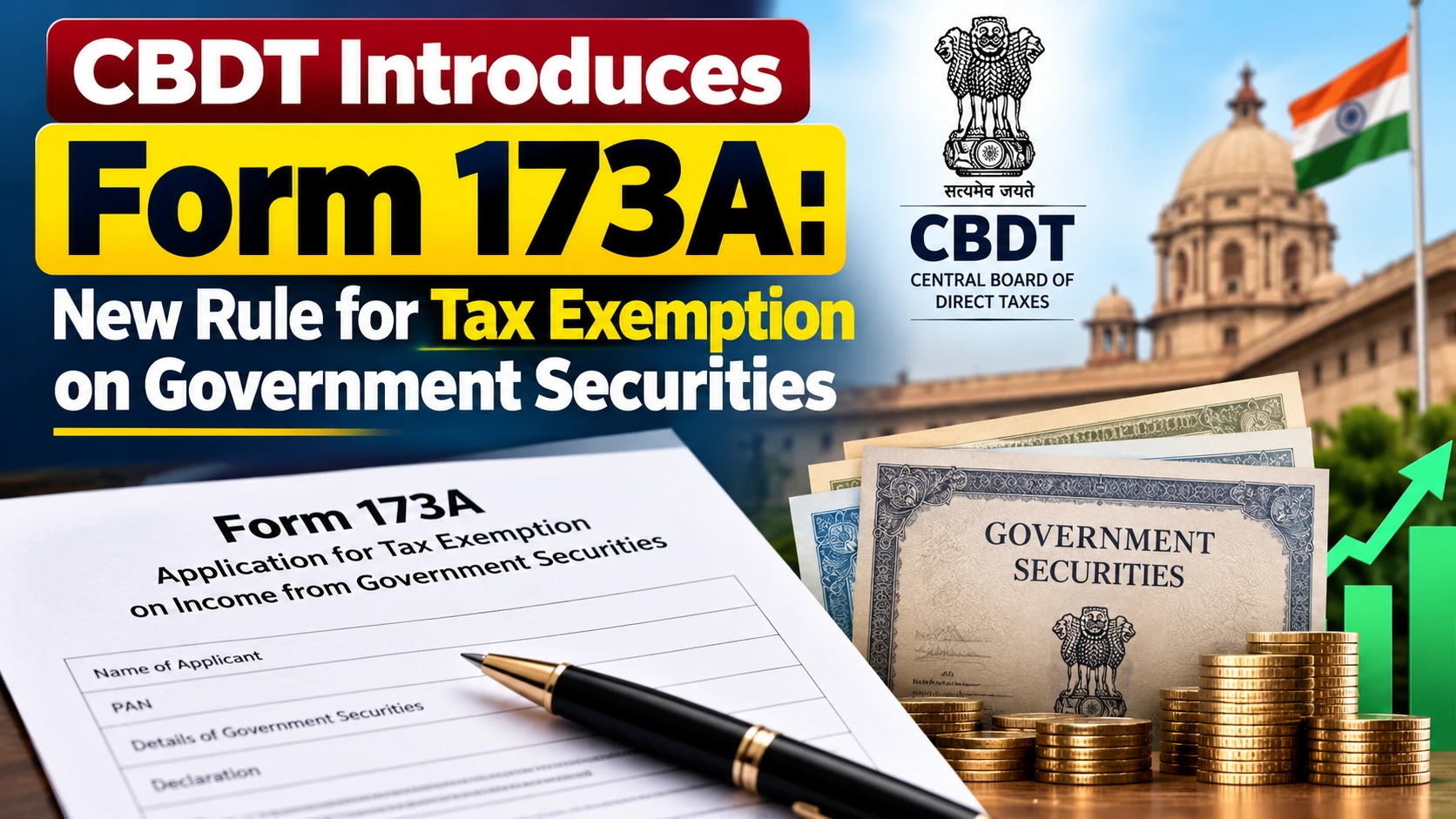
CBDT Introduces Form 173A: New Rule for Tax Exemption on Government Securities
Summary
- CBDT has notified the Income-tax (Seventh Amendment) Rules, 2026 through Notification No. 137/2026 dated 19 October 2026.
- The amendment introduces Rule 281A and Form No. 173A under the Income-tax Rules, 2026.
- The form is required for claiming specified exemptions on interest income and capital gains from government securities under Schedule IV, entries 13D and 13E, of the Income-tax Act, 2025.
- The eligible categories concern specified foreign institutional investors and the Bank for International Settlements (BIS).
- The underlying exemption applies to qualifying income arising from 1 April 2026; the new reporting rule came into force on 19 October 2026.
- Form 173A requires investor details, security-wise holdings, purchases, sales, interest income and capital gains.
- The notification does not create a blanket tax exemption for ordinary resident investors.
CBDT Form 173A: What Has Changed?
The Central Board of Direct Taxes (CBDT) has introduced a new reporting requirement for certain investors claiming income-tax exemption on government securities.
The change was notified on 19 October 2026 through Notification No. 137/2026, G.S.R. 901(E).
The notification amends the Income-tax Rules, 2026 by inserting Rule 281A and a new Form No. 173A.The amendments are officially titled the Income-tax (Seventh Amendment) Rules, 2026.


The new requirement concerns exemptions available under specified entries in Schedule IV of the Income-tax Act, 2025.
The rules require eligible claimants to provide prescribed information about their government-securities investments.
This is a compliance development rather than a newly announced exemption for all bondholders.
For foreign institutions and their tax advisers, Form 173A creates a standardised mechanism for furnishing information relevant to an exemption claim.
Notification No. 137/2026: Important Details
| Particular | Details |
|---|---|
| Issuing authority | CBDT |
| Notification number | 137/2026 |
| Gazette notification | G.S.R. 901(E) |
| Notification date | 19 October 2026 |
| Amendment | Income-tax (Seventh Amendment) Rules, 2026 |
| New rule | Rule 281A |
| New form | Form No. 173A |
| Relevant legislation | Income-tax Act, 2025 |
| Exemption provisions | Schedule IV, entries 13D and 13E |
| Amendment effective date | 19 October 2026 |
The date of the reporting-rule amendment must be distinguished from the date from which the underlying tax exemption applies.

- DURABLE MATERIAL: Die-casting iron applied and finished by stoving varnish, resulting in anti-corrosion, anti-rust and a…
- VINTAGE LOOK: Oil rubbed Copper wall light body and retro lamp design make place full of vintage feel, fitting nicely in…
- GLASS LAMP SHADE : Highly transparent glass shade makes the light of the bulb transmit completely, meeting your need of …
What Does Rule 281A Say?
Rule 281A establishes the information-furnishing requirement for specified exemptions under Schedule IV.
In practical terms, a qualifying claimant seeking exemption under entries 13D or 13E must furnish information in Form 173A.
This means the tax-exemption claim is accompanied by details that help identify the claimant, relevant government securities and income involved.
The rule should be read together with the relevant exemption provisions in the Income-tax Act, 2025.
A taxpayer cannot determine eligibility simply by seeing that a particular security is a government bond.
The claimant must fall within the appropriate legal category and satisfy the prescribed conditions.
Who Is Covered by Form 173A?
Foreign Institutional Investors and Eligible FPIs
Schedule IV entry 13D concerns foreign institutional investors as defined by the relevant provisions of the Income-tax Act, 2025.
Government communications describe the exemption in the context of eligible foreign institutional investors, including relevant SEBI-registered foreign portfolio investors.
Such investors may include certain overseas investment funds and institutions participating in India’s government-securities market.
However, the exact statutory definition and eligibility requirements take precedence over broad industry terminology.
Bank for International Settlements
Entry 13E concerns the Bank for International Settlements (BIS).
BIS is an international financial institution that promotes cooperation among central banks and provides certain financial services to them.
The government’s 2026 reforms extended the specified government-securities tax exemption to BIS as well.
Form 173A includes special instructions recognising its distinct institutional status.
Does It Apply to Every Indian Investor?
No.
An Indian resident who purchases a government bond, Treasury Bill or other debt instrument should not assume that the new notification exempts all corresponding income from taxation.
The new form relates to specified statutory exemptions for eligible claimants.
Ordinary individual investors remain subject to the tax treatment applicable to their own income and instruments.
This is an important distinction because misleading interpretations could cause incorrect income-tax returns.
Which Government-Securities Income Is Covered?
The relevant exemption provisions concern qualifying interest income and capital gains arising from government securities.
The Income-tax Department’s notification establishes how specified eligible claimants must furnish details about those income categories.
Interest Income
Interest may arise from eligible fixed-rate or floating-rate government securities.
For the exemption claim, the form seeks the gross amount of interest received or accrued during the relevant tax year.
Capital Gains
Capital gains may arise when a qualifying government security is sold, transferred or otherwise disposed of under an applicable transaction.
The exemption is restricted to income falling within the relevant statutory provisions.
A general investment in a corporate bond, bank fixed deposit or another financial product should not automatically be treated as covered.
What Information Does Form 173A Require?
The form is divided into two main sections.
Part A: Basic Information
Part A asks for details identifying the claimant.
These include:
- Full name
- Country of residence
- Overseas residential or headquarters address
- Permanent Account Number (PAN)
- Tax Identification Number (TIN) in the country of residence
- SEBI registration number as FPI/FII
- Tax year for which exemption is claimed
- Email address and contact number
The form notes that the overseas TIN and SEBI registration fields are optional for BIS.
Other details should be completed according to the official form and applicable requirements.
Part B: Details of Government Securities
Part B records information about the investments and exempt income claimed.
| Information requested | Purpose |
|---|---|
| ISIN | Identifies the security |
| Type of government security | Classifies the instrument |
| Tenor | Records maturity-related information |
| Value held on 1 April | Opening position |
| Purchases during the year | Investment activity |
| Sale consideration | Disposal-related information |
| Value held on 31 March | Closing position |
| Gross interest received or accrued | Interest exemption information |
| Capital gains during the year | Capital-gains exemption information |
Part B may be repeated to accommodate additional security details.
The form specifies that amounts should be expressed in Indian rupees unless otherwise provided.
More Stories

India October PMI 2026: Business Growth Hits 4-Month High, but Hiring Slows
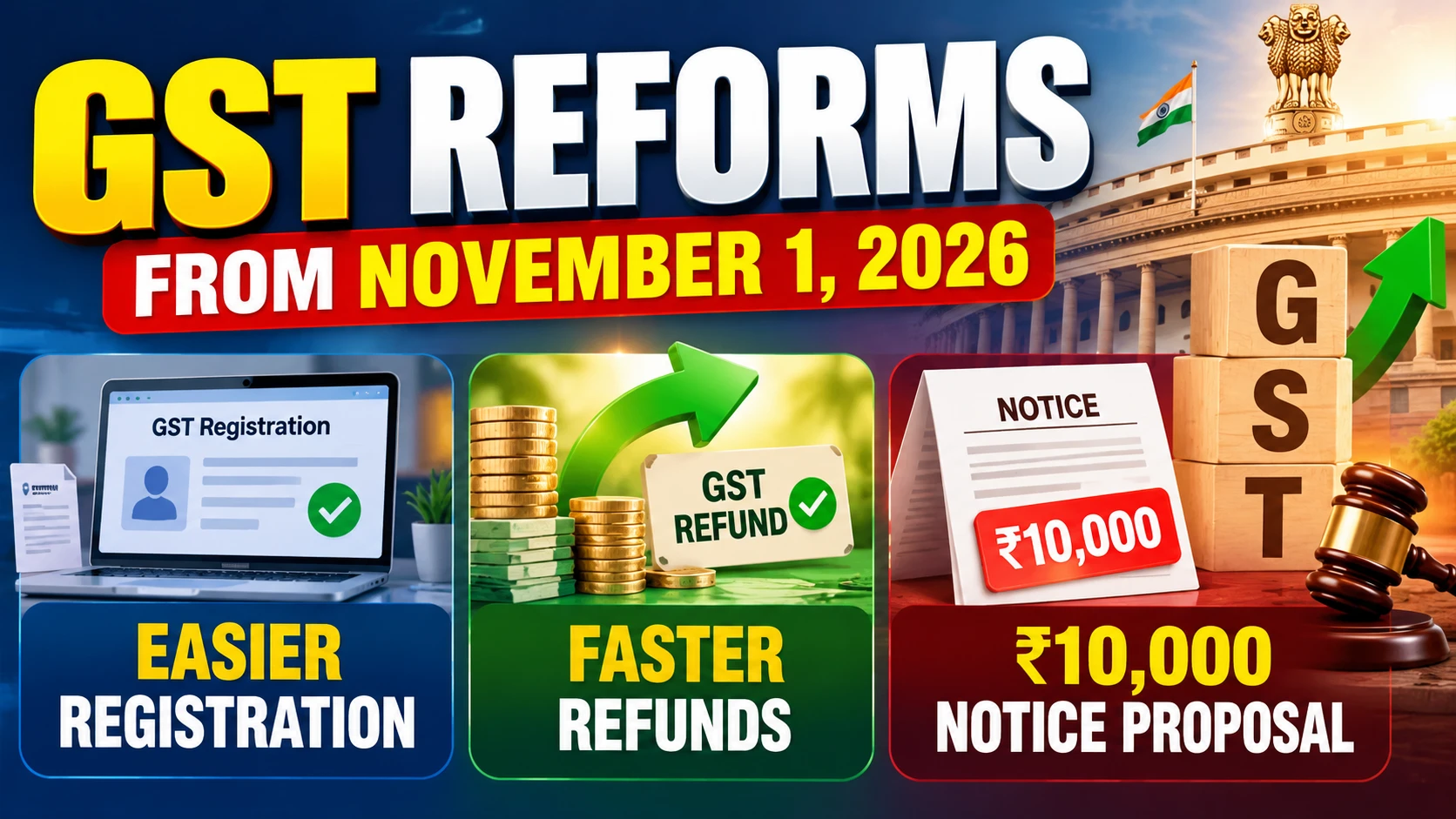
GST Reforms From November 1, 2026: Easier Registration, Faster Refunds and ₹10,000 Notice Proposal
HPCL Q2 Results 2026: ₹3,625 Crore Profit After Q1 Loss, but Half-Year Remains in Red
Adani Energy Q2 Results 2026: Profit Jumps 145% to ₹1,364 Crore, Smart Meter Business Expands



Which Types of Securities Are Listed?
Form 173A includes several categories of government securities.
These include Treasury Bills, fixed-rate bonds, floating-rate bonds and State Development Loans.
An option is also available to specify another security type.
The purpose of these categories is to identify the instruments involved in a claim.
Their inclusion in the form does not independently guarantee exemption in every possible circumstance.
Eligibility remains subject to the underlying law.
Why Has CBDT Introduced This Form?
The government announced broader reforms in June 2026 to encourage foreign investment in Indian government securities.
Those reforms sought to make India’s debt market more attractive to overseas investors by reducing certain tax and investment-related barriers.
Tax exemption can improve an eligible investor’s post-tax return.
At the same time, the tax administration needs sufficient information to identify qualifying claims and evaluate compliance.
Form 173A creates a structured reporting mechanism for this purpose.
The form may help align claimed exemptions with security-specific holdings and income records.
It also provides a consistent information format for eligible foreign institutions.
When Did the Underlying Tax Exemption Start?
The Ministry of Finance announced that the government-securities exemptions for qualifying foreign investors would apply to relevant income arising on or after 1 April 2026.
The legal provisions were introduced through an amendment to the Income-tax Act, 2025.
CBDT’s October notification is a subsequent procedural development.
It creates Rule 281A and prescribes the information required in Form 173A.
Therefore, there are two important dates:
| Development | Date |
|---|---|
| Underlying specified exemption applies from | 1 April 2026 |
| Form 173A reporting rule notified and effective | 19 October 2026 |
These dates should not be confused.
The October form requirement does not mean that the underlying exemption begins only in October.
How Should Eligible Investors Prepare?
Eligible claimants and their tax advisers should identify the relevant investment holdings and reconcile them with custodian and accounting records.
They should maintain accurate ISIN-level information and verify the amount of interest received or accrued.
Any disposal of government securities should be matched against sale proceeds and the appropriate capital-gains computation.
Overseas identification details, PAN and SEBI registration information should also be reviewed.
Because the form requires opening and closing positions, year-end records are important.
Any mismatch between transaction statements, tax computations and Form 173A could create avoidable compliance difficulties.
Is There a Separate Form 173A Filing Deadline?
The notification establishes the information-furnishing requirement but does not, in the text reviewed, prescribe a separate universal calendar deadline for Form 173A.
Taxpayers should therefore avoid relying on an invented due date.
The permitted submission procedure, applicable timing and relevant return-filing obligations should be verified through subsequent official instructions and professional advice.
What Does This Mean for the Government Bond Market?
India has been seeking to deepen its debt market and broaden participation by international institutions.
Government securities are used to finance public borrowing requirements.
A wider investor base may improve trading liquidity and diversify sources of demand.
In June 2026, the government also announced changes to investment-access arrangements, including expansion of the Fully Accessible Route and relaxation of certain limits applicable under the General Route.
The new tax-exemption reporting framework is part of that broader policy environment.
However, a tax concession does not guarantee that foreign investors will purchase more Indian bonds.
Investment decisions also depend on yields, currency risk, global interest rates and liquidity.
Does the New Form Affect Retail G-Sec Investors?
Most ordinary resident individuals will not need Form 173A merely because they hold government securities.
Their interest and capital-gains reporting depends on the tax law applicable to their circumstances.
They should not omit taxable income based on a headline about foreign-investor exemptions.
Likewise, the new rules do not provide a general exemption for interest earned from bank deposits.
Investors should distinguish between the legal status of a security, the type of income and the category of taxpayer.
What Should Tax Professionals Watch Next?
Tax advisers serving eligible foreign institutions should monitor official instructions regarding Form 173A’s submission procedure and any technical implementation on the income-tax portal.
They should also examine the final published form, validate PAN and registration details, and document the exemption calculations.
Any later CBDT clarification or correction should be incorporated before filing.
The notification should be considered alongside the relevant law, not as a standalone basis for determining every exemption.
Conclusion
CBDT’s Notification No. 137/2026 introduces Rule 281A and Form 173A as a reporting mechanism for specified government-securities tax exemptions.
The change became effective on 19 October 2026 and builds on tax reforms applicable to qualifying income from 1 April 2026.
Eligible foreign institutional investors and BIS must consider the form’s information requirements when claiming the relevant exemptions.
The main takeaway: Form 173A creates a new compliance obligation for specific eligible claimants. It is not a blanket tax exemption for all government-bond investors in India.
Official Sources
- Gazette of India: Notification No. 137/2026, G.S.R. 901(E), 19 October 2026. Gazette ID: CG-DL-E-19102026-277288.
- Ministry of Finance, PIB: Government-securities tax reforms announcement, 5 June 2026.
- PIB: Reforms to Expand Foreign Participation in Government Securities, 6 June 2026.
Disclaimer: This article was prepared with AI assistance using government notifications and financial reporting. It is intended for educational purposes and does not constitute tax, legal or investment advice. Readers should verify the applicable statute, forms and subsequent filing instructions. EduTaxTuber does not accept responsibility for losses arising from inaccurate or outdated information, to the extent permitted by applicable Indian law.
Disclaimer: EduTaxTuber provides content for general educational and informational purposes only. While we make reasonable efforts to keep the information accurate and updated, laws, regulations, market conditions, software features, and other information may change. Some content may be created or assisted by AI tools and may contain errors or omissions. Readers should verify important information with official sources or qualified professionals before making any tax, legal, financial, investment, business, or other decisions. EduTaxTuber does not guarantee the completeness or accuracy of the information and does not provide professional advice.