








RBI Injects ₹1 Lakh Crore Into Banks: Will Loan EMIs Fall? October 2026 Liquidity Update
Summary
- The Reserve Bank of India conducted a seven-day variable-rate repo (VRR) auction on 19 October 2026.
- RBI allotted ₹1,00,014 crore against bids worth ₹1,50,735 crore.
- The auction’s weighted average rate was 5.52%, compared with the policy repo rate of 5.50%.
- A separate ₹50,000 crore overnight VRR auction is scheduled for 21 October; it has not yet been completed.
- The intervention followed tighter short-term funding conditions and overnight interbank rates rising above the policy benchmark.
- The liquidity operation does not constitute a reduction in the policy repo rate.
- Existing home-loan and personal-loan EMIs will not automatically decrease because of this operation.
RBI’s ₹1 Lakh Crore Liquidity Injection Explained
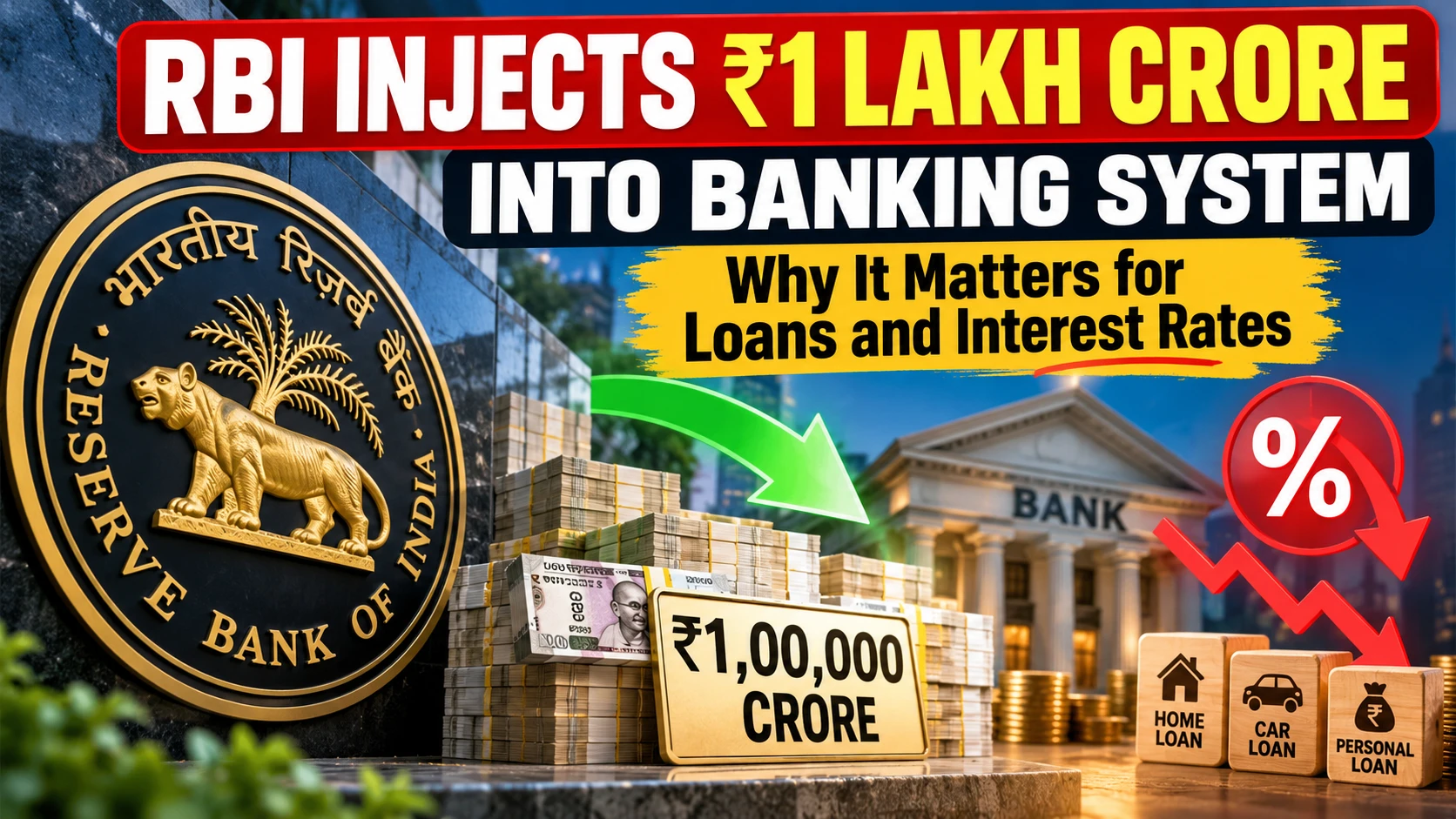
The Reserve Bank of India has supplied approximately ₹1 lakh crore of temporary liquidity to the banking system through a variable-rate repo auction conducted on Monday, 19 October 2026.
The intervention came as short-term borrowing costs for banks moved above the RBI’s policy repo rate.
According to the central bank’s published auction results, participating banks submitted bids worth ₹1,50,735 crore against a notified amount of ₹1,00,000 crore.

- No Installation Is Required
- Product Dimensions: 40 Cms
- Type : Rod , Power Requirement :230 – 250 V, 50 – 60 Hz , Water Heating

- TYPE: Instant; Capacity-5 Litres, Wattage – 3000 Watts; Pressure: 6.5 Bar Pressure Compatibility
- Elegant smooth design;Two Indicator lamps Red for power and green for Heating.
- INNER TANK: Hi Grade SS304 inner Tank for corrosion free performance; Heating Element: High Quality Copper Element for l…
RBI allotted ₹1,00,014 crore at a weighted average rate of 5.52%.
The operation is important because liquidity conditions influence how efficiently banks manage their daily funding needs.
When access to short-term funds becomes expensive, banks may face pressure on their cost of borrowing.
However, the development should not be confused with a conventional monetary-policy rate cut.
RBI has provided temporary funds through an auction; it has not announced a new reduction in the benchmark repo rate through this operation.
Read Also: RBI Updates Daily CRR Rule for Banks in October 2026
RBI Variable-Rate Repo Auction: Key Details
| Particular | Details |
|---|---|
| Auction conducted | 19 October 2026 |
| Type | Seven-day Variable Rate Repo |
| Notified amount | ₹1,00,000 crore |
| Total bids received | ₹1,50,735 crore |
| Amount allotted | ₹1,00,014 crore |
| Cut-off rate | 5.51% |
| Weighted average rate | 5.52% |
| Policy repo rate | 5.50% |
| Scheduled reversal | 26 October 2026 |
| Next announced VRR | 21 October 2026 |
The auction figures are based on RBI Press Release 2026-2027/1347, dated 19 October.
These figures demonstrate substantial demand for short-term liquidity from participating banks.
The bid amount and actual allotment must be kept separate.
RBI did not supply the entire ₹1,50,735 crore requested through the auction.
What Is a Variable-Rate Repo Auction?
A variable-rate repo, or VRR, is a tool used by RBI to provide short-term liquidity to eligible financial institutions.
In simplified terms, participating banks receive funds from the central bank against eligible collateral under the applicable repo arrangements.
The borrowing cost is determined through the auction mechanism rather than being fixed at an identical rate for every operation.
In the latest seven-day auction, the weighted average accepted rate was 5.52%.
The transaction is temporary.
Banks must repay the funds according to the operation’s specified tenor and settlement arrangements.
This means a ₹1 lakh crore VRR auction is not the same as permanently transferring ₹1 lakh crore to banks.
It is a short-term liquidity-management measure.
VRR Versus VRRR
The terms VRR and VRRR are easy to confuse.
A Variable Rate Repo (VRR) generally injects liquidity into the banking system.
A Variable Rate Reverse Repo (VRRR) absorbs liquidity by allowing the central bank to take in funds from eligible participants under the specified operation.
The distinction matters because an operation designed to supply cash serves a different immediate purpose from one designed to drain surplus funds.
Why Did RBI Need to Inject Liquidity?
India’s banking system had experienced substantial liquidity surpluses in previous months.
The central bank conducted liquidity-absorption operations after large foreign-currency inflows associated with special deposit arrangements.
However, short-term conditions subsequently tightened.
Several developments contributed to the changing environment.
Higher Short-Term Borrowing Rates
The weighted average call rate, or WACR, reached approximately 5.67% on 19 October.
That was 17 basis points above the prevailing policy repo rate of 5.50%.
The call money market is used by banks for short-term unsecured borrowing and lending.
RBI generally seeks to keep the overnight weighted average call rate aligned with its monetary-policy operating target.
When that market rate rises significantly above the repo rate, the central bank may use liquidity operations to manage temporary imbalances.
Tax-Related Cash Outflows
Banks also faced liquidity pressures associated with monthly tax payments.
When businesses and other taxpayers transfer funds to government accounts, cash balances available within parts of the banking system can change.
These movements may affect short-term funding conditions.
With 20 October being a market holiday, some participants expected tax-related outflows to affect the preceding working day.
Changes in Daily CRR Requirements
RBI recently tightened the daily cash reserve maintenance requirement.
The adjustment came into effect on 16 October 2026.
The cash reserve ratio, or CRR, refers to the proportion of specified bank liabilities that must be maintained as reserves with RBI.
Changes in reserve maintenance requirements can influence how much liquidity is available for other banking operations.
This was another factor cited by market participants in explaining the intervention.
More Stories

India October PMI 2026: Business Growth Hits 4-Month High, but Hiring Slows
GST Reforms From November 1, 2026: Easier Registration, Faster Refunds and ₹10,000 Notice Proposal
HPCL Q2 Results 2026: ₹3,625 Crore Profit After Q1 Loss, but Half-Year Remains in Red
Adani Energy Q2 Results 2026: Profit Jumps 145% to ₹1,364 Crore, Smart Meter Business Expands



Does This Mean India’s Banking System Has Run Out of Money?
No.
Temporary pressure in the money market should not automatically be interpreted as a systemic banking crisis.
The banking system still had a liquidity surplus of approximately ₹1.99 lakh crore as of 16 October, according to financial-market reporting.
However, aggregate liquidity and the distribution of liquidity among individual banks are different matters.
Some institutions may require short-term funds even when the banking system as a whole remains in surplus.
The timing of payments, reserve requirements and access to funding markets can all affect demand.
RBI’s VRR operation is designed to address such liquidity conditions through its established operating framework.
RBI Announces Another ₹50,000 Crore Auction
RBI has also announced a separate overnight variable-rate repo auction for Wednesday, 21 October 2026.
The notified amount is ₹50,000 crore.
The announced auction window is 9:30 AM to 10:00 AM, with reversal scheduled for 22 October.
| Particular | Upcoming operation |
|---|---|
| Date | 21 October 2026 |
| Amount notified | ₹50,000 crore |
| Tenor | One day |
| Auction window | 9:30–10:00 AM |
| Reversal | 22 October 2026 |
This information comes from RBI Press Release 2026-2027/1355, issued on 19 October.
As of 20 October, the second auction is scheduled but has not been completed.
It would therefore be inaccurate to state that RBI has already allotted another ₹50,000 crore.
The final amount accepted and auction rate will be known only after the operation takes place and results are announced.
Will Home Loan EMIs Decrease?
Not automatically.
This is one of the most important questions for borrowers.
A change in the policy repo rate may affect certain floating-rate loans, particularly those linked to the RBI’s external benchmark framework.
A VRR auction works differently.
The latest operation provides banks with temporary funds to help manage liquidity.
It does not directly rewrite the interest rate charged under an individual home-loan agreement.
Therefore, a borrower paying an EMI today should not assume the instalment will fall because RBI injected ₹1 lakh crore into the banking system.
Any change depends on the loan’s benchmark, reset period, interest-rate structure and the lender’s contractual terms.
What About Personal Loans?
Most personal loans are commonly offered with specified pricing terms that may be fixed or floating depending on the product.
An existing fixed-rate personal loan does not automatically change when RBI conducts a liquidity auction.
A bank may adjust pricing for new loans as its broader cost of funds changes, but such a decision is not guaranteed.
Borrowers should check the applicable rate and loan agreement rather than rely on headlines suggesting immediate cheaper loans.
Will FD Interest Rates Change?
The liquidity operation also does not automatically trigger a change in fixed-deposit rates.
Banks determine deposit pricing by considering funding requirements, competition, maturity profiles and monetary conditions.
Providing short-term liquidity can influence funding-market dynamics.
However, a bank may still need to attract stable customer deposits.
Consequently, FD rate changes depend on each institution’s own pricing decisions.
Existing fixed-rate deposits generally continue under their contracted terms unless the relevant product conditions provide otherwise.
What Is the Repo Rate After This Operation?
The policy repo rate remained at 5.50% in the reporting reviewed for this article.
The 5.52% weighted average rate from the VRR auction is not a newly announced policy repo rate.
It is the borrowing rate resulting from this particular short-term liquidity auction.
Confusing the two rates could mislead borrowers and investors.
Likewise, the call money rate of approximately 5.67% represents the overnight interbank funding market, not the interest rate charged on retail bank loans.
Each figure serves a different purpose.
What Could This Mean for Banking Stocks?
Banks depend on stable access to funding.
When short-term borrowing rates rise, funding costs can become an important consideration.
RBI’s liquidity operation may help reduce temporary stress in money markets.
However, a single auction is not enough to establish that bank earnings or share prices will increase.
Bank profitability also depends on loan growth, deposit costs, non-performing assets, fee income and provisions.
Investors should continue examining individual company results.
For example, strong lending growth combined with comparatively slower deposit growth may place different pressures on a bank than on a competitor with a more stable funding mix.
Read Also: Union Bank Q2 FY27 Results: Profit Jumps 30% to ₹5,537 Crore, NPAs Decline
The effect will vary across institutions.
What Should Investors and Borrowers Monitor Next?
The next significant development is the ₹50,000 crore overnight auction scheduled for 21 October.
Its bid demand, final allotment and weighted average rate will help show how much short-term funding banks seek.
Money-market participants will also monitor the weighted average call rate and whether it moves closer to the policy repo rate.
For households, the most relevant indicators remain actual changes in bank lending rates, deposit rates and RBI monetary-policy decisions.
A liquidity auction can influence financial conditions without producing an immediate change in everyday borrowing costs.
Conclusion
RBI’s seven-day variable-rate repo operation supplied approximately ₹1 lakh crore of temporary liquidity to banks on 19 October 2026.
The auction attracted bids exceeding the notified amount, indicating substantial demand for short-term funds.
The central bank has also scheduled a separate ₹50,000 crore overnight VRR operation for 21 October.
The development reflects active liquidity management in response to tighter short-term funding conditions.
Bottom line: RBI has provided temporary banking-system liquidity, not announced a new repo-rate cut. Borrowers should not expect an automatic EMI reduction, while investors should monitor the next auction and broader funding conditions.
Sources
- Reserve Bank of India, Press Release 2026-2027/1347, 19 October 2026 — Result of the seven-day VRR auction.
- Reserve Bank of India, Press Release 2026-2027/1355, 19 October 2026 — Scheduled overnight VRR auction for 21 October.
- The Economic Times, 20 October 2026 — RBI liquidity operation and short-term market rates.
- Reuters, carried by Business Standard, 19 October 2026 — Banking-system liquidity and institutional demand.
Disclaimer: This article was prepared with AI assistance using RBI announcement records and established financial reporting. It is for education and general information, not investment, banking, tax or legal advice. Interest rates and monetary conditions may change. EduTaxTuber disclaims liability for losses to the extent permitted by applicable Indian law.
Disclaimer: EduTaxTuber provides content for general educational and informational purposes only. While we make reasonable efforts to keep the information accurate and updated, laws, regulations, market conditions, software features, and other information may change. Some content may be created or assisted by AI tools and may contain errors or omissions. Readers should verify important information with official sources or qualified professionals before making any tax, legal, financial, investment, business, or other decisions. EduTaxTuber does not guarantee the completeness or accuracy of the information and does not provide professional advice.