








RBI MPC Minutes October 2026: More Repo Rate Hikes Possible, but Two Members Warn of Growth Risks
Summary
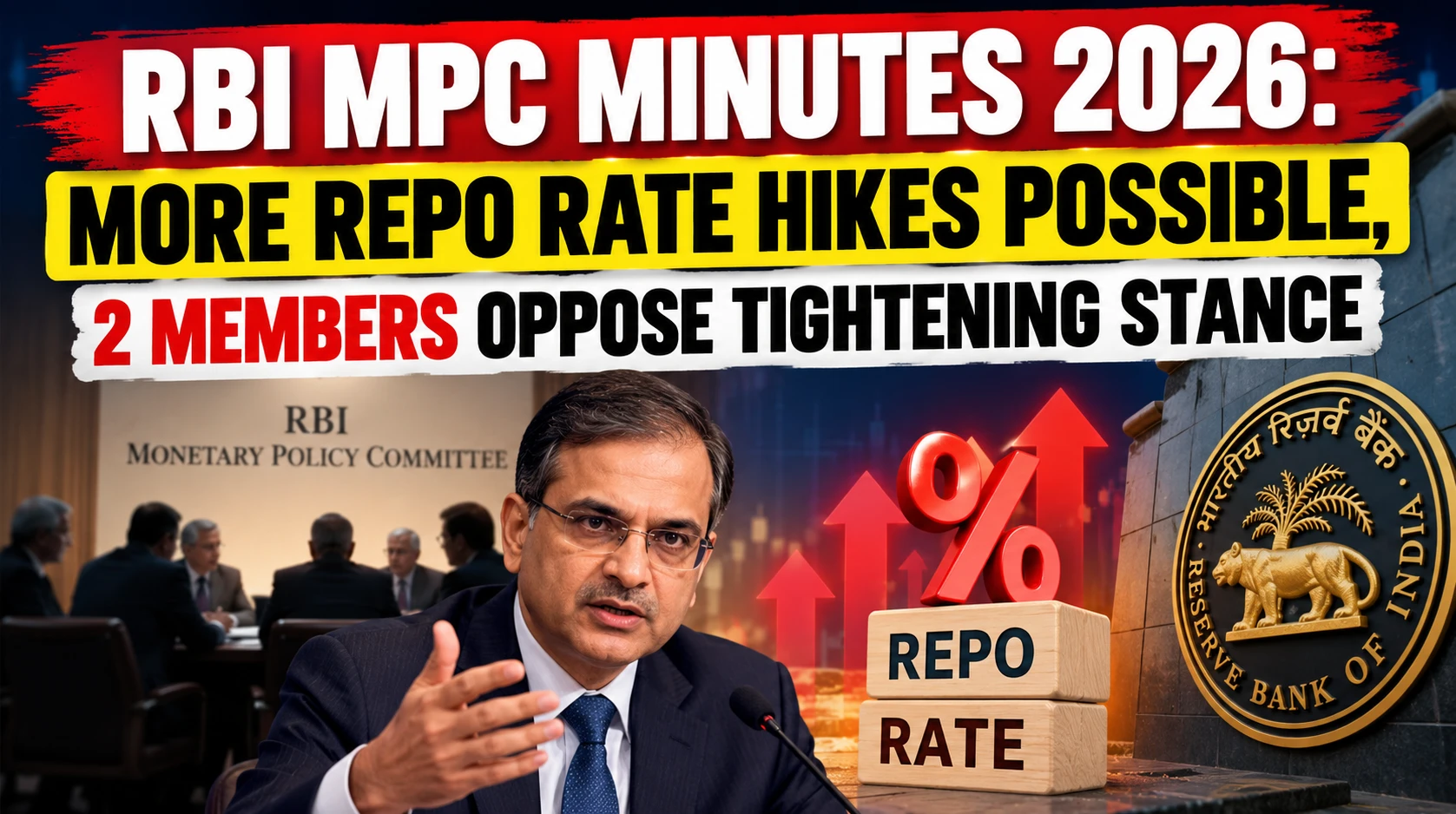
- RBI published the minutes of its October 5–7 Monetary Policy Committee (MPC) meeting on 21 October 2026.
- All six members voted to increase the repo rate by 25 basis points to 5.50% at the October meeting.
- Two members, Nagesh Kumar and Ram Singh, opposed changing the policy stance from neutral to calibrated tightening.
- Governor Sanjay Malhotra indicated that near-term policy choices could involve a rate hike or a pause, depending on incoming economic data.
- RBI projects FY27 CPI inflation at 5.2%, with inflation reaching 6.0% in October–December.
- The GDP growth forecast for FY27 stands at 7.1%.
- The next MPC meeting is scheduled for December 2–4, 2026.
- No fresh interest-rate hike was announced on October 21.
RBI Releases October 2026 Monetary Policy Minutes
The Reserve Bank of India has released the minutes of its October 2026 Monetary Policy Committee meeting, providing fresh insight into how policymakers view inflation, economic growth and the possibility of additional interest-rate increases.
The minutes were published on Wednesday, 21 October 2026, under RBI Press Release No. 2026-2027/1361.
Earlier this month, the six-member committee unanimously increased the policy repo rate by 25 basis points to 5.50%.




However, the newly released record shows differences in opinion about the appropriate monetary-policy stance.
Four members supported changing the stance to calibrated tightening, while two members preferred retaining a neutral stance.
This distinction is relevant to home-loan borrowers, businesses, depositors and investors because the stance communicates how policymakers are assessing future risks.
Importantly, the minutes do not announce another increase in the repo rate. They explain the reasoning behind the decision already taken on 7 October.
RBI MPC October 2026: Important Figures
| Indicator | Latest position |
|---|---|
| Policy repo rate | 5.50% |
| October rate increase | 25 basis points |
| Vote on rate increase | 6–0 |
| Vote on tightening stance | 4–2 |
| Standing Deposit Facility rate | 5.25% |
| Marginal Standing Facility rate | 5.75% |
| FY27 CPI inflation forecast | 5.2% |
| Q3 FY27 CPI inflation forecast | 6.0% |
| FY27 real GDP growth forecast | 7.1% |
| Next MPC meeting | December 2–4, 2026 |
Source: RBI’s official October 21 MPC minutes.
These projections are forecasts, not confirmed future inflation or growth outcomes.
What Does Calibrated Tightening Mean?
Monetary-policy stance is a communication tool used by central banks to explain their broad approach.
A neutral stance allows consideration of a rate hike, pause or reduction depending on economic conditions.
Calibrated tightening, as described by RBI Governor Sanjay Malhotra, indicates that the near-term policy focus is on a rate increase or a pause rather than a rate reduction.
The word calibrated is important.
It suggests a measured approach based on incoming inflation and growth data, rather than a predetermined series of aggressive increases.
Consequently, the stance should not be interpreted as a guarantee that the repo rate will rise at every subsequent meeting.
Why Did Two MPC Members Oppose the Stance Change?
All six MPC members agreed that a 25-basis-point rate increase was appropriate.
However, Nagesh Kumar and Ram Singh disagreed with changing the stance to calibrated tightening.
Nagesh Kumar’s View
Nagesh Kumar supported the rate hike to address inflation expectations but preferred maintaining a neutral policy stance.
He highlighted India’s resilient economic growth alongside continued international uncertainty.
His assessment emphasised that several inflationary pressures originated from supply-side developments, including crude oil prices and weather-related disruptions.
Read Also: RBI Repo Rate Hike: How 25 Bps Increase Affects Home Loan EMI
Maintaining a neutral stance, in his view, would preserve flexibility as economic conditions evolve.
Ram Singh’s View
Ram Singh also supported the 25-basis-point rate increase.
However, he warned that signalling an extended tightening cycle could weaken demand in interest-rate-sensitive sectors.
He specifically discussed risks to automobiles, real estate and private investment.
His argument was not that inflation should be ignored.
Rather, he considered gradual rate adjustments preferable to a signal that might lead households and businesses to expect substantial borrowing-cost increases.
These positions demonstrate a policy debate about the pace and communication of tightening, not a disagreement over whether to raise rates in October.
Why Is RBI Concerned About Inflation?
The MPC minutes identify several sources of inflation risk.
These include elevated crude oil prices, a deficient monsoon, rising food prices and the possibility that higher input costs will spread into broader consumer prices.
RBI’s FY27 CPI inflation forecast stands at 5.2%.
For the October–December quarter, inflation is projected at 6.0%, touching the upper limit of India’s inflation-targeting tolerance band.
The central bank’s inflation framework has a 4% target, with a tolerance band of 2% to 6%.
Higher food and fuel prices are especially important because they directly affect household budgets.
However, RBI also monitors whether these pressures influence wages, business pricing decisions and inflation expectations.
If temporary supply shocks become embedded in broader prices, they may become more difficult to reverse.
More Stories

Swiggy Q2 Results 2026: Net Loss Narrows to ₹922 Crore, Instamart Loss at ₹895 Crore

RBI Rejects All 224 Treasury Bill Bids in ₹23,000 Crore Auction: Why It Matters for Investors
Persistent Systems Opens ₹4,265 Crore QIP: Floor Price Clarified at ₹5,761, What Investors Should Know
Mahindra Finance Q2 Results 2026: Profit Jumps 55% to ₹882 Crore, Loan Disbursements Rise 22%

What Did Governor Sanjay Malhotra Say?
Governor Sanjay Malhotra supported the 25-basis-point increase and the shift to calibrated tightening.
He identified signs of inflation becoming more widespread.
According to the minutes, approximately 37% of the items in the consumer price index basket recorded inflation above 4% in August, compared with about 20% in March.
The Governor also discussed the importance of underlying inflation, monetary growth and credit conditions.
His assessment indicates that future policy decisions will depend on whether inflation pressures broaden and how the economy responds to earlier measures.
The governor did not announce a fixed number of additional interest-rate hikes.
What Is RBI’s Economic Growth Forecast?
Despite inflation concerns, RBI expects India’s economy to remain relatively resilient.
The central bank projects real GDP growth of 7.1% for FY27.
Read Also: India CPI Inflation Hits 5.54% in September 2026: Food Prices Surge
India’s economy expanded 7.8% in the April–June quarter.
Strong services activity, investment and credit demand have supported growth.
Nevertheless, higher interest rates can make financing more expensive for businesses and consumers.
This explains the challenge facing the MPC: controlling inflation without unnecessarily weakening economic activity.
The committee must consider both price stability and the broader economic environment.
Will Home Loan EMIs Increase Again?
Not necessarily.
The repo rate has already increased to 5.50% following the October policy decision.
For floating-rate loans linked to an external benchmark such as the repo rate, the earlier increase may affect lending rates according to the loan’s contractual reset schedule.
However, the October 21 publication of MPC minutes does not itself trigger another EMI increase.
A future EMI change would depend on a later policy decision, bank transmission and the borrower’s loan terms.
For example, if a lender raises a floating-rate home loan by 25 basis points, the repayment impact depends on the outstanding principal, remaining tenure and how the bank adjusts instalments or tenure.
Borrowers should review their loan statements and benchmark-reset terms rather than assume that every news report about potential hikes means their EMI has already changed.
What About Fixed Deposits and Savings?
Higher policy rates can influence banks’ cost of funds and deposit pricing.
However, the relationship is not automatic.
Banks may revise fixed-deposit rates based on funding requirements, competition and their own business conditions.
An existing fixed-rate deposit generally continues under the agreed terms.
Consumers considering a new FD should compare effective yields, tenure, premature-withdrawal conditions and applicable taxes.
The MPC minutes alone do not establish that all banks will increase FD rates.
What Could Happen in December?
The next MPC meeting is scheduled for December 2–4, 2026.
By then, policymakers will have additional information about consumer inflation, economic activity, global commodity prices and financial conditions.
The minutes indicate that a rate hike or pause is consistent with the current calibrated-tightening approach.
However, a particular December decision has not been announced.
Financial-market forecasts may differ, but they are not official RBI commitments.
For borrowers and investors, monitoring the actual policy resolution will be more useful than relying on predictions.
What Should Stock Market Investors Watch?
Interest-rate developments can affect banking, real estate, automobile and other rate-sensitive sectors.
Banks may experience changes in lending yields and deposit costs.
Real estate and automobile demand can respond to changes in financing conditions.
Bond prices and yields can also react to changes in interest-rate expectations.
However, the direction of individual share prices depends on many other factors, including valuation, earnings, liquidity and investor sentiment.
A cautious MPC outlook should not be treated as a standalone recommendation to buy or sell any security.
Conclusion
The RBI’s October 2026 MPC minutes reveal broad agreement that inflation risks require attention, alongside meaningful differences over how strongly future tightening should be signalled.
All six members supported the October rate increase to 5.50%, but two preferred retaining a neutral stance.
The central bank expects inflation to reach 6.0% during the December quarter while projecting FY27 GDP growth of 7.1%.
For borrowers, the central point is that no new rate hike was announced today. Future EMI and deposit-rate changes will depend on subsequent decisions and individual bank policies.
Sources
- RBI — MPC Minutes, October 5–7, 2026, published October 21
- RBI — October 7 Monetary Policy Statement
- Reuters — India Rate Panel Flags More Hikes but Cautions Against Aggressive Cycle
Editorial Disclaimer: This article was prepared with AI assistance using official RBI records and credible financial reporting. It is intended for general information and education, not investment, banking, tax or legal advice. Forecasts, interest rates and future policy decisions may change. EduTaxTuber disclaims responsibility for losses arising from inaccurate or outdated information to the extent permitted by applicable Indian law.
Disclaimer: EduTaxTuber provides content for general educational and informational purposes only. While we make reasonable efforts to keep the information accurate and updated, laws, regulations, market conditions, software features, and other information may change. Some content may be created or assisted by AI tools and may contain errors or omissions. Readers should verify important information with official sources or qualified professionals before making any tax, legal, financial, investment, business, or other decisions. EduTaxTuber does not guarantee the completeness or accuracy of the information and does not provide professional advice.
