









Summary
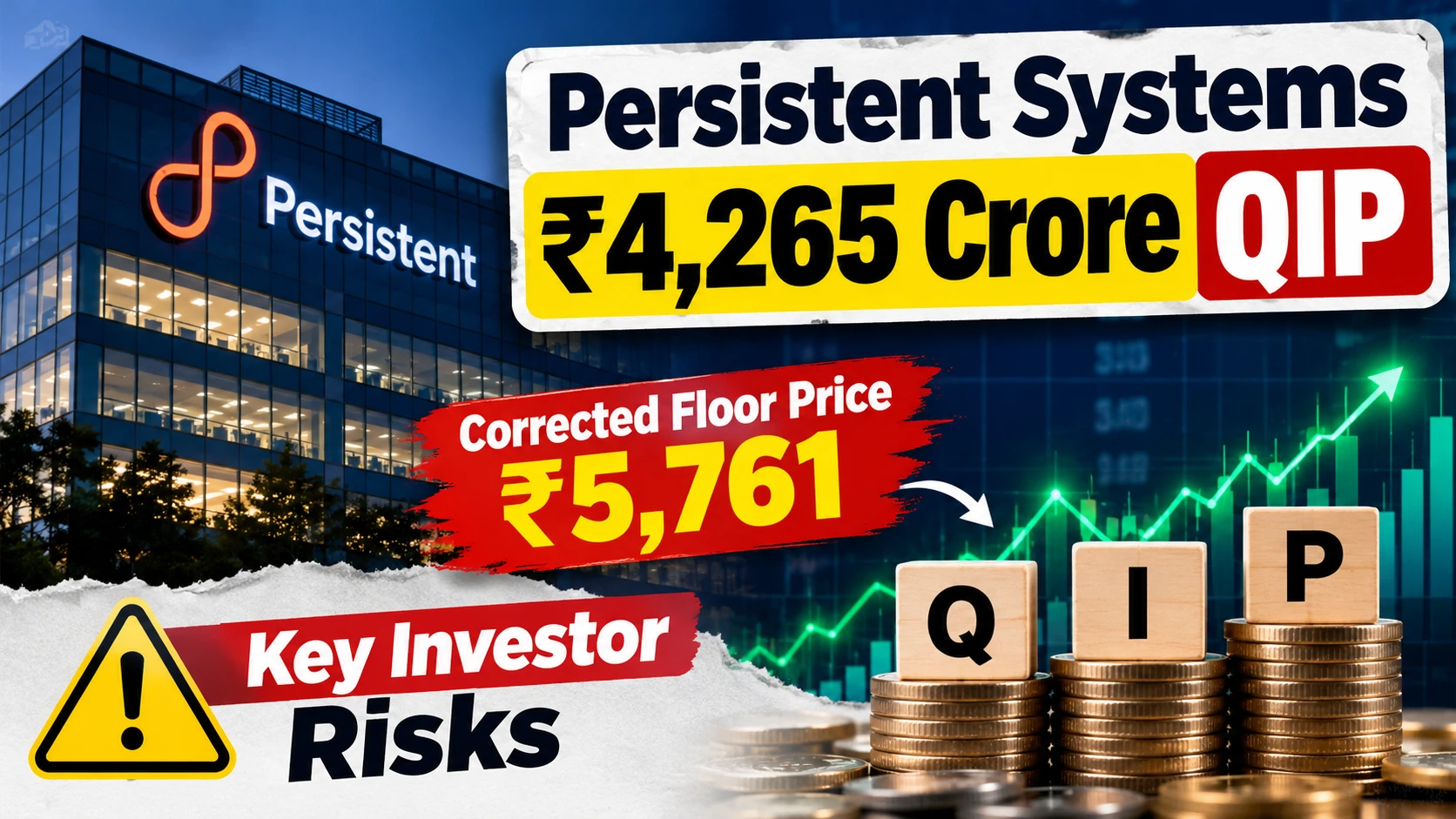
- Persistent Systems opened a Qualified Institutions Placement (QIP) on 21 October 2026 to raise up to US$450 million, approximately ₹4,264.61 crore.
- Its initial stock-exchange filing mentioned a floor price of ₹5,550 per share.
- A subsequent official clarification confirmed the approved floor price as ₹5,761 per equity share.
- The company may offer an eligible discount of up to 5%, subject to applicable regulations and shareholder approval.
- The final QIP issue price and number of shares to be allotted have not yet been announced.
- The fundraising comes as Persistent Systems works on financing its acquisition of Germany-based IT services company Nagarro.
Persistent Systems Announces Major QIP Fundraising
Persistent Systems Limited has opened a Qualified Institutions Placement to raise up to US$450 million, equivalent to approximately ₹4,264.61 crore.
The Pune-headquartered IT services company informed the National Stock Exchange and BSE about the fundraising decision on Wednesday, 21 October 2026.
The development is important because Persistent Systems is pursuing a major international acquisition while maintaining its investments in technology services and artificial intelligence.
However, one detail in the announcements requires special attention.


The company’s original disclosure stated a QIP floor price of ₹5,550 per share.
Later the same evening, Persistent Systems submitted a clarification confirming that the approved floor price should be considered ₹5,761 per share.
The later ₹5,761 figure is the relevant corrected floor price for this report.
The final price at which institutional investors receive shares will be decided separately.
Persistent Systems QIP 2026: Important Details
| Particular | Details |
|---|---|
| Company | Persistent Systems Limited |
| NSE symbol | PERSISTENT |
| BSE code | 533179 |
| Fundraising instrument | Qualified Institutions Placement |
| Issue opening date | 21 October 2026 |
| Maximum issue size | US$450 million |
| Approximate rupee equivalent | ₹4,264.61 crore |
| Original filing’s floor price | ₹5,550 per share |
| Corrected approved floor price | ₹5,761 per share |
| Maximum permitted discount | Up to 5% |
| Final issue price | Not yet announced |
| Relevant date for pricing | 21 October 2026 |
Sources: Persistent Systems’ stock-exchange filings dated 21 October 2026 and subsequent financial-news reporting.
The rupee equivalent of the US-dollar issue size was calculated using the RBI/FBIL reference exchange rate of ₹94.7691 per US dollar as of 19 October 2026, as disclosed by the company.
The ₹4,264.61-crore amount is a maximum proposed fundraising size, not confirmation that this much money has already been collected.
Why Did Persistent Systems Correct the Floor Price?
The company’s Special Committee of the Board met on the evening of 21 October.
It approved opening the QIP and adopting the preliminary placement document.
The original filing identified the floor price as ₹5,550.
Subsequently, Persistent submitted an updated letter referencing the earlier announcement and clarifying that the approved floor price should be considered ₹5,761 per equity share.
The company stated that the price was determined using the formula prescribed under SEBI’s Issue of Capital and Disclosure Requirements Regulations.
The clarification did not announce a final allotment price.
Read Also: LTTS Share Price Jumps Nearly 15% After Q2 Results: ₹548 Crore Profit, ₹20 Dividend and AI Deals
This distinction matters because investors following only the first report may continue seeing the earlier ₹5,550 figure.
Financial-market reports also reflected the two different figures.
The later company clarification is the appropriate basis for reporting the corrected floor price.
What Is a Qualified Institutions Placement?
A Qualified Institutions Placement is a fundraising mechanism through which an eligible listed company issues securities to qualified institutional buyers.
QIBs can include certain mutual funds, insurance companies and other institutions that satisfy the relevant regulatory definition.
Unlike an initial public offering, a QIP is not designed as a public subscription opportunity for all categories of investors.
Existing retail shareholders generally cannot submit a standard retail IPO-style application merely because the company has announced a QIP.
The company typically uses the process to raise capital from eligible institutions without conducting a conventional public offering.
The applicable issue terms, regulatory framework and company approvals determine how the placement is conducted.
What Does the 5% Discount Mean?
Persistent Systems has stated that it may offer a discount of not more than 5% on the calculated floor price.
The authority follows the applicable SEBI framework and a special resolution approved by shareholders on 5 October 2026.
However, three figures should be kept separate:
- Calculated floor price: ₹5,761 per share, as clarified by the company.
- Permitted discount: Up to 5%, if the company chooses to provide it.
- Final issue price: The amount ultimately determined in consultation with the book-running lead managers.
An authorised maximum discount does not mean that the company has already decided to offer the full 5%.
Similarly, the corrected floor price is not an announcement that shares have already been allotted at ₹5,761.
Who Is Managing the QIP?
Persistent Systems identified three book-running lead managers for the placement:
- J.P. Morgan India Private Limited
- IIFL Capital Services Limited
- HSBC Securities and Capital Market (India) Private Limited
These institutions assist with the capital-raising process, including interactions with eligible investors and the relevant transaction arrangements.
The company’s final issue price will be determined in consultation with the lead managers.
Investors should look for the formal issue-closing and allotment announcements before treating the fundraising as completed.
Why Is Persistent Systems Raising Capital?
The QIP comes during a significant expansion period for Persistent Systems.
The company has been pursuing the acquisition of Germany-based digital engineering and IT services company Nagarro SE.
Persistent reported in October that it had secured approximately 94.04% of Nagarro’s share capital and voting rights, excluding treasury shares.
The transaction has substantial financing requirements.
Reuters previously reported that Persistent was planning rupee-denominated debt issuance of up to ₹8,000 crore as part of its acquisition-financing arrangements.
The company has also considered commercial-paper financing.
Read Also: Eternal Q2 FY27 Results: Profit Rises 92% to ₹125 Crore, Blinkit Expands to 2,751 Stores
The proposed equity raise adds another potential source of capital.
However, the final allocation of QIP proceeds must be assessed against the preliminary placement document and subsequent official disclosures.
It would be misleading to assume that every rupee raised through the QIP has already been spent on the acquisition.
More Stories

India October PMI 2026: Business Growth Hits 4-Month High, but Hiring Slows
GST Reforms From November 1, 2026: Easier Registration, Faster Refunds and ₹10,000 Notice Proposal
HPCL Q2 Results 2026: ₹3,625 Crore Profit After Q1 Loss, but Half-Year Remains in Red
Adani Energy Q2 Results 2026: Profit Jumps 145% to ₹1,364 Crore, Smart Meter Business Expands



What Is the Nagarro Acquisition?
Nagarro is a Germany-based digital engineering and technology services company.
Its operations complement parts of Persistent Systems’ existing business in software engineering, cloud, data and digital transformation.
The acquisition could increase Persistent’s international customer base and business capabilities.
It may also create opportunities to combine technical expertise across the two companies.
Nevertheless, acquisitions involve meaningful risks.
The purchasing company must manage integration costs, financing arrangements, employee retention, customer relationships and operational differences.
Potential business benefits are not guaranteed simply because a controlling stake has been acquired.
Persistent Systems Q2 FY27 Results
The company recently reported its September-quarter earnings.
According to Persistent’s official investor-relations disclosure, revenue reached approximately ₹4,663.9 crore.
This was 30.3% higher in rupee terms than the corresponding quarter of the previous financial year.
In US-dollar terms, quarterly revenue was $487.6 million, up 20% year-on-year.
The company reported its 26th consecutive quarter of sequential revenue growth.
Financial Highlights
| Metric | Q2 FY27 |
|---|---|
| Revenue | ₹4,663.9 crore |
| Revenue growth (INR) | +30.3% YoY |
| Revenue growth (USD) | +20.0% YoY |
| EBIT | ₹697.72 crore |
| EBIT margin | 15.0% |
| Operating profit after tax | ₹495.15 crore |
| Reported profit after tax | ₹351.51 crore |
| Quarterly order bookings (TCV) | $633.5 million |
Source: Persistent Systems’ official Q2 FY27 financial highlights.
The difference between operating profit after tax and reported profit after tax is important.
Persistent reported an exceptional expense related to the proposed Nagarro transaction.
As a result, reported profit declined even though revenue continued growing.
This illustrates why investors should review exceptional items rather than relying on a single profit-growth headline.
How Can a QIP Affect Existing Shareholders?
A QIP may create new equity shares.
When the number of outstanding shares increases, the ownership percentage of an existing shareholder can decline unless they receive additional shares.
This is called equity dilution.
For example, suppose an investor owns 100 shares of a company that has 10,000 shares outstanding.
The investor initially owns 1% of the business.
If the company issues 1,000 additional shares to institutional investors and the original shareholder receives none, the holding becomes 100 out of 11,000 shares.
The ownership percentage would fall to approximately 0.91%.
This example is illustrative and is not Persistent Systems’ actual post-QIP shareholding calculation.
The eventual dilution will depend on the final issue price, number of shares allotted and existing equity capital.
Raising additional funds can also benefit a business if the capital is deployed profitably.
Investors must weigh both possibilities.
Is the QIP Positive or Negative for the Share Price?
The impact cannot be determined from the announcement alone.
A successful equity raise may strengthen the balance sheet, support acquisitions or reduce reliance on borrowings.
However, new share issuance can dilute existing ownership and earnings per share if profits do not grow proportionately.
The pricing of the placement also matters.
A large discount to the prevailing market price may influence sentiment, although the stock’s subsequent movement depends on broader factors.
Persistent’s share price will also reflect expectations about the Nagarro acquisition, financial performance, integration risks and market conditions.
Because this report focuses on the late-evening disclosure, it does not claim a specific 22 October share-price reaction without a verified market snapshot.
What Should Investors Watch Next?
The most important pending information is the final QIP issue price.
Investors should also review the final number of equity shares allotted and the total proceeds raised.
The company’s disclosures concerning use of funds will be relevant to understanding its acquisition-financing strategy.
Subsequent developments involving Nagarro’s integration and Persistent’s operating margins will help evaluate whether the expansion delivers the expected benefits.
Read Also: FPI Outflows October 2026: Foreign Investors Withdraw ₹52,100 Crore From Indian Stocks
Current shareholders may also want to examine changes in earnings per share, debt levels and future cash generation.
An institutional placement can be an important financing milestone, but it is not a guarantee of investment returns.
Conclusion
Persistent Systems has opened a QIP to raise up to approximately ₹4,264.61 crore, equivalent to US$450 million.
The company subsequently clarified that the applicable floor price is ₹5,761 per share, replacing the ₹5,550 figure in its earlier filing.
The placement comes during a major acquisition and business-expansion period for the IT services company.
The key takeaway: the corrected floor price is ₹5,761, but the final issue price, shares allotted and proceeds raised remain subject to further announcements. Investors should evaluate both the financing benefits and potential equity dilution.
Sources
- NSE — Persistent Systems Original QIP Opening Disclosure, 21 October 2026
- Persistent Systems — Later QIP Floor-Price Clarification
- NDTV Profit — Corrected QIP Floor Price
- Persistent Systems — Official Q2 FY27 Results
- Reuters — Persistent Acquisition Financing
Disclaimer: This article was prepared with AI assistance using company stock-exchange disclosures and credible financial reporting. It is intended for general information and education, not investment, tax, financial or legal advice. Fundraising terms and market prices may change. EduTaxTuber disclaims liability for losses to the extent permitted by applicable Indian law.
Disclaimer: EduTaxTuber provides content for general educational and informational purposes only. While we make reasonable efforts to keep the information accurate and updated, laws, regulations, market conditions, software features, and other information may change. Some content may be created or assisted by AI tools and may contain errors or omissions. Readers should verify important information with official sources or qualified professionals before making any tax, legal, financial, investment, business, or other decisions. EduTaxTuber does not guarantee the completeness or accuracy of the information and does not provide professional advice.
