








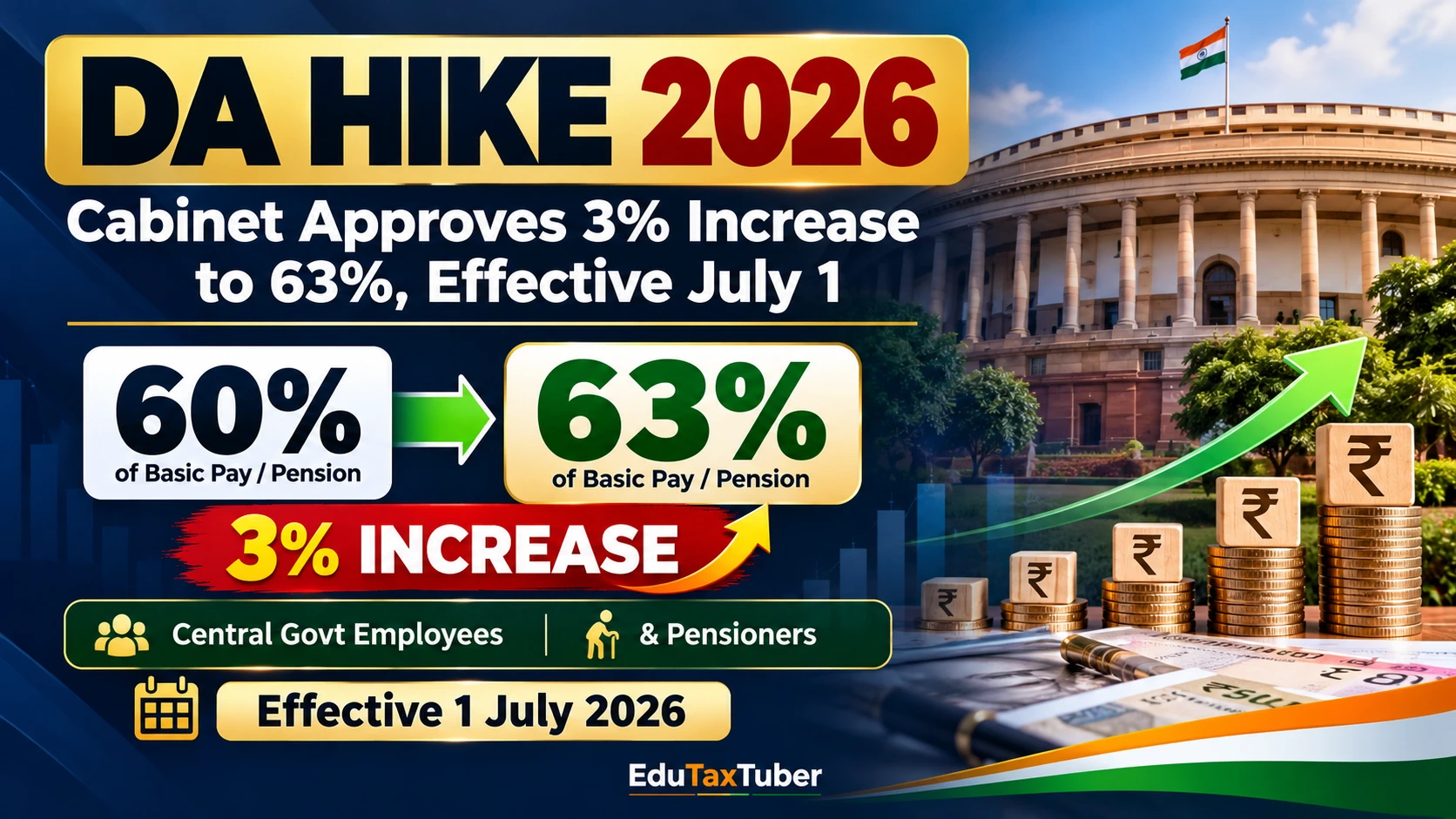
DA 63% Official Order Issued on 29 October 2026
Following the Union Cabinet’s approval, the Ministry of Finance’s Department of Expenditure issued Office Memorandum No. 1/2(i)/2026-E.II(B) on October 29, 2026.
Summary
- The Union Cabinet approved the DA and DR increase on October 28, 2026.
- DA and DR rise from 60% to 63%, an increase of 3 percentage points.
- The effective date is July 1, 2026.
- Approximately 48.54 lakh Central Government employees will benefit.
- Around 68.71 lakh pensioners will benefit.
- The estimated annual cost to the government is ₹10,016.10 crore.
- The decision follows the accepted formula based on the recommendations of the Seventh Central Pay Commission.
The order revises Dearness Allowance for the applicable Central Government employee category from 60% to 63% of basic pay, effective July 1, 2026.
Under the relevant 7th CPC pay structure, basic pay refers to pay drawn in the prescribed Pay Matrix level and excludes other forms of pay such as special pay.
Separate orders have also been issued for employees continuing under the applicable earlier Central Pay Commission structures.
DA Arrears Calculation Example
If eligible basic pay remains ₹50,000 throughout the period:
- Previous monthly DA at 60%: ₹30,000
- Revised monthly DA at 63%: ₹31,500
- Additional monthly DA: ₹1,500
- Illustrative arrears for July–October, if all four months remain unpaid at the revised rate: ₹6,000
The actual arrears will depend on payroll processing, eligibility, changes in basic pay and any amounts already received.
Official source: Department of Expenditure, Ministry of Finance, 29 October 2026.
What Is the Latest DA Hike?
Dearness Allowance is a cost-of-living component paid to eligible government employees.
It is calculated as a percentage of basic pay and is intended to help compensate for rising consumer prices.



Dearness Relief provides corresponding inflation-related support to eligible pensioners.
The newly approved increase raises the applicable rate from 60% to 63%.
This is an increase of three percentage points, not a 3% increase in the total salary or pension.
The difference matters because DA is calculated on eligible basic pay, not on an employee’s complete gross salary.
New DA Rate and Effective Date
| Particulars | Details |
|---|---|
| Previous DA/DR rate | 60% |
| Revised DA/DR rate | 63% |
| Increase | 3 percentage points |
| Effective date | July 1, 2026 |
| Cabinet approval | October 28, 2026 |
| Beneficiary employees | 48.54 lakh |
| Beneficiary pensioners | 68.71 lakh |
| Estimated annual expenditure | ₹10,016.10 crore |
Source: Ministry of Finance, Press Information Bureau, October 28, 2026.
The effective date determines when the revised entitlement begins. The date on which arrears are actually credited may depend on implementation instructions and payroll processing.
DA Hike Salary Calculation: How Much More Will Employees Receive?
The additional monthly Dearness Allowance is calculated by multiplying eligible basic pay by three percentage points.
Additional monthly DA = Basic Pay × 3 ÷ 100
For example, an employee earning basic pay of ₹40,000 previously received ₹24,000 as DA at the 60% rate.
At the revised 63% rate, the DA becomes ₹25,200.
The monthly increase is therefore ₹1,200.
Salary Increase Examples
| Monthly basic pay | DA at 60% | DA at 63% | Monthly increase |
|---|---|---|---|
| ₹18,000 | ₹10,800 | ₹11,340 | ₹540 |
| ₹25,000 | ₹15,000 | ₹15,750 | ₹750 |
| ₹40,000 | ₹24,000 | ₹25,200 | ₹1,200 |
| ₹50,000 | ₹30,000 | ₹31,500 | ₹1,500 |
| ₹70,000 | ₹42,000 | ₹44,100 | ₹2,100 |
| ₹1,00,000 | ₹60,000 | ₹63,000 | ₹3,000 |
These figures are illustrative and exclude other salary components, deductions and applicable taxes.
How Much Will Pensioners Receive?
Eligible pensioners will receive the corresponding increase in Dearness Relief.
The revised percentage is applied to the relevant basic pension.
For example, if a pensioner’s basic pension is ₹25,000, the additional monthly DR is ₹750.
Read Also: HUL Q2 FY27 Results: 15% Sales Growth, ₹19 Dividend and 7% Volume Growth
If basic pension is ₹40,000, the additional monthly DR is ₹1,200.
The precise benefit depends on the eligible pension amount and applicable rules.
For family pensioners and other categories, entitlement should be checked against the relevant pension instructions.
Will Employees and Pensioners Get Arrears?
Because the revised rate takes effect from July 1, 2026, eligible beneficiaries would generally become entitled to the difference for the applicable period before the revised amount is reflected in regular payments.
For a person with unchanged eligible basic pay of ₹40,000, the additional DA is ₹1,200 per month.
For July through September, that would represent ₹3,600.
Including October would make the illustrative total ₹4,800.
However, these examples should not be treated as confirmed arrears-payment amounts or dates. Actual arrears depend on each beneficiary’s eligibility, changes in basic pay or pension and the implementation of payroll instructions.
Why Did the Government Increase DA?
DA and DR are intended to cushion the effect of inflation.
When consumer prices increase, the purchasing power of a fixed amount of salary or pension declines.
The Central Government generally reviews DA and DR twice each year, with revisions commonly effective from January and July.
The calculation is based on the accepted formula linked to the Consumer Price Index for Industrial Workers.
The government stated that the latest increase follows the formula associated with the Seventh Central Pay Commission.
Who Will Benefit From the Increase?
The official announcement identifies two principal beneficiary groups.
The first includes approximately 48.54 lakh eligible Central Government employees.
The second includes around 68.71 lakh pensioners.
Together, these represent more than 1.17 crore beneficiaries.
The announcement does not mean that all private-sector employees or every state government employee automatically receive the same increase.
State governments and private employers have their own compensation policies and legal frameworks.
More Stories

XLOOKUP in Excel: 3 Powerful Tricks for Multiple Columns (Hindi)
ChatGPT in Excel: 5 Powerful AI Tricks to Save Time (Hindi Tutorial)
GST REG-14 OTP Verification 2026: New 3-Day Rule, ARN Not Generated and Registration Amendment Steps
SEBI NRI KYC Rules 2026: Open Investment Accounts From Abroad Without Visiting India — 7 Major Changes


Does the DA Hike Apply to State Government Employees?
The Union Cabinet’s decision applies to eligible Central Government employees and pensioners under the relevant rules.
State governments may separately revise the DA or DR applicable to their employees and pensioners.
Some states may adopt similar rates or effective dates, while others may follow different schedules.
State employees should refer to their respective government’s official orders instead of assuming automatic implementation.
Is DA Hike a Basic Salary Increase?
No.
The rate of DA has changed, but the Cabinet announcement does not itself revise the basic pay structure.
For example, an employee with basic pay of ₹50,000 continues to have the same basic pay in this simplified illustration.
What changes is the Dearness Allowance calculated on that amount.
Other salary components might be affected under separate service rules, but such effects should not be presumed solely from the DA announcement.
Is Dearness Allowance Taxable?
For salaried employees, Dearness Allowance is generally included in taxable salary under applicable income-tax provisions.
Its treatment for particular calculations may depend on the relevant statutory rules.
Pension-related tax treatment can also vary according to the type of receipt and individual circumstances.
Employees and pensioners should therefore review their payslips, tax calculations and applicable withholding rather than assuming that the entire increase will be received free of tax.
What Is the Financial Impact on the Government?
The Ministry of Finance estimates that the combined DA and DR revision will cost approximately ₹10,016.10 crore annually.
This reflects the additional expenditure expected from the approved increase.
The decision is a recurring fiscal commitment designed to provide inflation-related compensation.
The actual timing of payments will follow the relevant administrative processes.
What Should Employees Do Now?
Eligible employees should monitor official orders, departmental payroll instructions and upcoming salary slips.
Pensioners should check their pension-paying bank or pension disbursing authority for implementation updates.
There is no need to trust unsolicited messages promising early release of arrears in exchange for payment, banking details or one-time passwords.
The safest approach is to rely on official communication and normal salary or pension channels.
Read Also: GST Fraud Notices 2026: CBIC’s 7 Important Rules on Evidence, SCNs and Taxpayer Rights
Frequently Asked Questions
1. What is the new DA rate in October 2026?
The approved rate is 63% of eligible basic pay, compared with the previous 60%.
2. How much has DA increased?
By three percentage points.
3. When is the new DA rate effective?
July 1, 2026.
4. Will pensioners also benefit?
Yes. The Cabinet approved the corresponding increase in Dearness Relief.
5. How much extra DA will someone with ₹50,000 basic pay receive?
An illustrative ₹1,500 per month before other adjustments.
6. Has an arrears-payment date been confirmed?
The official Cabinet announcement confirms the retrospective effective date but does not specify a universal credit date for all beneficiaries.
7. Is the new rate applicable to all employees in India?
No. The announcement concerns eligible Central Government employees and pensioners.
Conclusion
The Cabinet’s October 28 decision increases DA and DR from 60% to 63%, with effect from July 1, 2026.
More than 1.17 crore Central Government employees and pensioners are expected to benefit from the revision.
For eligible beneficiaries, the increase provides additional monthly income and a basis for arrears relating to the retrospective effective period.
Employees and pensioners should check official implementation instructions for the exact amount and timing of their payments.
Sources
- Ministry of Finance, Press Information Bureau, October 28, 2026.
- Business Standard, October 28, 2026.
- DD India, October 28, 2026.
Disclaimer: EduTaxTuber provides content for general educational and informational purposes only. While we make reasonable efforts to keep the information accurate and updated, laws, regulations, market conditions, software features, and other information may change. Some content may be created or assisted by AI tools and may contain errors or omissions. Readers should verify important information with official sources or qualified professionals before making any tax, legal, financial, investment, business, or other decisions. EduTaxTuber does not guarantee the completeness or accuracy of the information and does not provide professional advice.