






There is now a new GST registration option for small internet retailers who want to grow into other Indian states.
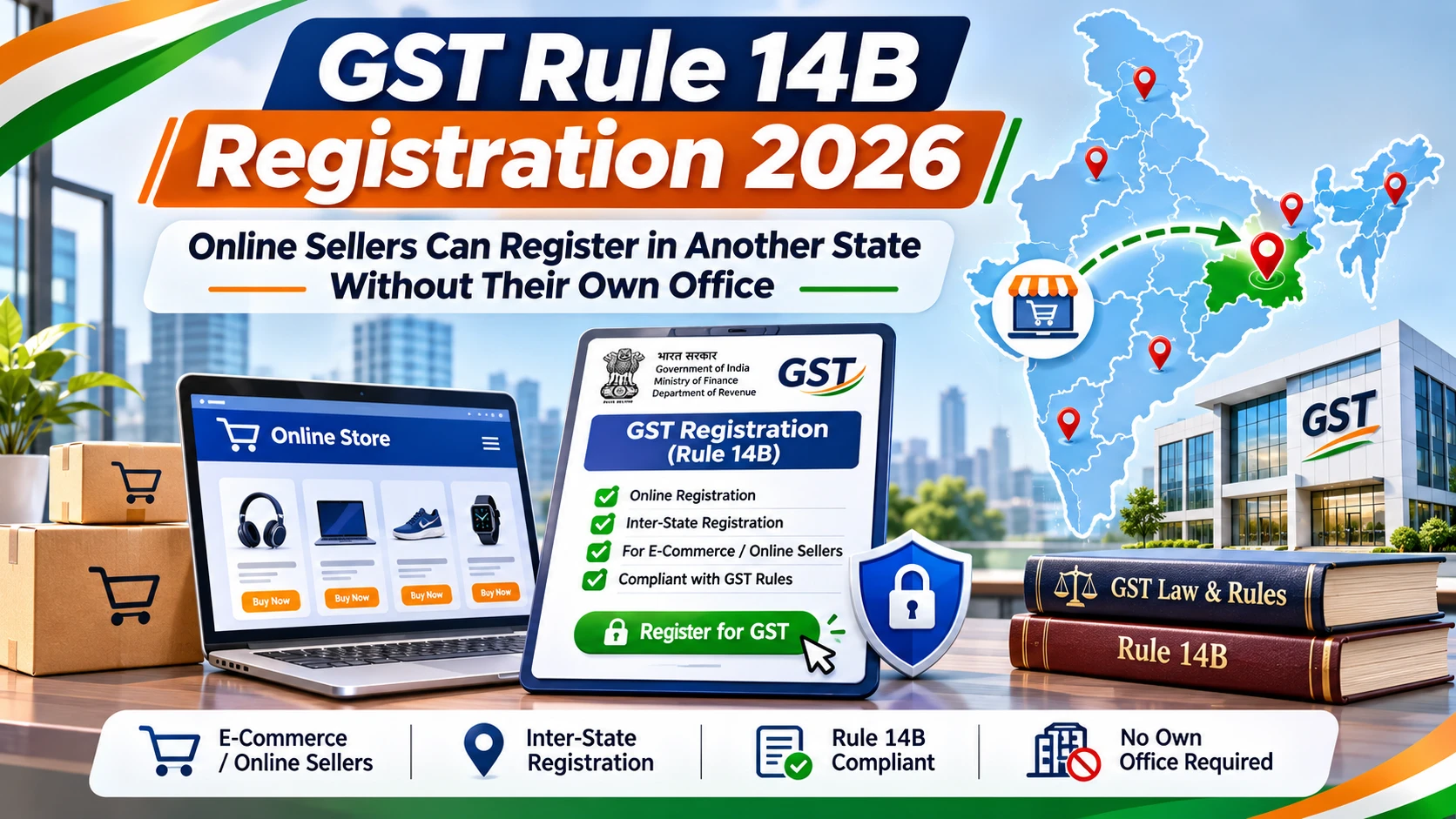
Under Rule 14B of the Central Goods and Services Tax Rules, 2017, the Goods and Services Tax Network (GSTN) established a streamlined registration process that enables qualified companies to register for GST in another state without setting up a physical office or warehouse there.
Following GSTN Advisory No. 682 and Notification No. 05/2026–Central Tax dated October 26, the facility opened for business on November 1, 2026.
Summary
- GST Rule 14B became operational on November 1, 2026.
- Eligible goods sellers can seek registration in another state without maintaining their own physical premises there.
- The seller must already have an eligible active, regular GST registration in a home state under the same PAN.
- The new registration is intended exclusively for supplies of goods through e-commerce operators collecting TCS under Section 52.
- The e-commerce operator must consent to the use of its warehouse address.
- The operator has seven working days to respond to the required consent request.
- The qualifying monthly output-tax limit is ₹2.5 lakh on specified supplies to registered persons, excluding same-PAN supplies.
- Biometric authentication and physical verification may apply.
- One Rule 14B registration per PAN is permitted in a state or union territory.
What Is GST Rule 14B?
Rule 14B introduces an optional simplified registration mechanism for certain goods suppliers operating through electronic commerce operators.
An electronic commerce operator, or ECO, operates an online marketplace or platform through which sellers supply products.
Under the relevant GST arrangements, some operators are required to collect tax at source under Section 52 of the CGST Act.
Read Also: GST registration form REG-01 changes in November 2026
The new registration mechanism is designed for eligible sellers who already operate in one state and wish to supply goods through an operator’s warehouse located in another state.
Instead of establishing their own physical premises in the new state, eligible applicants can use the operator’s approved warehouse address for GST registration.
This can reduce a practical barrier faced by smaller online sellers.
However, it does not remove the need to comply with GST registration, invoicing, returns and other applicable requirements.
Why Is the New Scheme Important?
A seller operating from Uttar Pradesh may want to store products in a fulfilment warehouse in Maharashtra so customers can receive faster deliveries.
Previously, the need to maintain suitable registration-related premises and documentation could make expansion more complicated.


Rule 14B provides an alternative, subject to eligibility and the operator’s approval.
For example, consider a seller with an active regular GSTIN in Uttar Pradesh.
If the seller wants to use a participating e-commerce operator’s warehouse in Maharashtra and does not have a physical business presence or existing regular registration there, Rule 14B may be relevant.
That seller must still satisfy the remaining requirements.
Read Also: GST registration reforms for online sellers
The scheme does not automatically permit every marketplace seller to use any warehouse address without consent.
GST Rule 14B Eligibility Conditions
The official government FAQ and GSTN advisory specify important conditions.
| Requirement | Rule 14B condition |
|---|---|
| Existing home-state registration | Active eligible regular GSTIN under the same PAN |
| Target state | No physical presence or existing regular registration |
| Business channel | Supplies of goods exclusively through qualifying ECOs |
| Warehouse | Approved address with operator consent |
| Monthly threshold | Specified output-tax liability not above ₹2.5 lakh |
| Registration count | One Rule 14B registration per PAN per state/UT |
| Application | FORM GST REG-01 through GST portal |
1. Existing Home-State GSTIN Is Required
The applicant must already have an eligible regular GST registration in another state or union territory.
A person without any existing GST registration cannot assume this scheme provides a first-time registration without a home-state base.
The new application must be linked to the same Permanent Account Number.
The home-state registration must also satisfy the eligibility restrictions described in the advisory.
2. No Physical Presence in the Target State
The scheme applies to a state or union territory where the applicant does not maintain its own physical presence and does not already hold an active regular registration.
It is not intended as a replacement for all ordinary GST registrations.
3. Only Qualifying E-Commerce Supplies
The Rule 14B registration is intended for goods supplied exclusively through electronic commerce operators required to collect TCS under Section 52.
The registered person cannot use that registration to conduct unrelated direct or offline sales outside the permitted ECO arrangement.
This distinction matters for businesses operating both online and offline.
4. Warehouse Consent Is Mandatory
The relevant e-commerce operator must agree to the use of its warehouse address.
The applicant cannot independently select a warehouse and treat the address as approved.
Consent is provided through the prescribed portal workflow.
What Does the ₹2.5 Lakh Limit Actually Mean?
This is one of the most frequently misunderstood conditions.
The ₹2.5 lakh figure is not a monthly sales-turnover limit.
It concerns the total output-tax liability, including the relevant Central, State or Union Territory and Integrated GST components, on supplies made to registered persons, excluding supplies to persons registered under the same PAN.
For example, assume a seller makes qualifying supplies that create ₹1.8 lakh of relevant monthly output-tax liability.
That figure would be within the specified ₹2.5 lakh limit, provided the remaining scheme requirements are met.
But if the corresponding liability exceeds ₹2.5 lakh, the seller cannot simply assume that the special registration remains suitable.
Actual liability must be determined using the applicable tax provisions and transaction details.
Businesses should not confuse gross sales value, tax collected, input tax credit and net cash payment when assessing this condition.
How to Apply Under GST Rule 14B
GSTN Advisory No. 682 explains the operational registration process.
Step 1: Visit the GST Portal
Open https://www.gst.gov.in/.
Choose Services → Registration → New Registration.
Complete the required preliminary registration information.
Step 2: Select Rule 14B in REG-01
In Part B of FORM GST REG-01, open the Business Details tab.
Select Yes for the option relating to registration under Rule 14B.
Read and accept the prescribed declaration regarding the scheme’s conditions.
Step 3: Enter the Home-State GSTIN
Enter the active regular GSTIN in the state where the applicant maintains its physical business presence.
The GSTIN must belong to the same PAN and satisfy the eligibility requirements.
Step 4: Enter the E-Commerce Operator’s GSTIN
Provide the relevant operator GSTIN in the principal or additional place-of-business section.
The registration system will allow the required warehouse-address access request to be initiated.
Only eligible and approved warehouse addresses can be selected.
Step 5: Obtain Warehouse Address Access
The e-commerce operator must approve the request for access to the relevant warehouse information.
Once address access is approved, the applicant can select the required warehouse address as its principal or additional place of business.
The nature-of-possession field is handled through the prescribed Rule 14B process.
Step 6: Complete the Application
Provide the remaining required particulars, upload applicable documents and complete the submission process.
The application is then subject to the required operator consent and verification steps.
Starting an application does not guarantee immediate generation of an Application Reference Number.
More Stories

ChatGPT in Excel: 5 Powerful AI Tricks to Save Time (Hindi Tutorial)
GST REG-14 OTP Verification 2026: New 3-Day Rule, ARN Not Generated and Registration Amendment Steps
SEBI NRI KYC Rules 2026: Open Investment Accounts From Abroad Without Visiting India — 7 Major Changes
GST Rule 14B Registration 2026: How Online Sellers Can Register in Another State Without Their Own Office


E-Commerce Operator Consent: Seven Working Days
After the required validations, the application is forwarded to the concerned e-commerce operator for consent.
The operator is required to respond within seven working days.
The operator must also provide the details of its authorised representative for the relevant state or union territory.
If the necessary warehouse consent is not provided, the application cannot progress through the normal Rule 14B registration workflow.
The warehouse selection and operator-consent stages must not be confused with final GST registration approval.
Aadhaar Authentication and Verification
Once the required operator consent is available, the portal checks whether prescribed verification has already been completed for the home-state GSTIN.
If the relevant biometric Aadhaar authentication and document verification were previously completed, some steps may not need to be repeated.
Otherwise, the designated persons must complete the applicable verification requirements through the authorised process.
The GSTN advisory specifies a 15-day period from submission of Part B for completing the required biometric/document verification where applicable.
Failure to complete mandatory verification within the stipulated period can prevent ARN generation.
Applicants should follow the actual portal instructions and designated GST Seva Kendra procedures.
When Will Registration Be Approved?
Once an ARN is generated, the application may be assigned for physical verification if that has not already been completed for the home-state GSTIN.
The scheme provides for deemed approval following successful verification or expiry of the prescribed 30-day period from ARN generation, whichever occurs earlier, subject to the scheme’s conditions.
However, a negative verification finding can have serious consequences.
Where the relevant home-state verification produces negative findings, pending applications under the scheme may be rejected according to the prescribed process.
Therefore, applicants should not interpret the phrase simplified registration as unconditional registration without examination of their actual business.
What If the E-Commerce Operator Withdraws Consent?
A seller’s continued registration under Rule 14B depends partly on the prescribed warehouse arrangement.
If the operator withdraws consent, the seller must take the required steps to amend the principal or additional place-of-business information.
The official framework specifies a 30-day period for the relevant amendment following the operator’s withdrawal intimation.
Failure to comply can lead to the electronic cancellation mechanism prescribed under Rule 14B.
The home-state GSTIN also remains important.
Cancellation of the qualifying home-state registration can affect the registration obtained under Rule 14B.
Is This Available to Amazon and Flipkart Sellers?
The scheme applies based on the legal status of the operator, the specific warehouse and the seller’s eligibility.
A seller using Amazon, Flipkart or another marketplace should first confirm whether the relevant operator and warehouse support the required GSTN consent process.
A marketplace’s existence does not mean that every warehouse address is available under Rule 14B.
The operator must have the appropriate registration and provide the necessary consent.
Businesses should review the marketplace’s authorised seller documentation alongside GSTN instructions.
Can Services Businesses Use Rule 14B?
The new mechanism is specifically directed towards eligible suppliers of goods through qualifying e-commerce operators.
It should not be described as a general scheme under which every freelance professional, consultant or service provider can register anywhere in India using an e-commerce warehouse.
Those businesses must follow the registration provisions relevant to their own activities.
Does Rule 14B Eliminate GST Returns?
No.
The scheme provides a special mechanism for registration.
It does not exempt registered persons from all ordinary tax-accounting, invoicing, return-filing and recordkeeping requirements.
The government FAQ also explains that relevant books and records must be maintained at the home-state principal place of business under the applicable framework.
Read Also: GST compliance and taxpayer notice guidelines
Applicants should review the continuing obligations before choosing the scheme.
Frequently Asked Questions
1. What is GST Rule 14B?
It is an optional registration mechanism for eligible goods sellers using qualifying e-commerce operators in another state without having their own physical premises there.
2. When did the scheme become operational?
November 1, 2026.
3. Is a home-state GSTIN required?
Yes, an eligible active regular GSTIN under the same PAN is required.
4. Is ₹2.5 lakh the maximum monthly turnover?
No. It is the specified monthly output-tax liability limit on qualifying supplies to registered persons, excluding same-PAN supplies.
5. Can I use an e-commerce warehouse as my GST address?
Yes, where the scheme applies and the operator provides the necessary consent.
6. How long does the operator have to provide consent?
Seven working days under the prescribed process.
7. Can I use the Rule 14B GSTIN for offline sales?
The registration is intended exclusively for qualifying supplies through e-commerce operators.
8. Is GST registration automatically approved within three days?
Do not confuse Rule 14B with other simplified registration arrangements. Rule 14B has its own operator-consent and verification procedures.
9. What happens if warehouse consent is withdrawn?
The required registration amendment must be made within the prescribed period; otherwise electronic cancellation may apply.
Conclusion
Rule 14B represents an important compliance development for smaller businesses expanding their online sales across state borders.
By allowing eligible applicants to use a consenting e-commerce operator’s warehouse instead of maintaining their own physical premises, it addresses a practical obstacle to interstate expansion.
Read Also: latest GST news and practical guides
However, businesses must carefully check the existing home-state GSTIN, warehouse consent, qualifying sales restrictions, tax-liability ceiling and verification requirements.
A well-prepared application can avoid unnecessary registration delays and compliance problems.
Sources
- GSTN Advisory No. 682, dated 1 November 2026.
- Notification No. 05/2026–Central Tax, dated 26 October 2026.
- Press Information Bureau — FAQs on Simplified Registration Schemes for ECO Sellers, 9 October 2026.
Disclaimer: EduTaxTuber provides content for general educational and informational purposes only. While we make reasonable efforts to keep the information accurate and updated, laws, regulations, market conditions, software features, and other information may change. Some content may be created or assisted by AI tools and may contain errors or omissions. Readers should verify important information with official sources or qualified professionals before making any tax, legal, financial, investment, business, or other decisions. EduTaxTuber does not guarantee the completeness or accuracy of the information and does not provide professional advice.
