








Container Manufacturing Scheme 2026: Cabinet Approves ₹10,000 Crore to Boost India’s Shipping Industry
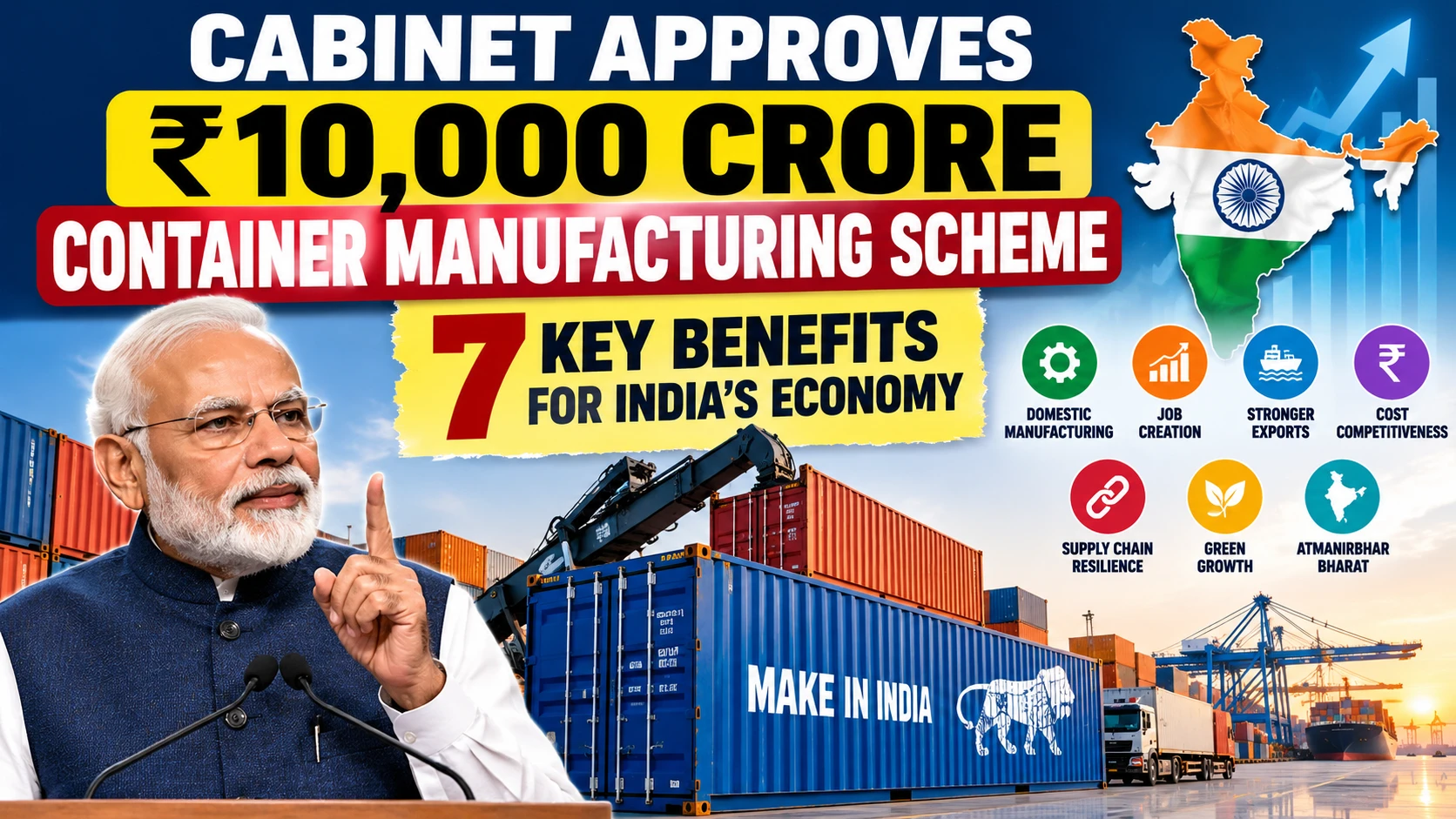
The Union Cabinet has approved a major ₹10,000 crore Container Manufacturing Promotion Scheme (CMPS) aimed at increasing domestic production of shipping containers, reducing dependence on imports and strengthening India’s position in international trade.
Summary
- Union Cabinet approved the ₹10,000 crore Container Manufacturing Promotion Scheme.
- The scheme extends through FY 2039–40.
- Its objective is to increase annual manufacturing capacity to 7.5 lakh TEUs.
- Eligible manufacturers may receive 3% annual interest subvention on qualifying loans.
- An operational expenditure assistance component supports eligible production.
- The scheme includes testing and certification support.
- Local-content requirements are intended to strengthen domestic supply chains.
What Is the Container Manufacturing Promotion Scheme?
The Container Manufacturing Promotion Scheme is a government initiative to encourage shipping-container production in India.
Shipping containers are essential to global trade because they enable goods to be transported efficiently across vessels, railways and trucks.
India currently relies on a combination of domestic production and imported containers.


Expanding local manufacturing could help develop an integrated supply chain involving steel fabrication, engineering, logistics and supporting services.
The programme seeks to attract investment into both new factories and expansions of existing units.
Its main objectives are to increase production capacity, support domestic value addition and improve the industry’s international competitiveness.
₹10,000 Crore Scheme: Financial Structure
The government’s official announcement divides the scheme into three principal assistance components.
| Component | Allocation |
|---|---|
| Interest Subvention Assistance | ₹859 crore |
| Operational Expenditure Assistance | ₹8,891 crore |
| Testing and certification assistance | ₹150 crore |
| Total | ₹10,000 crore |
These allocations provide the financial framework for the scheme.
They do not mean that the entire amount has already been distributed to manufacturers.
Actual assistance will depend on eligible projects, applicable guidelines and implementation.
1. Interest Subvention Assistance
The scheme provides a 3% per annum interest subvention on eligible term loans taken by qualifying container manufacturers.
This is intended to lower financing costs for investment in new facilities and expansion of existing ones.
The component has an allocation of ₹859 crore.
According to the government’s published eligibility framework, new manufacturing facilities must achieve a minimum annual capacity of 1,00,000 TEUs.
Eligible expansions of existing facilities must add at least 25,000 TEUs of annual capacity.
These conditions are important because the scheme targets substantial manufacturing investment rather than providing automatic financial assistance to every small business.
Read Also: Nike Vegam Run India Launch 2026: ₹3,795 Price, November 1 Release and Business Strategy Explained
A manufacturer must satisfy the applicable requirements before claiming benefits.
2. Operational Expenditure Assistance
The largest component of the programme is operational expenditure assistance.
It has an allocation of ₹8,891 crore and is designed to help eligible Indian manufacturers compete with overseas producers.
The assistance is linked to qualifying containers manufactured and sold in accordance with the scheme’s conditions.
The published assistance rates include:
| Container type | Assistance per eligible unit |
|---|---|
| 20-foot container | ₹49,500 |
| 40-foot container | ₹86,625 |
| 20-foot specialised container | ₹37,125–₹74,250 |
These are programme assistance amounts, not retail selling prices.
The actual amount payable depends on the type of container and applicable eligibility conditions.
3. Testing and Certification Support
The third component provides ₹150 crore for testing and certification-related infrastructure.
Container manufacturing requires compliance with technical and safety standards.
Testing facilities help manufacturers demonstrate that their products are suitable for demanding international logistics operations.
For example, containers may need to withstand repeated handling, stacking, transport and environmental exposure.
Investing in shared testing infrastructure can reduce barriers to complying with international standards.
However, the availability and conditions of specific testing facilities will depend on implementation.
4. Domestic Capacity Target of 7.5 Lakh TEUs
One of the programme’s most ambitious objectives is to increase India’s annual container manufacturing capacity to approximately 7.5 lakh TEUs.
The government’s reference level is around 70,000 TEUs.
If achieved, the proposed expansion would increase manufacturing capacity more than tenfold.
It is important to distinguish capacity from actual output.
A factory may have the ability to manufacture a particular number of containers without necessarily producing or selling that full quantity each year.
Actual production will depend on orders, raw materials, investment, operating efficiency and market conditions.
What Does TEU Mean?
TEU stands for Twenty-foot Equivalent Unit.
It is a standard measure used in container shipping and logistics.
A standard 20-foot container is generally counted as one TEU.
A standard 40-foot container is generally equivalent to two TEUs.
This measurement helps compare container capacity across factories, ships, ports and logistics systems.
The proposed 7.5 lakh TEU manufacturing target therefore refers to a standardised capacity measure, not necessarily 7.5 lakh individual containers of identical dimensions.
5. Local-Content Requirements
The scheme seeks to build stronger Indian manufacturing supply chains through minimum domestic-content requirements.
Official government material specifies a 70% local-content threshold through FY 2031–32.
The requirement is intended to increase to 90% from FY 2032–33.
These conditions aim to encourage more manufacturing value to remain within India.
Domestic suppliers of materials, components and industrial services may benefit if container production expands.
However, the precise calculation of local content and the conditions attached to assistance must be determined under the applicable scheme guidelines.
6. Why Does India Need More Container Manufacturing?
Shipping containers are basic infrastructure for international commerce.
Exporters and importers depend on reliable container availability to transport products.
A shortage or mismatch in container availability can create difficulties for logistics operators and businesses.
Greater domestic manufacturing capacity may reduce some forms of dependence on overseas suppliers.
It could also support related industries, including metal fabrication, coatings, components and engineering.
Nevertheless, local production alone cannot solve every shipping disruption.
Container availability is also influenced by trade flows, vessel routes, port congestion and the location of empty containers.
The scheme addresses manufacturing capacity, which is only one part of the wider logistics system.
More Stories

Hindalco Q2 Results 2026: Profit Jumps 59% to ₹7,533 Crore, Copper EBITDA Surges 164% — 5 Key Investor Takeaways
XLOOKUP in Excel: 3 Powerful Tricks for Multiple Columns (Hindi)
ChatGPT in Excel: 5 Powerful AI Tricks to Save Time (Hindi Tutorial)
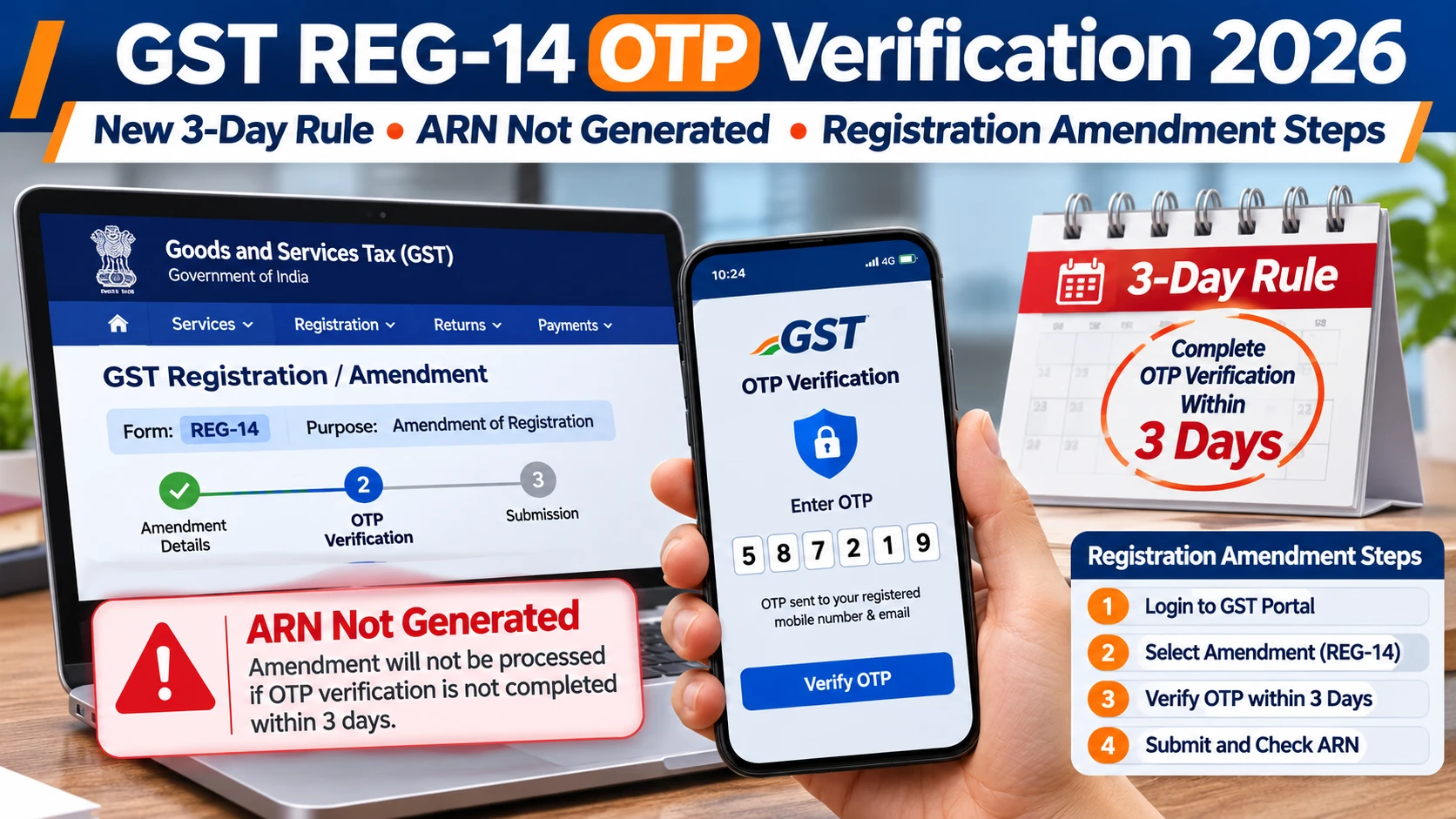
GST REG-14 OTP Verification 2026: New 3-Day Rule, ARN Not Generated and Registration Amendment Steps


7. Employment and Manufacturing Opportunities
The government expects the programme to encourage investment and support employment opportunities.
New factories may create demand for engineers, technicians, welders, quality-control professionals and industrial workers.
Supporting supply chains may also benefit from additional business activity.
However, any specific job-creation number should be treated carefully unless supported by an official estimate.
The number of jobs ultimately created will depend on actual investment, factory construction, production volumes and the technologies employed.
The announcement establishes the government’s objectives, not completed employment outcomes.
Why Is the Scheme Important for India’s Economy?
Manufacturing competitiveness and supply-chain resilience are closely connected to trade.
When companies can produce industrial products domestically at competitive quality and cost, they may become less dependent on imported equipment.
The container programme seeks to strengthen India’s ability to participate in global logistics supply chains.
It could also encourage exports of containers if domestic manufacturers become competitive internationally.
However, export success is not guaranteed.
Indian manufacturers will have to compete on quality, pricing, delivery performance and international certification requirements.
Which Businesses Could Benefit?
The programme is particularly relevant to eligible container manufacturers and the industries supporting them.
Potential supporting sectors include engineering, steel processing, industrial equipment, logistics services and testing.
These are possible indirect beneficiaries, not companies that have automatically received government assistance.
Investors should avoid assuming that every listed infrastructure or logistics company will benefit financially.
The actual impact on an individual company would depend on whether it participates in eligible projects, supplies qualifying manufacturers or obtains relevant commercial contracts.
Is the ₹10,000 Crore Scheme Already Implemented?
The Cabinet has approved the scheme.
That is different from saying that all eligible projects have been selected, every facility has been built or all incentives have been disbursed.
The programme is planned to operate through FY 2039–40, with the official schedule distinguishing the facility-development phase from the production-support period.
Read Also: SEBI–Bank of England MoU 2026: 5 Key Facts About Clearing Corporations and Market Safety
Detailed implementation requirements, project approvals and disbursement procedures must be followed.
Manufacturers should consult the applicable government guidelines rather than treating the headline allocation as automatic eligibility.
Frequently Asked Questions
1. What is the Container Manufacturing Promotion Scheme?
It is a Union Cabinet-approved programme intended to expand India’s domestic shipping-container manufacturing industry.
2. What is the total financial allocation?
₹10,000 crore.
3. When was the scheme approved?
October 28, 2026.
4. What is India’s proposed annual capacity target?
Approximately 7.5 lakh TEUs.
5. What interest assistance is available?
Eligible projects may receive a 3% annual interest subvention on qualifying term loans, subject to conditions.
6. Is every container manufacturer automatically eligible?
No. Eligibility depends on the scheme’s requirements, including project specifications and other conditions.
7. Does the scheme guarantee immediate jobs?
No. Employment creation is an objective and potential outcome, not an already verified result.
Conclusion
The ₹10,000 crore Container Manufacturing Promotion Scheme represents a significant government effort to strengthen India’s industrial and logistics capabilities.
Its combination of financing support, production assistance, testing infrastructure and local-content requirements aims to encourage investment in domestic shipping-container manufacturing.
The proposed expansion from approximately 70,000 TEUs to 7.5 lakh TEUs annually is ambitious.
The key measure of success will be whether manufacturers establish capacity, produce internationally competitive containers and develop sustainable supply chains over the coming years.
Sources
- Ministry of Ports, Shipping and Waterways — Cabinet approval, 28 October 2026.
- Press Information Bureau — Container Manufacturing Promotion Scheme explainer, 28 October 2026.
- Ministry of Ports, Shipping and Waterways — Additional official scheme announcement, 28 October 2026.
Disclaimer: EduTaxTuber provides content for general educational and informational purposes only. While we make reasonable efforts to keep the information accurate and updated, laws, regulations, market conditions, software features, and other information may change. Some content may be created or assisted by AI tools and may contain errors or omissions. Readers should verify important information with official sources or qualified professionals before making any tax, legal, financial, investment, business, or other decisions. EduTaxTuber does not guarantee the completeness or accuracy of the information and does not provide professional advice.