








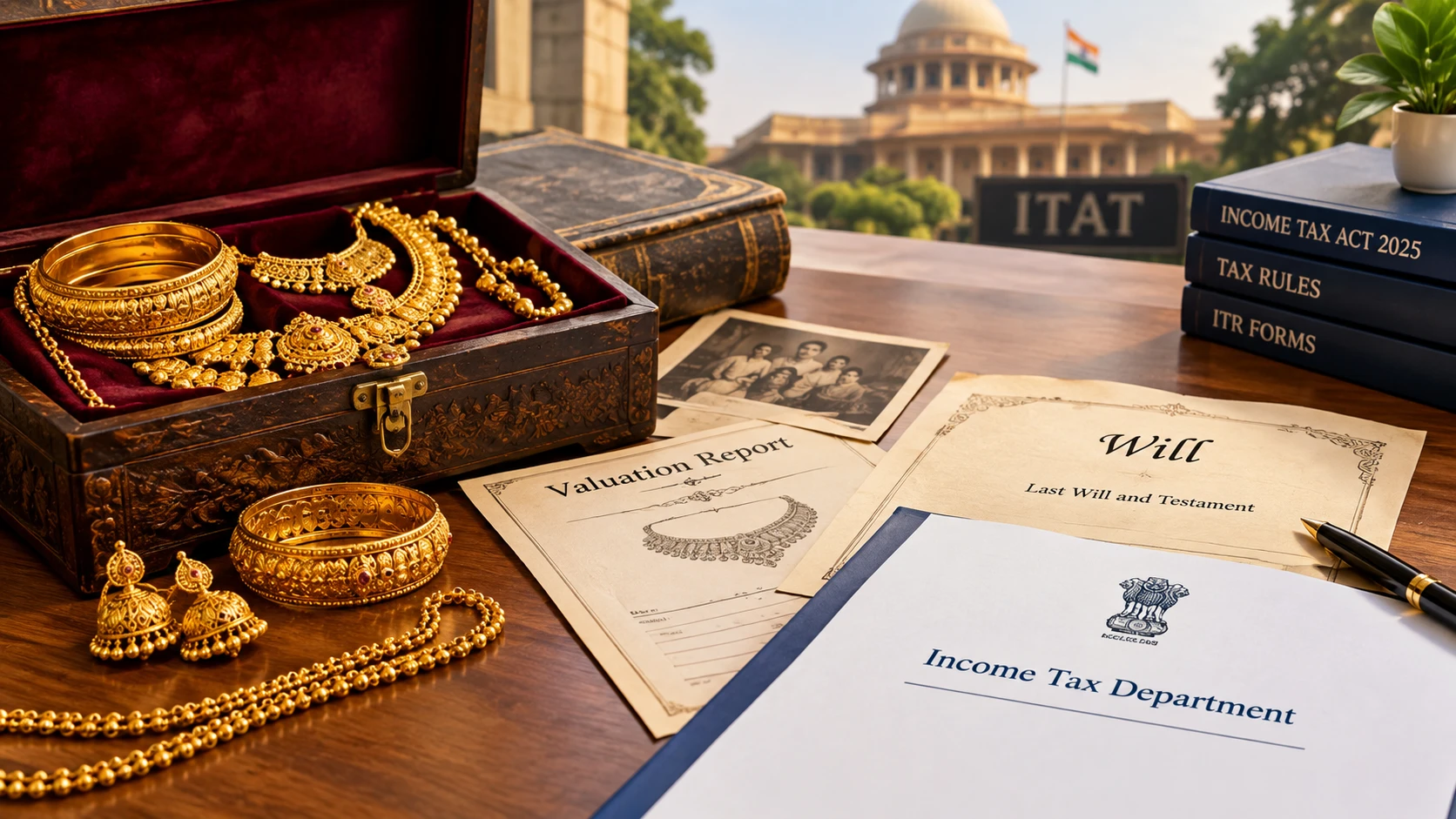
Inherited Family Gold? How to Prove Ownership and Source of Jewellery to Income Tax Department
Summary
- Inherited gold jewellery is not automatically treated as unexplained income merely because it is found in the possession or control of a taxpayer.
- A recent Kolkata ITAT case involving jewellery worth ₹1.56 crore highlights the importance of old valuation reports, family records and other evidence establishing ownership.
- Purchase bills are useful but not the only evidence that can establish the history of inherited jewellery.
- Wills, succession documents, affidavits, photographs, insurance records, locker details and old valuation reports can help establish a credible chain of ownership.
- The commonly quoted 500 grams for a married woman, 250 grams for an unmarried woman and 100 grams for a male member are not statutory limits on how much gold a person can own.
Inherited Family Gold? Why Ownership and Source Matter
Gold jewellery is often passed from one generation to another in Indian families. In many cases, the jewellery may have been purchased decades ago by parents or grandparents, and the original purchase bills may no longer exist.
This can create a problem when the Income Tax Department asks a taxpayer to explain the ownership, acquisition and source of jewellery.
A recent ruling by the Kolkata Income Tax Appellate Tribunal (ITAT) involving jewellery valued at around ₹1.56 crore brings this issue into focus. The case shows that where a taxpayer claims jewellery was inherited or belonged to other family members, the explanation needs to be supported by credible and consistent evidence.
The important lesson for families is simple: do not wait until a tax notice or search to start documenting the history of family jewellery.
What Did the Kolkata ITAT Say About Inherited Jewellery?
The case involved 3,233.11 grams of jewellery connected with family bank lockers. The Revenue had challenged the deletion of an addition of approximately ₹1.56 crore, while the taxpayer maintained that the jewellery belonged to deceased family members and the family HUF rather than being his unexplained personal wealth.
The Kolkata ITAT considered the evidence relating to the jewellery’s ownership and family history. Reports relating to the valuation of the jewellery, including older valuation records, and an affidavit from the taxpayer’s mother were among the evidence considered in support of the explanation. The Tribunal ultimately upheld the deletion of the ₹1.56 crore addition.
The ruling is particularly relevant for families holding ancestral or inherited gold, because it demonstrates why documentary evidence can become important when the original purchase invoice is unavailable.
Read Also: CBDT Circular No. 7/2026: Tax Audit Deadline Extended to 21 October 2026 for AY 2026-27
More Stories

ixigo Q2 Results: Profit Reaches ₹63.42 Crore, Revenue Rises 13% as Hotels Business Expands
FPI Outflows October 2026: Foreign Investors Withdraw ₹52,100 Crore From Indian Stocks

Paras Healthcare IPO 2026: ₹1,450 Crore Issue, Price Band, Dates and Review
57th GST Council Meeting 2026: Major Reforms Proposed for Taxpayers and Businesses



Does Possession of Jewellery Prove Ownership?
Not necessarily.
The fact that jewellery is physically found in a person’s house, locker or other premises does not by itself explain when, how or from whom the jewellery was acquired.
For inherited jewellery, there can be a difference between:
- the person physically possessing the jewellery;
- the person who originally purchased it;
- the person who inherited it; and
- the person in whose name a bank locker is maintained.
This distinction can become particularly important during an income-tax search.
Under Section 524 of the Income-tax Act, 2025, where jewellery or other specified assets are found in the possession or control of a person during a search or survey, the law provides for a presumption that the asset belongs to that person in relevant proceedings. The provision therefore makes documentation of ownership and source particularly important where jewellery is held on behalf of other family members.
How Can You Prove That Jewellery Was Inherited?
There is no single document that will necessarily prove the complete history of inherited jewellery.
Instead, taxpayers can build a documentary chain of ownership using several pieces of evidence.
1. Old Jewellery Valuation Reports
Old valuation reports can be particularly useful.
For example, if a jewellery valuation report prepared years ago identifies jewellery belonging to a parent or grandparent, it can help demonstrate that the jewellery existed in the family well before the current tax proceedings.
In the Kolkata ITAT case, older valuation reports were among the evidence supporting the ancestral ownership explanation.
Taxpayers should therefore avoid destroying old valuation reports simply because they appear outdated.
2. Will or Testamentary Documents
A will can provide direct evidence regarding the transfer of jewellery from one family member to another.
If a parent or grandparent specifically mentions jewellery in a will, the document can help establish:
- who owned the jewellery;
- who was intended to receive it;
- the nature of the inheritance; and
- the transfer of ownership after the person’s death.
Families should preserve the original will and relevant supporting documents wherever applicable.
3. Succession and Legal-Heir Documents
Where jewellery is inherited after the death of a family member, documents establishing succession can also help.
Depending on the circumstances, relevant records may include:
- death certificate;
- succession-related documents;
- probate or other court documents, where applicable;
- family settlement documents;
- legal-heir documentation; and
- correspondence or records relating to distribution of family assets.
The objective is to establish a logical connection between the previous owner and the person currently claiming ownership.
4. Family Photographs
Old photographs can sometimes provide useful supporting evidence.
For example, photographs showing a mother, grandmother or other family member wearing particular jewellery can help establish that the jewellery was in the family’s possession in an earlier period.
A photograph by itself may not establish complete ownership or source, but when combined with valuation reports, family records and inheritance documents, it can strengthen the overall explanation.
5. Affidavits From Family Members
An affidavit or sworn statement from a family member may also provide supporting evidence regarding the history of jewellery.
For example, a family member may explain:
- who originally owned the jewellery;
- how it was passed down;
- when it came into the possession of another family member; and
- where it was kept.
However, taxpayers should not rely solely on an affidavit where other documentary evidence is reasonably available.
The stronger approach is to maintain multiple independent pieces of evidence that tell the same story.
6. Bank Locker Records
Locker documentation can become important when inherited jewellery is kept in a bank locker.
Families should retain records showing:
- name of the locker holder;
- joint locker holders, if any;
- locker operation history;
- relevant correspondence with the bank; and
- records identifying which family members had access to or control over the locker.
This is especially relevant because Section 524 focuses on possession or control of specified assets during a search.
Can a Current Jewellery Valuation Report Prove Ownership?
A current valuation report is useful, but it has limitations.
Suppose a family gets jewellery valued at ₹20 lakh in 2026. The report can establish details such as the jewellery’s:
- weight;
- description;
- composition;
- approximate market value; and
- physical identification.
However, the valuation report by itself may not establish when the jewellery was acquired or who originally purchased it.
Therefore, a better approach is to combine the current valuation report with historical evidence.
A good jewellery record can contain:
- Photographs of each jewellery item
- Detailed description
- Gross and net weight
- Gold purity
- Valuation report
- Purchase invoice, if available
- Previous valuation reports
- Inheritance documents
- Will or family settlement documents
- Insurance records
- Relevant locker details
This creates a much clearer record of the family’s jewellery holdings.
What If the Original Gold Purchase Bill Is Missing?
This is one of the most common concerns with inherited jewellery.
Jewellery purchased 20, 30 or even 40 years ago may not have an easily traceable invoice. In some families, the jewellery may have been purchased by grandparents or great-grandparents.
The absence of an old purchase bill does not automatically mean that the jewellery becomes unexplained.
The taxpayer can instead present other credible evidence establishing the history of the jewellery.
For example:
Grandfather purchased the jewellery → jewellery remained with grandfather → it was inherited by the grandmother/father → family records or valuation reports documented it → jewellery was subsequently passed to the present owner.
The more consistently this chain can be supported through contemporaneous records, the easier it may be to explain the asset if questions arise.
The Kolkata ITAT case illustrates the relevance of such supporting evidence where the taxpayer’s claim was that the jewellery belonged to deceased family members.
How to Explain the Source of Inherited Jewellery to the Income Tax Department
Ownership and source are related but separate questions.
A taxpayer may need to explain not only whose jewellery it is, but also how the family originally acquired it.
Possible explanations can include:
- inheritance from parents or grandparents;
- jewellery purchased from disclosed income;
- family savings accumulated over several years;
- jewellery received through family settlement;
- gifts received on marriage or other occasions; or
- assets inherited through succession.
The explanation should be consistent with the taxpayer’s financial and family circumstances and, wherever possible, supported by documentary evidence.
Is There a Limit on How Much Gold Jewellery You Can Own?
A common misconception is that an individual is legally allowed to own only 500 grams, 250 grams or 100 grams of gold jewellery, depending on gender and marital status.
That is not what the commonly cited CBDT guidelines mean.
CBDT Instruction No. 1916 provides guidelines concerning the seizure of jewellery during an income-tax search. The commonly cited quantities are:
- 500 grams for a married woman;
- 250 grams for an unmarried woman; and
- 100 grams for a male member of the family.
The figures should not be treated as statutory ownership limits. Recent tax reporting and judicial discussions have also clarified that these quantities are relevant to search and seizure circumstances rather than creating a general legal ceiling on gold ownership.
Therefore, simply saying that a person owns more than 500 grams or 1 kg of jewellery does not, by itself, establish that the jewellery represents unexplained income.
The source, ownership, circumstances and supporting evidence remain important.
Why Jewellery Kept in a Family Locker Needs Extra Documentation
A family may keep jewellery belonging to several members in one locker.
For example:
- Mother’s jewellery;
- father’s jewellery;
- grandmother’s inherited jewellery;
- wife’s jewellery; and
- jewellery belonging to another family member.
The locker may nevertheless be registered in only one person’s name.
This can create an evidentiary issue if the locker is searched.
Under Section 524 of the Income-tax Act, 2025, jewellery found in the possession or control of a person during a search may be presumed to belong to that person for proceedings under the Act.
That does not mean every piece of jewellery found in a family locker automatically becomes taxable in the hands of the locker holder. Rather, it highlights why the actual ownership should be capable of being demonstrated through evidence.
What Records Should Families Maintain for Gold and Jewellery?
A simple family jewellery register can help avoid future confusion.
For every significant jewellery item, families can maintain:
| Record | What to keep |
|---|---|
| Photograph | Clear photograph of the jewellery |
| Description | Necklace, bangles, ring, chain, etc. |
| Weight | Gross/net weight where available |
| Purity | Gold purity, if known |
| Valuation | Current valuation report |
| Purchase record | Original invoice, if available |
| Historical record | Old valuation or family records |
| Ownership | Name of the family member |
| Inheritance | Will/succession/family settlement documents |
| Insurance | Policy and valuation records |
| Locker | Locker and access-related records |
For older jewellery where purchase bills are unavailable, the family should focus on preserving historical evidence of possession, ownership and inheritance.
What Documents Can Help Prove Inherited Jewellery?
Here is a practical checklist for taxpayers:
Ownership documents
- Old purchase bills
- Old valuation reports
- Insurance documents
- Jewellery inventories
- Family settlement agreements
- Wills
- Succession documents
- Affidavits
- Family photographs
- Locker records
Source-related documents
- Income-tax returns of relevant family members, where available
- Records showing disclosed income
- Bank records, where relevant
- Estate or inheritance records
- Gift documentation, where applicable
- Other documents establishing how the family acquired the jewellery
Not every taxpayer will have every document. The important point is to maintain credible and consistent evidence appropriate to the history of the jewellery.
What Should You Do If You Have Old Inherited Gold Without Bills?
If your family owns old inherited jewellery and the original invoices are unavailable, consider creating a proper record now rather than waiting for a future tax query.
Step 1: Photograph the jewellery
Take clear photographs of each significant item.
Step 2: Prepare an inventory
Record the description, weight and identifying characteristics.
Step 3: Obtain a valuation
Consider getting a valuation from a qualified or registered valuer, as appropriate.
Step 4: Identify the ownership history
Write down who originally owned the jewellery and how it was transferred through the family.
Step 5: Collect old documents
Search for old valuation reports, insurance policies, wills, photographs and other family records.
Step 6: Organise inheritance records
Keep succession, will, family settlement and other relevant documents together.
Step 7: Keep digital copies
Scan important records and maintain secure digital backups.
This can make it considerably easier to explain the jewellery’s history if questions arise in the future.
Does Inherited Jewellery Need to Be Reported in Income Tax Return?
The tax treatment and reporting requirements depend on the taxpayer’s circumstances and the applicable provisions.
Importantly, physical possession of jewellery and beneficial ownership are not necessarily the same thing.
Where jewellery belongs to another family member, taxpayers should maintain evidence supporting that position rather than assuming that physical custody automatically makes them the owner.
For reporting requirements involving assets, taxpayers should also consider the applicable ITR form, Schedule requirements and the relevant assessment year.
Disclaimer: EduTaxTuber provides content for general educational and informational purposes only. While we make reasonable efforts to keep the information accurate and updated, laws, regulations, market conditions, software features, and other information may change. Some content may be created or assisted by AI tools and may contain errors or omissions. Readers should verify important information with official sources or qualified professionals before making any tax, legal, financial, investment, business, or other decisions. EduTaxTuber does not guarantee the completeness or accuracy of the information and does not provide professional advice.