









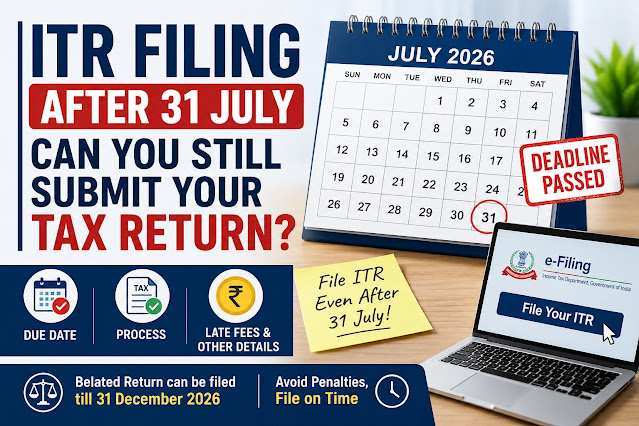
ITR Filing After 31 July 2026: Can You Still Submit Your Tax Return? Check Process, Due Date, Late Fees and Other Details

ITR Filing After 31 July 2026: Can You Still Submit Your Tax Return? Check Process, Due Date and Other Details
The deadline for filing ITRs was July 31, 2026 for most salaried taxpayers and it is officially over, with the Income Tax Department not announcing any extension. While crores of taxpayers managed to file their Income Tax Returns (ITR) before the deadline, many could not do so due to reasons such as missing documents, technical issues or personal emergencies.
If you have missed the due date, do not panic straight away. Eligible taxpayers can still file a belated Income Tax Return (ITR) under the Income-tax Act within the due date. But there are consequences of filing after the due date, including late filing fees and interest on any tax liability due.
Can You File ITR After 31 July 2026?
Yeah. Missing the original due date is not a permanent closure of the option to file your Income Tax Return.
People and Hindu Undivided Families (HUFs) who failed to file their return by the deadline of 31 July 2026 can still file a belated return.
Last Date of filing of Belated return for Assessment Year (AY) 2026-27 is:
31 Dec 2026
But filing after the deadline can incur extra costs based on your tax liability and total income.
Read Also: FD vs RD: Key Differences Explained for Smart Savers
What Is the Belated ITR Filing Due Date?
Last Date to File Belated ITR
Taxpayers who missed the original due date can file a belated income tax return till December 31, 2026.
A belated return is filed through the same Income Tax e-filing portal. The process is similar to filing a regular return except that the return is treated as a delayed filing under the Income Tax Act.
You’ll want to do this sooner rather than later and do not wait until December as any delays may incur interest if taxes are not paid.
How to File ITR After 31 July 2026
Step-by-Step Process to File Belated Return
If you missed the deadline, follow these steps:
- Visit the Income Tax e-Filing portal.
- Log in using your PAN and password.
- Select File Income Tax Return.
- Choose Assessment Year 2026-27.
- Select the appropriate ITR form.
- Enter your income details carefully.
- Verify tax calculations.
- Pay any outstanding self-assessment tax if applicable.
- Submit the return as a Belated Return.
- Complete e-verification to successfully file your ITR.
The filing process remains straightforward, but taxpayers should ensure all details are accurate to avoid future notices.
Late Filing Fee for ITR After 31 July
How Much Penalty Will You Pay?
If your total income exceeds ₹5 lakh, the late filing fee can be up to ₹5,000.
If your total income is ₹5 lakh or below, the maximum late filing fee is ₹1,000.
The exact fee depends on the provisions applicable while processing your return.
Interest on Outstanding Tax After Missing ITR Due Date
Additional Interest Under Section 234A
If you have unpaid income tax, filing late may also attract interest under Section 234A.
Interest is generally calculated at 1% per month or part of a month on the unpaid tax amount from the applicable due date until the tax is paid, subject to the provisions of the Income-tax Act.
Therefore, taxpayers with tax dues should file and pay taxes as early as possible to reduce additional interest.
Read Also: ITR Filing 2026: How to E-Verify Your Return? 5 Key Points
What Happens If You Miss the Belated Return Deadline?
Can You Still File an Updated Return?
Yes.
If you fail to submit even the belated return by 31 December 2026, you may still have an option to file an Updated Return (ITR-U) under the applicable provisions.
An updated return can generally be filed within the permitted period from the end of the relevant assessment year, subject to prescribed conditions and payment of additional tax. However, this facility cannot be used in every situation, and certain restrictions apply.
Taxpayers should carefully review their eligibility before choosing this option.
ITR Filing Due Dates for Businesses and Professionals
Not every taxpayer was required to file the return by 31 July 2026.
Businesses and professionals have different due dates depending on their category.
Business and Professional ITR Due Dates
Non-audit cases
The due date for filing Income Tax Return is:
31 August 2026
Tax Audit Cases
Businesses and professionals whose accounts require audit have time until:
31 October 2026
These revised timelines provide additional time to complete financial statements and statutory compliance before filing the return.
If these taxpayers also miss their respective deadlines, they can generally file a belated return up to 31 December 2026, subject to applicable provisions.
Other Consequences of Filing ITR After the Due Date
Filing a belated return may have consequences beyond late fees.
Loss of Carry Forward Benefits
One major disadvantage is that certain losses generally cannot be carried forward when the return is filed after the original due date, subject to the provisions of the Income-tax Act.
These may include:
- Capital losses on shares
- Mutual fund losses
- Property-related capital losses
- Business losses
Losing the ability to carry forward eligible losses could increase tax liability in future years.
Will You Still Receive Income Tax Refund?
Yes.
If excess tax has been deducted or paid, eligible taxpayers can still receive an Income Tax Refund even after filing a belated return.
However, filing within the original due date generally helps the Income Tax Department process refunds earlier.
Therefore, taxpayers expecting a refund should avoid unnecessary delays in filing.
Read Also:
- Income-tax returns: New Form 121 replaces 15G, 15H — Eligibility, download link
- How Much Cash You Can Deposit to Prepay Home Loan Without I-T Notice
- Gift tax rules: When cash, jewellery, wedding gifts & property turn taxable
- Zero Income Tax Nations: A Global Guide to Tax-Free Living
Should You File Your ITR Immediately After Missing the Deadline?
Absolutely.
Even though the original deadline has passed, delaying the filing further may increase interest liability and postpone refund processing.
If you have missed 31 July 2026, it is advisable to file your belated Income Tax Return well before 31 December 2026 to avoid last-minute issues and additional compliance concerns.
Frequently Asked Questions (FAQs)
Can I file ITR after 31 July 2026?
Yes. Eligible taxpayers can file a belated Income Tax Return until 31 December 2026.
What is the penalty for late ITR filing?
The late filing fee can be up to ₹5,000 if total income exceeds ₹5 lakh. For income up to ₹5 lakh, the maximum fee is ₹1,000.
Can I get an income tax refund after filing a belated return?
Yes. Eligible taxpayers can still receive a refund, although processing may take longer.
Can I file ITR after 31 December 2026?
If eligible, taxpayers may be able to file an Updated Return (ITR-U) within the prescribed period and subject to applicable conditions.
Conclusion
Missing the 31 July ITR filing deadline does not mean you lose the opportunity to comply with tax laws. The Income Tax Department allows eligible taxpayers to file a belated return until 31 December 2026, although late filing fees, interest, and certain compliance consequences may apply.
If you have not yet filed your return, it is advisable to complete the process as soon as possible rather than waiting until the last moment. Early filing can help reduce additional costs, speed up refund processing, and ensure better compliance with the Income-tax Act.
Disclaimer: This article is intended for informational and educational purposes only. Tax laws are subject to amendments and official notifications. Readers should verify the latest provisions on the Income Tax Department’s e-Filing portal or consult a qualified tax professional before making any tax-related decisions.
AI Transparency: Portions of this article were generated with the assistance of Artificial Intelligence (AI) and have been reviewed and edited by the EduTaxTuber editorial team to improve accuracy, readability, and usefulness for readers.