







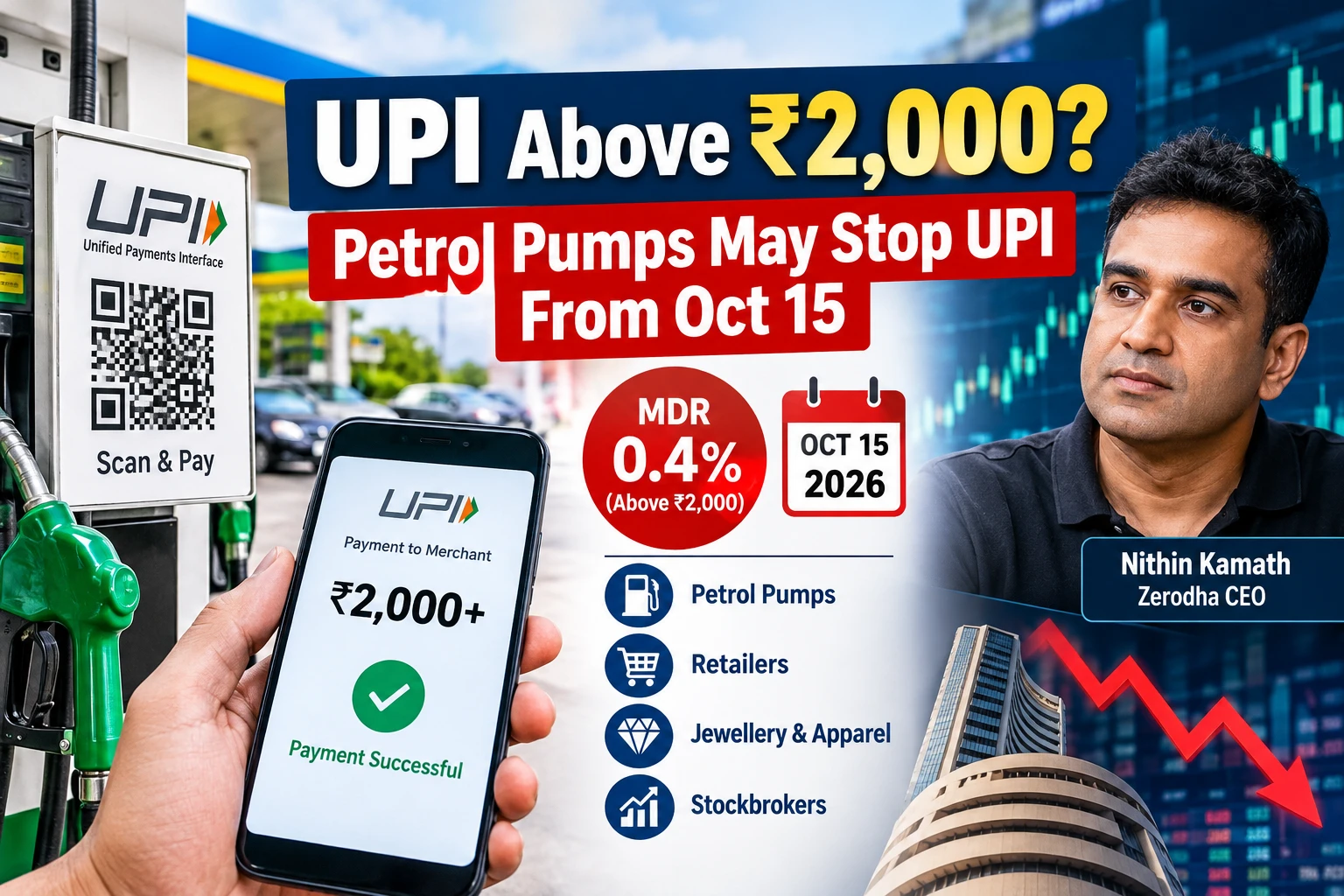
UPI Payments Above ₹2,000: Will Petrol Pumps Stop Accepting UPI From October 15?
Summary
- Mumbai petrol pumps may stop accepting UPI payments above ₹2,000 from October 15, 2026, if fuel retailers do not receive an exemption from the revised MDR framework.
- The revised UPI framework introduces a 0.4% Merchant Discount Rate (MDR) on specified person-to-merchant transactions above ₹2,000, with a maximum MDR of ₹300 for transactions above ₹75,000.
- Fuel and certain essential/thin-margin categories have a different treatment, with reports indicating a flat ₹5 charge above ₹2,000 rather than the standard 0.4% MDR.
- Zerodha CEO Nithin Kamath has warned that the new UPI MDR framework could affect the economics of stockbroking, because brokers may incur payment costs even when customers transfer money without actually trading.
UPI MDR Charges Above ₹2,000: What Is Changing From October 15?
India’s UPI payment system is heading for an important change from October 15, 2026, with a revised Merchant Discount Rate framework for selected high-value merchant transactions.
Under the new framework, a 0.4% MDR will apply to eligible person-to-merchant (P2M) UPI transactions above ₹2,000. The MDR is a merchant-side charge rather than a direct fee imposed on the customer. For larger transactions, the charge is capped at ₹300.
The change has already triggered objections from retailers, fuel dealers, distributors and other industry groups.
One of the most visible concerns has come from petrol pump dealers in Mumbai, who have warned that they could stop accepting UPI payments above ₹2,000 from October 15 if the government does not provide an exemption for fuel retailers.
For consumers, however, this does not mean that every UPI payment will suddenly become chargeable.
That distinction is important.
Will Petrol Pumps Stop Accepting UPI Payments Above ₹2,000?
The answer, as of September 19, is not necessarily across all petrol pumps.
Petrol pump operators in Mumbai have threatened to withdraw UPI acceptance for payments above ₹2,000 from October 15 if their concerns over the revised MDR are not resolved. The Petrol Dealers Association of Mumbai has reportedly approached the RBI and Finance Ministry seeking a waiver.



According to the reported framework, fuel is being treated differently from the standard merchant category. Instead of the regular 0.4% MDR, fuel transactions above ₹2,000 are reported to attract a flat ₹5 charge.
This means the issue for petrol pump dealers is not simply whether customers will be charged.
The concern is whether fuel retailers will have to absorb additional payment-processing costs while operating with relatively tight margins.
Mumbai dealers have also highlighted their high dependence on digital payments, with reports saying that more than 60% of fuel sales at their outlets are conducted digitally.
What could happen at petrol pumps?
If the dispute is not resolved before October 15, customers could potentially encounter different payment practices at some outlets.
For example:
- UPI may continue for payments below ₹2,000.
- Customers may be asked to pay cash for larger fuel purchases.
- Some outlets could continue accepting UPI if the MDR issue is resolved.
- Payment practices could vary depending on the final regulatory implementation and merchant decisions.
Therefore, the headline “UPI will stop at petrol pumps” would be too broad. The current issue concerns high-value UPI payments and the response of certain fuel retailers, particularly the Mumbai dealers who have issued the warning.
What Is UPI MDR and Why Are Merchants Opposing It?
MDR stands for Merchant Discount Rate.
It is a fee associated with processing certain merchant payment transactions. Under the revised framework, eligible high-value P2M UPI transactions will attract an MDR from October 15.
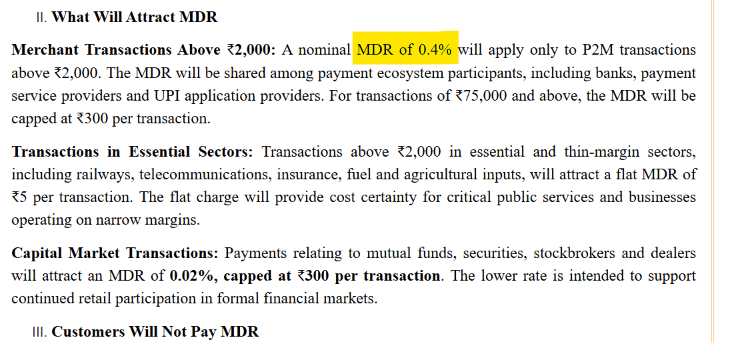
For the standard category, the reported rate is 0.4% for transactions above ₹2,000, subject to a maximum charge of ₹300.
For example, if a qualifying merchant receives a ₹10,000 UPI payment, a 0.4% MDR would amount to ₹40.
For a ₹50,000 transaction, it would be ₹200.
Once the transaction value reaches the level where the cap applies, the maximum MDR would be ₹300.
Importantly, the MDR is intended to be borne by the merchant and not directly passed on to the customer. Recent reporting says banks and UPI providers have been directed not to transfer the MDR burden to consumers.
This is where the concerns of businesses come into the picture.
A merchant with a thin profit margin may look at every transaction cost differently from a customer who simply wants to make a convenient digital payment.
More Stories

ixigo Q2 Results: Profit Reaches ₹63.42 Crore, Revenue Rises 13% as Hotels Business Expands
FPI Outflows October 2026: Foreign Investors Withdraw ₹52,100 Crore From Indian Stocks

Paras Healthcare IPO 2026: ₹1,450 Crore Issue, Price Band, Dates and Review
57th GST Council Meeting 2026: Major Reforms Proposed for Taxpayers and Businesses


Why Retailers Fear Customers Could Move Back to Cash
The Retailers Association of India has raised concerns that the new MDR could encourage merchants to prefer cash for higher-value transactions.
The concern becomes particularly relevant during the festive season, when many purchases naturally exceed ₹2,000.
Retailers dealing in categories such as:
- Jewellery
- Apparel
- Consumer electronics
- Premium retail
- Travel
- Insurance
- Fuel
- Other high-value purchases
could see a greater proportion of transactions crossing the ₹2,000 threshold.
The broader argument from industry bodies is that if merchants have to absorb an additional payment cost, some may reconsider their preferred payment method.
The All India Consumer Products Distributors Federation has also sought continuation of zero-MDR UPI payments, arguing that the cost of maintaining the digital payment infrastructure should not fall entirely on merchants.
The debate therefore goes beyond petrol pumps.
It concerns who should ultimately bear the cost of maintaining India’s large-scale digital payment infrastructure.
Ghaziabad Traders Also Protest New UPI Charges
The opposition to the revised MDR framework is not limited to Mumbai.
Reports have indicated that some merchants in Ghaziabad have displayed notices saying that UPI payments will not be accepted, as a form of protest against the new charges.
Such developments show why the issue could become more visible as October 15 approaches.
However, consumers should distinguish between merchant protests or individual business decisions and a nationwide rule requiring shops to stop accepting UPI.
There is currently no basis to say that UPI acceptance will automatically stop at every shop or petrol pump above ₹2,000.
The framework specifies charges for eligible merchant transactions; individual merchants may respond to those costs in different ways.
Will Customers Have to Pay UPI Charges?
This is probably the biggest question for ordinary UPI users.
The revised MDR is a merchant-side charge, not a universal customer transaction fee.
Regular person-to-person UPI transfers continue to remain outside the merchant MDR framework. Similarly, the new rules do not mean that every time a consumer scans a QR code, an additional fee will automatically be deducted from the consumer’s bank account.
This is also important because EduTaxTuber had earlier covered the confusion surrounding UPI Charges 2026, when viral messages claimed that ordinary users would have to start paying for routine UPI transfers.
You can internally link that article here:
Related: UPI Charges 2026: Will You Pay for UPI Transfers, Grocery Payments? MyGovIndia Clarifies
The current development is different because it concerns a specific MDR framework for eligible merchant transactions.
What Is the UPI MDR for Stockbrokers?
The revised framework also has implications for the financial and capital-market sector.
According to recent reporting, UPI transactions involving stockbrokers, mutual funds, securities dealers and investment platforms will attract a 0.02% MDR, subject to a maximum of ₹300 per transaction.
This is significantly different from the standard 0.4% rate.
But even a relatively small percentage can become meaningful for businesses processing very large numbers of transactions.
This is where Zerodha CEO Nithin Kamath’s warning has attracted attention.
Why Nithin Kamath Is Concerned About the New UPI MDR
Nithin Kamath has warned that the revised UPI charges could create a problem for the economics of the stockbroking industry.
The issue is not necessarily limited to customers who actually buy or sell shares.
A brokerage platform may receive money from a customer through UPI, but the customer may subsequently decide not to trade.
From the broker’s perspective, a payment-processing cost could therefore arise without corresponding brokerage revenue from a transaction.
Kamath has also pointed to situations where customers transfer money back into their trading accounts after settlement-related processes, potentially creating repeated payment costs.
This becomes particularly relevant for discount brokers that offer low-cost or free equity delivery services.
If payment processing costs rise while brokerage revenue remains limited, brokers may have to reconsider how they structure payment options and account funding.
How Could UPI MDR Affect Stockbrokers and Investors?
The impact on the stockbroking ecosystem could develop through several channels.
1. Higher payment-processing costs
Brokers could face additional expenses when customers add money to their trading accounts through UPI.
2. Cost even when customers do not trade
A customer can transfer money into a trading account and later decide not to place an order.
The broker may still incur the payment-related cost.
3. Pressure on low-cost brokerage models
Discount brokers operate on relatively low fees for several services. Additional transaction costs could put pressure on the economics of such models.
4. Possible changes in payment preferences
Brokers may encourage customers to use alternative payment mechanisms where the cost structure is different.
5. Potential impact on free investment services
Kamath’s concern is particularly relevant to businesses offering low-cost equity delivery services, because payment-processing expenses can become significant when there is little or no brokerage revenue attached to the transaction.
These are potential business implications; the actual impact will depend on how the framework is implemented and how brokers respond.
UPI MDR: Which Transactions Are Affected?
The revised framework is not a blanket charge on every UPI transaction.
Broadly, the reported structure differentiates between transaction categories.
| Transaction category | Reported treatment from October 15, 2026 |
|---|---|
| Eligible P2M transactions above ₹2,000 | 0.4% MDR |
| Standard MDR maximum | ₹300 |
| Capital-market transactions | 0.02% MDR, capped at ₹300 |
| Fuel/selected essential categories | Reported flat ₹5 charge above ₹2,000 |
| P2P UPI transfers | No merchant MDR |
| Small merchants within specified exemption criteria | Zero-MDR treatment |
The exact applicability depends on the transaction category and merchant classification. The reported framework is therefore more complicated than simply saying “UPI above ₹2,000 will be charged 0.4%.”
Why the ₹2,000 Threshold Matters
The ₹2,000 threshold is important because many routine UPI purchases fall below it.
A customer paying ₹500 for groceries or ₹1,500 for a restaurant bill is in a different situation from someone making a ₹10,000 jewellery purchase or paying a ₹5,000 fuel bill.
This creates a distinction between low-value everyday UPI usage and high-value merchant payments.
The government and payment ecosystem have also indicated that most routine UPI usage will remain unaffected, while higher-value merchant transactions will be subject to the revised framework.
For consumers, the practical question is therefore not simply:
“Is UPI free?”
Instead, it is:
What type of UPI transaction am I making, what is its value and which merchant category does it fall under?
What Should UPI Users Do From October 15?
For ordinary consumers, there is no need to stop using UPI simply because the MDR framework is changing.
However, it would be useful to understand the distinction between merchant charges and customer charges.
If you are making a payment above ₹2,000:
- Check whether the merchant accepts UPI.
- Ask whether the merchant has changed its payment policy.
- Do not assume that every high-value UPI transaction carries a direct customer fee.
- Keep an alternative payment method available where necessary.
- For investment-related payments, check the payment options provided by your broker or investment platform.
Most importantly, avoid relying on viral social-media messages claiming that all UPI payments will become chargeable.
What Does This Mean for India’s Digital Payment Ecosystem?
The UPI MDR debate highlights a larger issue in India’s digital economy.
UPI has grown into a critical payment infrastructure used by consumers, retailers, banks, financial platforms and businesses.
The revised MDR framework is intended to create a mechanism for funding aspects of the UPI ecosystem, including infrastructure and related services. At the same time, merchants are concerned about the effect of additional costs on businesses operating with narrow margins.
The outcome will depend partly on how merchants respond.
If businesses continue accepting UPI and absorb the cost, consumers may see little practical change.
If more merchants shift towards cash or alternative payment methods, customers could notice changes at petrol pumps, retailers and other high-value payment points.
The coming weeks will therefore be important, particularly before the October 15, 2026 implementation date.
Disclaimer: EduTaxTuber provides content for general educational and informational purposes only. While we make reasonable efforts to keep the information accurate and updated, laws, regulations, market conditions, software features, and other information may change. Some content may be created or assisted by AI tools and may contain errors or omissions. Readers should verify important information with official sources or qualified professionals before making any tax, legal, financial, investment, business, or other decisions. EduTaxTuber does not guarantee the completeness or accuracy of the information and does not provide professional advice.