








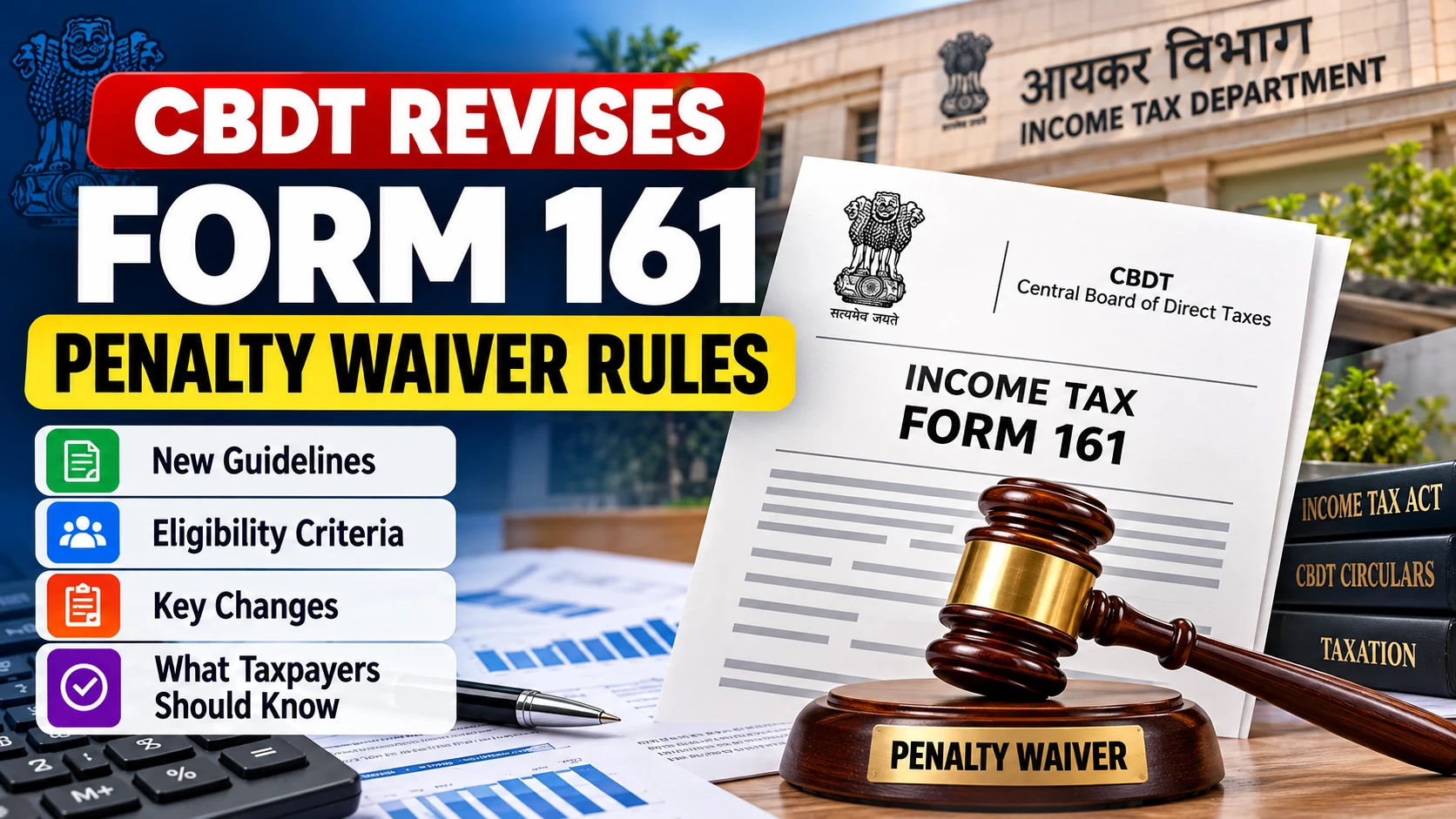
CBDT Form 161 Revised: Tax Penalty Waiver Rules 2026
Updated October 12, 2026. CBDT has substituted Form 161 for applications seeking waiver of certain income-tax penalties. The October 8 notification introduces more structured reporting of assessment details, under-reported income and payments, but does not provide automatic immunity.
Key Takeaways
- Notification 134/2026 amends Rule 231 and Form 161.
- Applications are governed by Section 440 of the Income-tax Act, 2025.
- The new form records misreporting categories, payments and appeal declarations.
- Relief depends on eligibility and compliance with the statutory conditions.
What has CBDT changed?
The Central Board of Direct Taxes notified the Income-tax (Sixth Amendment) Rules, 2026, through Notification No. 134/2026 dated October 8. The notification inserts the words “or waiver” in Rule 231 and substitutes Form No. 161, which is used to apply for penalty waiver under Section 440(2) of the Income-tax Act, 2025. It takes effect on publication in the Official Gazette. This is a change to the prescribed procedure, not a declaration that every penalty has been cancelled. Taxpayers should read the statutory provisions alongside the form.
Who may need the revised Form 161?
Taxpayers who have received a relevant assessment or reassessment order involving under-reported income may need to examine the revised application if they are considering the statutory waiver mechanism. Eligibility depends on the nature of the order, the facts, payment obligations and conditions in Section 440. The form does not replace a return of income, an appeal or a rectification application. Businesses dealing with older assessment years must also check transitional rules. Simply having a penalty notice does not establish that the waiver procedure is available in a particular case.
What personal and assessment information is required?
Part A seeks the applicant’s full name, Permanent Account Number, address and contact details. Part B asks for the tax year, the section under which the order was passed, its Document Identification Number, the date of the order, its date of service and the payment deadline in the demand notice. It also requires assessed income and the under-reported income identified by the assessment. These are not optional background details: the department must connect the request with the exact assessment and payment records. Applicants should use the official order rather than estimated figures.
How are different kinds of under-reporting treated?
The new form separates under-reporting arising from specified misreporting situations under Section 439(11)(a) to (f), situations under Section 439(11)(g), and under-reporting not arising from misreporting. This distinction affects the additional amount calculated in lieu of penalty. It is not appropriate to select a category merely because it produces a smaller payment. The assessment findings and law determine the classification. If a taxpayer disputes the findings, the implications of applying for waiver instead of pursuing an appeal require careful professional consideration.
What do the additional tax fields mean?
The form contains entries for tax payable on the relevant under-reported amounts and additional income-tax in lieu of penalty. Its calculation lines specify 100% of tax for one identified category and 120% for another, then aggregate the applicable amounts. These percentages do not apply to every taxpayer’s total income. The resulting payment must be considered with the tax and interest already shown in the assessment computation. A correct calculation requires identifying the relevant portion of income, the corresponding tax and the statutory conditions, not multiplying the entire demand by a headline percentage.
Payment and appeal requirements
Form 161 asks for the demand deadline, bank BSR code, deposit date and challan serial number. It also requires a declaration that no appeal has been filed against the specified assessment order and an undertaking concerning the period in Section 440(5). These are significant legal and financial requirements. Applicants should reconcile payments with the demand notice, verify the order details and review available appeal options before signing the form. An application does not automatically cancel a penalty or preserve every possible remedy.

Checklist before applying
Begin with the complete assessment or reassessment order and the demand notice. Check the tax year, Document Identification Number, date of service and payment deadline. Reconcile the tax and interest calculation, identify which amounts the order treats as under-reported, and check the applicable misreporting classification. Confirm payment records through the official portal. If an appeal or rectification request is already pending, obtain advice about the legal consequences before signing the declaration. Keep copies of all submitted documents and acknowledgements.
Which tax years are covered?
The substituted form is issued under the Income-tax Act, 2025 and Income-tax Rules, 2026. Earlier assessment years and transitional situations may still involve the Income-tax Act, 1961. Taxpayers should not assume that this notification changes every historical penalty demand. The relevant tax year, date of the order, governing statute and savings provisions all matter. Professional advice is especially important where a substantial demand is disputed or a deadline is close. An online article cannot determine individual eligibility.
After submitting Form 161
The assessing authority considers the request under the law rather than treating the application as a self-executing waiver. Keep the filing acknowledgement and monitor official communications. If further information is requested, submit accurate records through authorised channels. A missing response should not be treated as approval. Preserve the order, payment documents and correspondence until the matter is formally resolved. The official CBDT notification should be checked on Income Tax Department website and the Gazette of India for authoritative wording. The department’s online portal can also be used to confirm payment records and official correspondence. EduTaxTuber’s Income Tax and Notifications sections contain related explainers and updates. Readers should remember that the revised Form 161 is a prescribed application mechanism rather than a guarantee of relief. The assessing authority must consider the statutory conditions, including payments and appeal-related declarations. Before filing, applicants should compare the official form with their own order and keep documentary evidence. The difference between a waiver application and a challenge to the assessment should be discussed with a qualified adviser when the consequences are significant.
Editorial note: This article includes AI-assisted writing and is intended for general information. Check the official notification before acting. EduTaxTuber does not accept responsibility for losses arising from reliance on this article to the extent permitted by law. The Information Technology Act, 2000 does not provide automatic immunity from legal liability.