








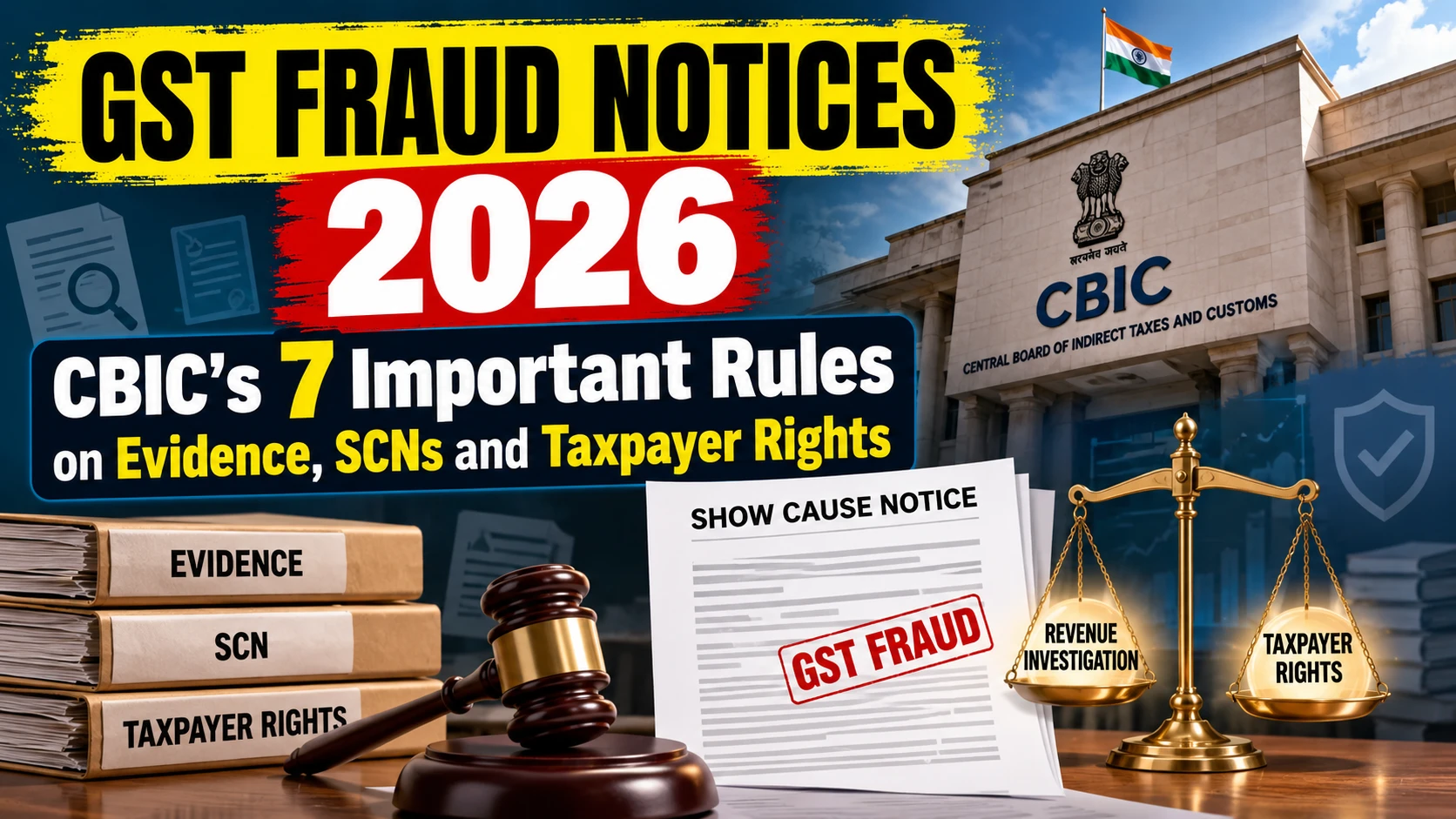
GST Fraud Notices 2026: CBIC’s 7 Important Rules on Evidence, SCNs and Taxpayer Rights
The Central Board of Indirect Taxes and Customs (CBIC) has issued fresh instructions aimed at improving the quality of GST show cause notices, tax adjudication and appeals.
Summary
- CBIC issued Circular No. 258/04/2026-GST on 26 October 2026.
- Non-payment of tax or a return mismatch alone does not establish fraud.
- Fraud-related allegations must be supported by specific facts and evidence.
- GST show cause notices should clearly explain allegations and the legal basis of demands.
- Tax, interest and penalties should be appropriately quantified, preferably financial-year-wise and issue-wise.
- Adjudicating authorities must consider taxpayers’ submissions and provide reasoned decisions.
- Personal hearing, appeal and procedural safeguards continue to apply under the GST law.
What Has CBIC Clarified About GST Fraud Notices?
A show cause notice, commonly called an SCN, is a formal communication asking a taxpayer to explain why a particular tax demand or proposed action should not be confirmed.



Such notices can arise from tax shortfalls, incorrect input tax credit claims, mismatches, refunds or other compliance concerns.
However, a mistake and a deliberate attempt to evade tax are not necessarily the same thing.
CBIC has clarified that officers should not mechanically apply provisions concerning fraud or suppression solely on the basis of unpaid tax or an apparent discrepancy.
Instead, the circumstances indicating intentional wrongdoing must be identified and supported by material evidence.
This clarification is intended to improve consistency, fairness and the quality of GST proceedings.
1. Fraud Allegations Require Supporting Evidence
One of the most important instructions concerns Section 74 and the fraud-related provisions of Section 74A of the Central Goods and Services Tax Act.
The circular states that officers should establish a factual basis before alleging fraud, wilful misstatement or suppression of facts with an intention to evade tax.
For example, a difference between GSTR-1 and GSTR-3B may require examination.
But the difference itself does not automatically prove that the taxpayer deliberately concealed information.
The officer must examine the records and circumstances before reaching a conclusion.
This does not mean that taxpayers are exempt from paying legally due tax or that every mismatch is harmless.
It means allegations involving intentional evasion require the appropriate evidentiary foundation.
2. GST Show Cause Notices Must Be Specific
The circular emphasises that a show cause notice should clearly identify the allegations made against the taxpayer.
The notice should contain relevant facts, legal provisions, supporting material and the basis used to calculate the proposed demand.
A taxpayer cannot respond effectively when the allegations are vague or the calculation is unclear.
For example, a notice merely claiming that a business wrongly claimed ₹5 lakh of input tax credit may be insufficiently informative without identifying the relevant transactions and reasons.
A properly drafted notice should enable the recipient to understand the case and prepare a meaningful reply.
The applicable legal requirements remain important, and the outcome of any challenge will depend on the facts and relevant judicial principles.
3. Tax Demands Should Be Clearly Quantified
CBIC’s procedural instructions emphasise clearer quantification of tax, interest and penalties.
Where appropriate, demands should be presented separately for different issues and financial years.
This can help taxpayers identify whether the department’s computation is correct.
Consider a company facing disputes relating to three financial years.
If the demand combines several transactions and tax periods without a meaningful breakdown, preparing an accurate response becomes difficult.
A year-wise and issue-wise calculation makes it easier to examine the evidence, identify errors and determine the relevant statutory provisions.
However, these administrative instructions should not be interpreted as automatically invalidating every consolidated demand. The applicable law and circumstances must be examined.
4. Officers Must Consider the Taxpayer’s Reply
A GST notice is not itself a final determination of liability.
The taxpayer ordinarily has an opportunity to respond in accordance with the applicable procedure.
CBIC has emphasised the importance of adjudicating authorities considering submissions, evidence and judicial decisions cited by taxpayers.
A final order should explain why particular arguments have been accepted or rejected.
Merely reproducing a notice or stating that a reply was considered, without addressing material issues, can raise questions about the adequacy of the reasoning.
This is often discussed as the requirement for a speaking order.
A reasoned order supports transparency and helps taxpayers understand the basis of a decision.
Read Also: EPFO ₹25,000 Crore Reserve Plan: Will Your PF Interest Become More Stable?
5. Personal Hearings and Natural Justice
The circular also addresses procedural safeguards during adjudication.
A taxpayer facing an adverse decision may be entitled to a personal hearing in accordance with Section 75 and other applicable provisions.
Officers should follow statutory requirements when scheduling hearings and considering requests for adjournment.
Virtual hearings may also be used where permitted and appropriate.
Businesses should not assume that receiving a notice means the demand has already been finally established.
They should preserve their records and participate in the proceedings within the prescribed timelines.
6. Avoiding Unnecessary Parallel Proceedings
Where Central and State GST authorities are involved, coordination is important to prevent overlapping proceedings on the same subject matter.
The circular discusses the need to observe the relevant statutory framework governing such proceedings.
For a business, receiving similar notices from different authorities can create confusion and compliance costs.
However, the mere involvement of two authorities does not automatically invalidate a proceeding.
The facts, subject matter, jurisdiction and legal provisions must be examined.
7. Better Adjudication and Appeals
The circular provides guidance relating to the preparation of adjudication orders and the handling of first appeals.
Appellate decisions should address material grounds raised by the parties and explain the reasoning behind the outcome.
This is important because an appeal is intended to provide meaningful review of a disputed decision.
Businesses should continue to observe statutory appeal periods and other procedural requirements.
They should not assume that a request for rectification automatically extends the deadline for filing an appeal.
Section 74 vs Section 74A: Why the Difference Matters
The CGST Act contains different mechanisms for determining tax that has not been paid, has been short-paid or has otherwise been dealt with incorrectly.
Section 74 concerns specified earlier periods involving fraud, wilful misstatement or suppression with intent to evade tax.
Section 74A governs determination of tax for FY 2024–25 onwards, with different consequences depending on whether fraud-related circumstances are established.
The circular’s central message is that officers must examine whether the facts justify invoking the fraud-related provisions.
A simple compliance error should not automatically be described as intentional evasion.
Nevertheless, the applicable tax, interest and penalties depend on the underlying provisions and the findings in each case.
More Stories

XLOOKUP in Excel: 3 Powerful Tricks for Multiple Columns (Hindi)
ChatGPT in Excel: 5 Powerful AI Tricks to Save Time (Hindi Tutorial)
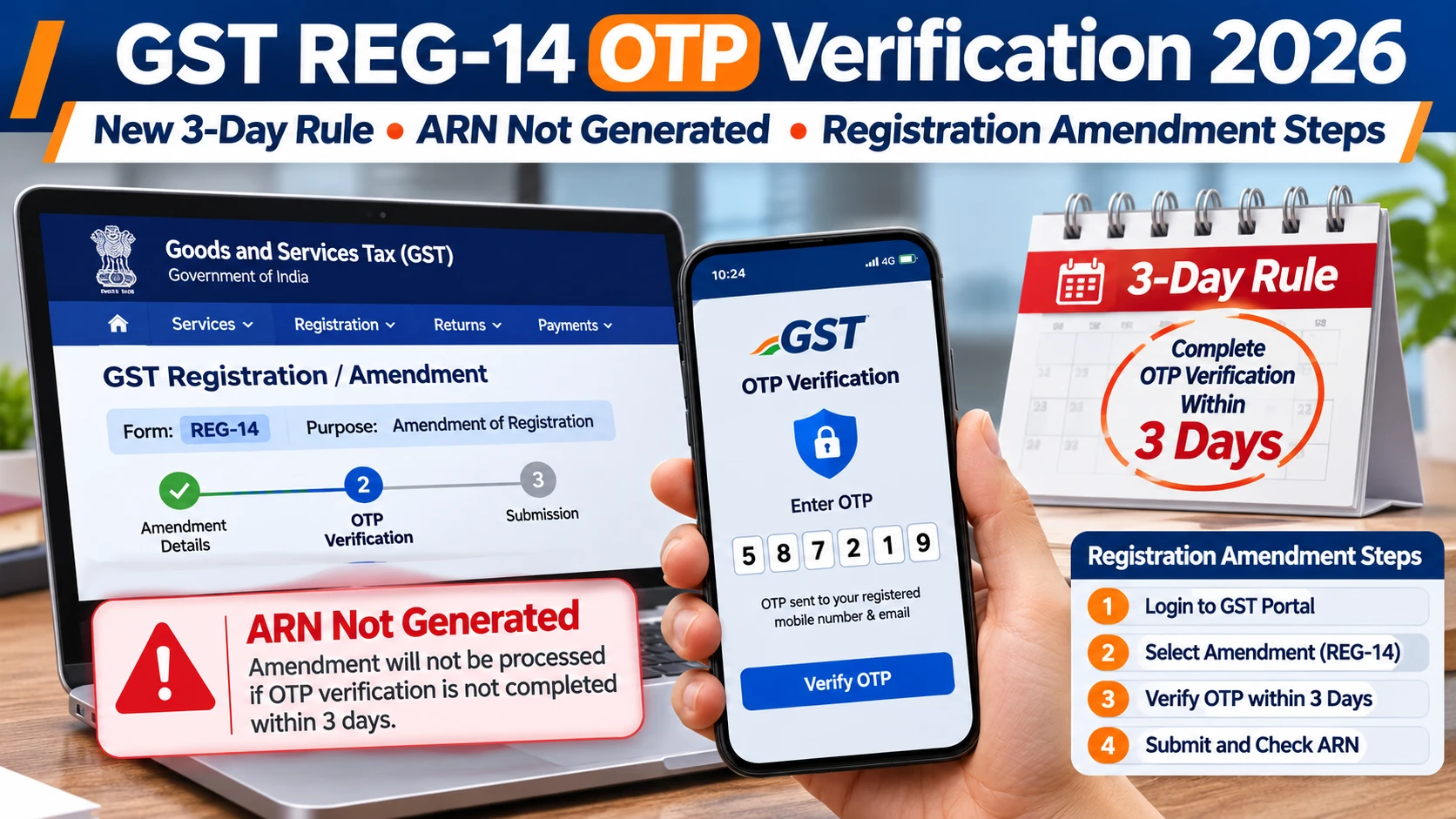
GST REG-14 OTP Verification 2026: New 3-Day Rule, ARN Not Generated and Registration Amendment Steps
SEBI NRI KYC Rules 2026: Open Investment Accounts From Abroad Without Visiting India — 7 Major Changes

Example: GST Return Mismatch
Suppose a business reports ₹12 lakh of outward GST liability in one return but deposits ₹11.5 lakh through another return.
The difference is ₹50,000.
This discrepancy warrants reconciliation and may result in a legitimate demand if tax remains unpaid.
However, the mismatch does not necessarily establish that the business deliberately attempted to evade tax.
The business might have made a reporting error, or the difference could arise from other facts requiring investigation.
Equally, the department may discover evidence that changes the conclusion.
The relevant point is that the nature of the violation should be determined through a proper examination rather than assumption.
What Should Taxpayers Do After Receiving a GST Notice?
Businesses should read the notice carefully and identify the relevant tax periods, transactions and provisions.
Read Also: GST Changes From November 1, 2026: Government Notifies New Discount and Refund Rules
They should reconcile the notice with accounting records, returns, invoices and payment information.
If fraud or suppression is alleged, the taxpayer should examine the specific facts and evidence relied upon by the department.
A response should address each material allegation, attach supporting records and be submitted within the applicable deadline.
Where a substantial demand or complex legal issue is involved, professional assistance from a qualified GST practitioner may be appropriate.
Taxpayers should also preserve hearing records, acknowledgements and copies of orders.
Are Existing GST Notices Automatically Cancelled?
No.
The circular does not announce cancellation of all pending notices or grant a blanket amnesty for tax defaults.
It provides procedural directions that must be read together with the applicable law.
Whether a particular notice or demand is legally sustainable depends on its facts, statutory provisions, evidence and judicial interpretation.
Businesses should therefore avoid ignoring notices simply because the CBIC has issued these clarifications.
Frequently Asked Questions
1. What is CBIC Circular No. 258/04/2026-GST?
It is a circular dated 26 October 2026 providing guidelines on GST show cause notices, adjudication and first appeals.
2. Can unpaid GST automatically be treated as fraud?
No. Fraud-related allegations require the relevant statutory conditions and supporting evidence.
3. Does the circular waive outstanding GST?
No. Legally payable tax remains payable.
4. What is a speaking order?
It is an order that explains the decision and addresses the material issues and arguments.
5. Can taxpayers challenge an unsupported fraud allegation?
They may contest allegations through the prescribed reply, adjudication and appeal procedures, subject to applicable law and deadlines.
6. Does this circular introduce a new GST rate?
No. It primarily addresses procedural standards rather than changing GST rates.
Conclusion
CBIC’s latest circular is an important development for GST taxpayers and professionals because it reinforces the distinction between genuine compliance errors and deliberate tax evasion.
The instructions emphasise properly supported allegations, clear notices, meaningful hearings and reasoned decisions.
For taxpayers, the immediate priority remains accurate record-keeping and timely responses to official proceedings.
The circular provides procedural guidance, not automatic cancellation of tax demands or immunity from lawful enforcement.
Sources
- CBIC Circular No. 258/04/2026-GST, dated 26 October 2026.
- The Economic Times, 27 October 2026 — GST officers must prove intent to evade tax.
- Financial Express, 28 October 2026 — Evidence required for GST fraud allegations.
- The Indian Express, 28 October 2026 — CBIC issues eight GST reform circulars.
- Official CBIC portal: https://taxinformation.cbic.gov.in/
Disclaimer: EduTaxTuber provides content for general educational and informational purposes only. While we make reasonable efforts to keep the information accurate and updated, laws, regulations, market conditions, software features, and other information may change. Some content may be created or assisted by AI tools and may contain errors or omissions. Readers should verify important information with official sources or qualified professionals before making any tax, legal, financial, investment, business, or other decisions. EduTaxTuber does not guarantee the completeness or accuracy of the information and does not provide professional advice.


