








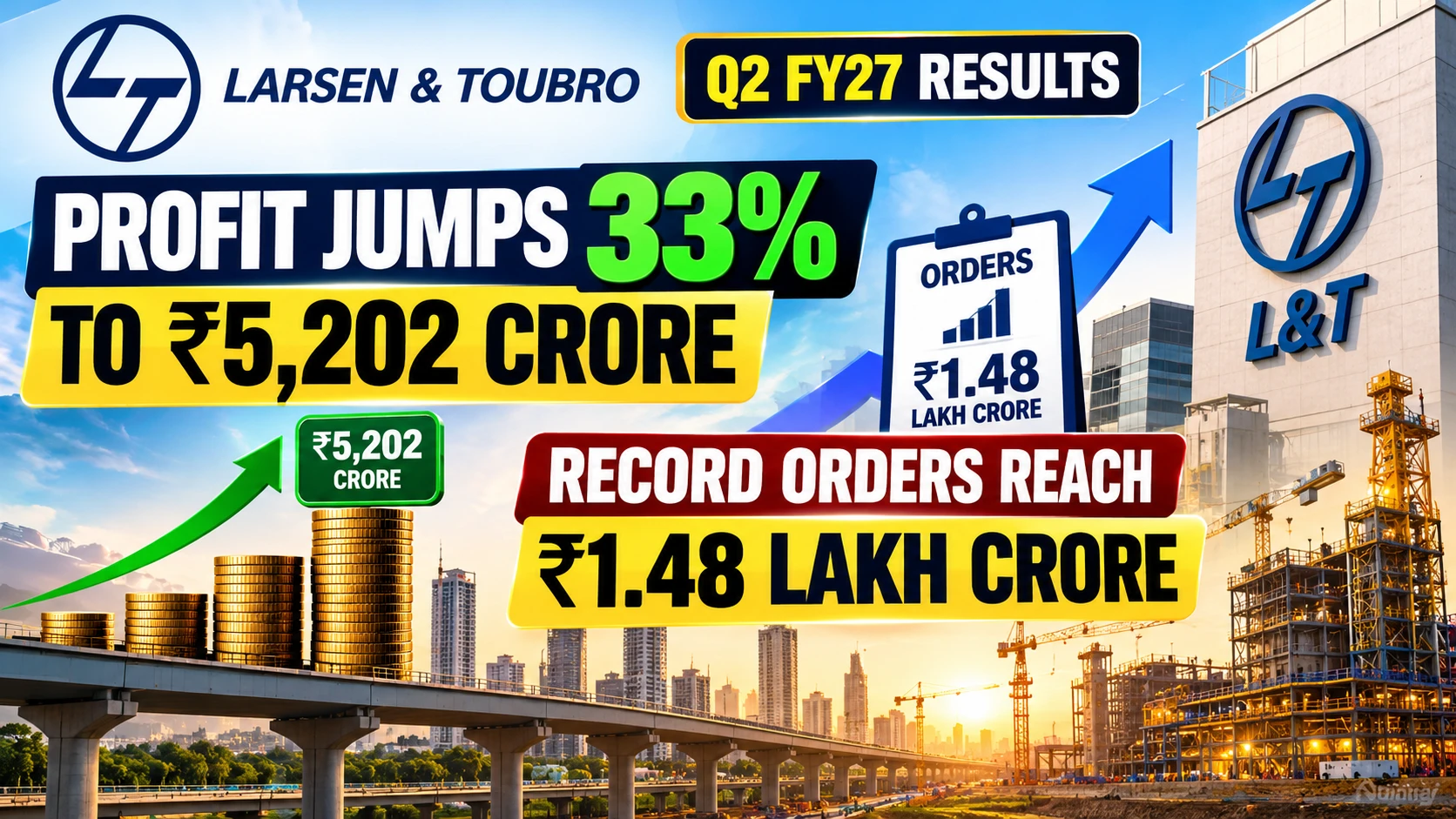
Larsen & Toubro (L&T), one of India’s largest engineering and infrastructure companies, reported strong financial results for the July–September 2026 quarter, supported by record order inflows, higher project revenue and continued contributions from international businesses.
Summary
- L&T reported Q2 FY27 net profit of ₹5,202 crore, up 33% year-on-year.
- Consolidated revenue grew 16% to ₹78,750 crore.
- Order inflows increased 28% to ₹1,47,665 crore, setting a quarterly record.
- Total order book reached approximately ₹8.54 lakh crore, up 28%.
- International orders contributed 63% of quarterly order inflows.
- International revenue accounted for 58% of the company’s quarterly sales.
- EBITDA margin declined to 8.7% from 10.0%, despite higher reported net profit.
L&T Q2 FY27 Results: Financial Performance
The September quarter reflected continued demand for L&T’s engineering, procurement, construction and related businesses.
Large infrastructure and energy projects contributed to new orders, while ongoing projects supported revenue growth.



Quarterly Financial Highlights
| Indicator | Q2 FY27 | Year-on-year change |
|---|---|---|
| Consolidated revenue | ₹78,750 crore | +16% |
| Net profit | ₹5,202 crore | +33% |
| EBITDA | ₹6,845 crore | Approximately +1% |
| EBITDA margin | 8.7% | Down from 10.0% |
| New order inflow | ₹1,47,665 crore | +28% |
| Total order book | ₹8,53,514 crore | +28% |
Source: Larsen & Toubro quarterly results and earnings presentation dated October 27, 2026. Values are rounded.
The company delivered stronger revenue and bottom-line growth.
However, there is an important distinction between the growth in net profit and operating performance.
While net profit increased significantly, EBITDA grew only marginally.
This suggests that factors beyond growth in core operating earnings contributed to the improvement in reported profitability.
Why Did L&T Net Profit Rise 33%?
The company’s net profit rose to ₹5,202 crore from approximately ₹3,926 crore in the year-earlier quarter.
The improvement was supported by higher business activity and contributions from other income and financial items.
Reuters reported a decline in finance costs and depreciation during the quarter.
The company’s results also included higher other income.
These items matter because profit after tax includes more than income from the core operations of construction and engineering projects.
A rising net profit is an encouraging sign, but investors should consider the sustainability of the underlying earnings.
One-time income, changes in financing costs and accounting effects may not repeat every quarter.
L&T Order Inflows Reach Record ₹1.48 Lakh Crore
One of the most important developments was the company’s record quarterly order inflow.
L&T secured new orders worth ₹1,47,665 crore during the September quarter, representing 28% growth over the corresponding period last year.
Order inflow refers to the value of new contracts received during a particular period.
For a project-oriented business, order inflows are an important measure of future revenue opportunities.
The company highlighted large projects across energy and infrastructure businesses as important contributors.
Management described the order performance as evidence of continued customer confidence despite geopolitical uncertainty.
Read Also: Tata Consumer Q2 FY27 Results: Profit Rises 16% to ₹470 Crore, Revenue Jumps 14%
Why Are Large Orders Important?
Infrastructure and engineering companies frequently execute projects over several months or years.
A new order can provide future revenue opportunities, but revenue is generally recognised as contractual obligations are performed under applicable accounting principles.
Therefore, a new ₹1,000 crore contract does not necessarily translate into ₹1,000 crore of immediately recognised revenue.
Actual profitability also depends on project cost estimates, contract terms, execution timelines and other commercial factors.
Total Order Book Reaches ₹8.54 Lakh Crore
At the end of September 2026, L&T reported an outstanding order book of approximately ₹8,53,514 crore.
This represented 28% year-on-year growth.
The order book provides an indication of work yet to be executed under existing contracts.
For investors, this can offer visibility into future revenue opportunities.
However, a large order book does not guarantee future profit.
Execution delays, input cost inflation, labour availability, regulatory requirements and customer payments can influence the financial performance of individual projects.
How Does the Order Book Compare With Quarterly Revenue?
The order book is much larger than the company’s revenue for a single quarter.
This reflects the multi-year nature of many engineering and construction contracts.
It also highlights the importance of execution capacity.
The ability to complete projects efficiently, control costs and collect payments will determine how much of the order book ultimately contributes to sustainable earnings.
International Orders Drive Business Growth
International operations played a major role in the company’s Q2 FY27 performance.
According to Reuters and the company’s investor presentation, overseas markets accounted for approximately 63% of new order inflows.
International revenue reached ₹45,870 crore, or about 58% of consolidated quarterly revenue.
This highlights L&T’s exposure to infrastructure and industrial projects beyond India.
Middle East Projects Remain Important
The Middle East continues to be an important region for L&T’s project business.
Demand for energy, infrastructure and industrial investment has created opportunities for engineering companies.
However, the region also carries geopolitical, logistical and execution risks.
Political developments, supply-chain interruptions and changing investment priorities can affect project schedules.
L&T’s substantial international exposure therefore provides opportunities for diversification but also makes overseas developments important to its performance.
EBITDA Margin Declines to 8.7%
Despite higher revenue and net profit, operating profitability deserves closer examination.
The company’s reported EBITDA margin declined to 8.7% from 10.0% a year earlier.
EBITDA increased only modestly to approximately ₹6,845 crore.
This means operating earnings did not grow as quickly as revenue.
It is an important distinction because investors may otherwise assume that a 33% rise in net profit reflects an equivalent improvement in operating margins.
What Is EBITDA Margin?
EBITDA margin measures EBITDA as a percentage of revenue.
It is used to understand how much operating earnings a company generates relative to its sales, before interest, tax, depreciation and amortisation.
For project businesses, margin performance can vary depending on the mix of projects being executed.
Contracts signed at different points in time can also have different cost structures.
A lower margin does not automatically indicate that a company is performing poorly, but it deserves analysis alongside revenue growth and project profitability.
Infrastructure and Energy Businesses
L&T operates across engineering, infrastructure, energy, manufacturing and other business areas.
The infrastructure and utilities segment remained an important contributor to revenue.
Reuters reported approximately 6% revenue growth in that segment during the quarter.
The broader company’s growth also reflected activity in energy, manufacturing and financial services.
Infrastructure execution can involve substantial working capital and technical complexity.
Energy projects may face additional challenges linked to equipment availability, logistics and international market conditions.
These characteristics make disciplined project selection and cost management important for long-term financial performance.
L&T Q2 FY27: Half-Year Performance
For the first half of FY27, L&T reported consolidated revenue of approximately ₹1,46,692 crore.
First-half profit after tax reached about ₹9,325 crore.
These figures indicate that the company maintained substantial business activity across the April–September period.
However, half-year performance should be assessed alongside cash flows, margin trends and the company’s full-year guidance.
Quarterly revenue or profit growth alone does not determine the outcome for the entire financial year.
What Did L&T Management Say?
Chairman and Managing Director S. N. Subrahmanyan highlighted strong customer confidence and the company’s ability to secure large and complex projects across different sectors and regions.
Management also emphasised execution capabilities, productivity, digital innovation and future investment in technology-led businesses.
The company identified opportunities in areas such as electronics, semiconductor design, data centres and green hydrogen.
These initiatives may contribute to diversification over time.
However, the financial benefits of newer businesses will depend on commercial demand, investment requirements and execution.
More Stories

ChatGPT in Excel: 5 Powerful AI Tricks to Save Time (Hindi Tutorial)
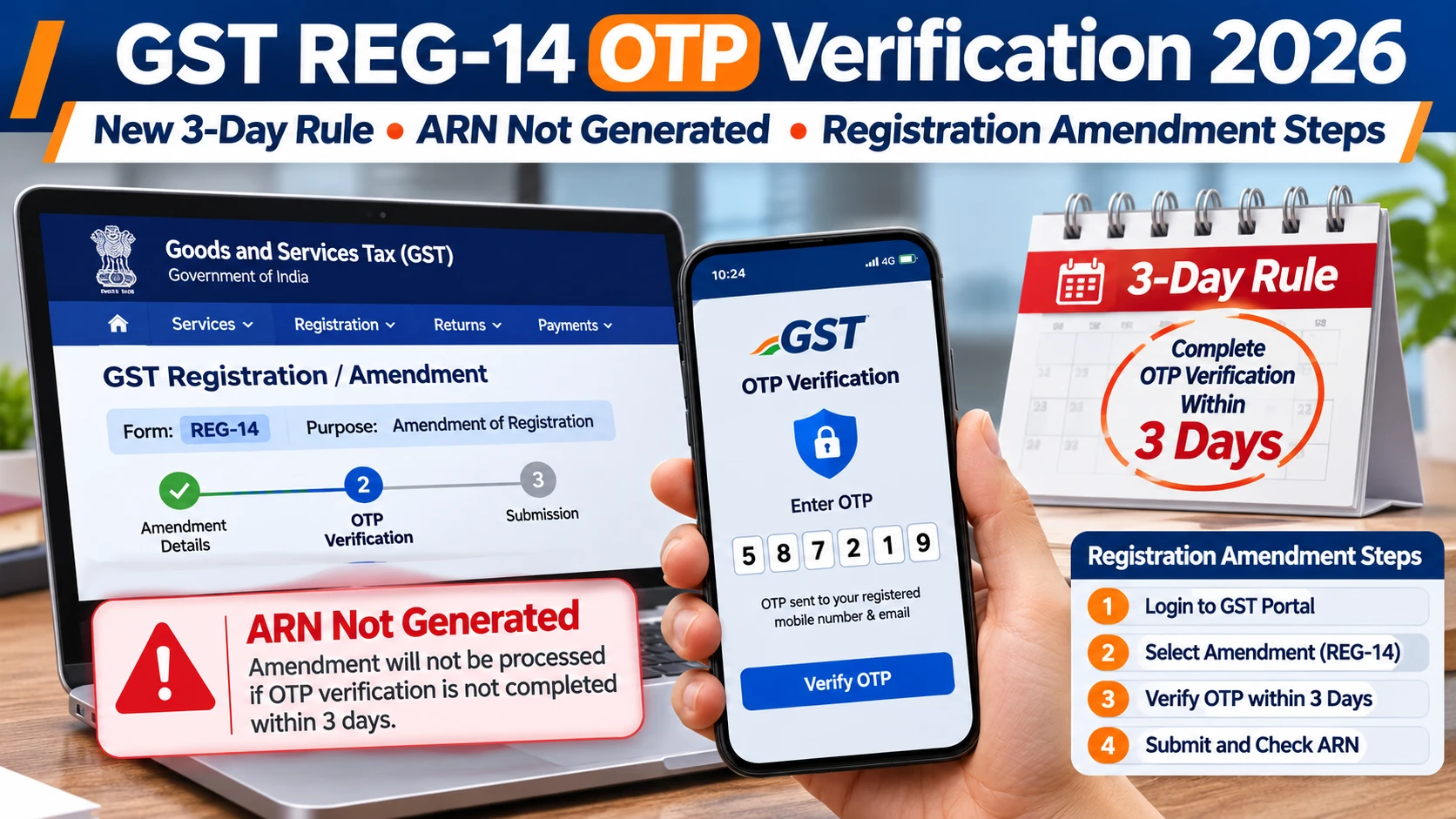
GST REG-14 OTP Verification 2026: New 3-Day Rule, ARN Not Generated and Registration Amendment Steps
SEBI NRI KYC Rules 2026: Open Investment Accounts From Abroad Without Visiting India — 7 Major Changes
GST Rule 14B Registration 2026: How Online Sellers Can Register in Another State Without Their Own Office



What Do the Results Mean for Investors?
The quarterly performance contains both positive indicators and points that require monitoring.
On the positive side, the company reported stronger revenue, higher net profit, record new orders and a large outstanding order book.
These developments support expectations of continued project activity.
On the other hand, the decline in EBITDA margin indicates that operating profitability has not improved at the same pace as reported net profit.
Investors should also examine international project risks, cash conversion and the valuations reflected in L&T’s share price.
A strong set of financial results does not automatically mean that a stock is attractively valued.
Read Also: ESTIC 2026: India’s AI and Deep-Tech Conclave Features 150 Startups and 12 Technology Themes
Five Things to Watch After L&T Q2 Results
1. Project Execution
Can the company deliver large projects within planned schedules and budgets?
2. EBITDA Margin Recovery
Will operating margins improve as the business executes newer contracts?
3. International Order Momentum
Can L&T sustain overseas order growth amid geopolitical uncertainty?
4. Working Capital and Cash Flow
Does revenue growth translate into efficient collections and operating cash generation?
5. New Technology Businesses
Will investments in semiconductors, data centres and green energy contribute meaningfully to future growth?
Frequently Asked Questions
What was L&T’s net profit in Q2 FY27?
L&T reported consolidated net profit of approximately ₹5,202 crore, up 33% year-on-year.
How much revenue did L&T generate?
Consolidated revenue from operations reached approximately ₹78,750 crore, an increase of 16%.
What was the value of new orders?
The company secured orders worth ₹1,47,665 crore during the September quarter.
How large is L&T’s outstanding order book?
The outstanding order book was approximately ₹8.54 lakh crore as of September 30, 2026.
Did L&T’s operating margin improve?
No. The reported EBITDA margin declined from approximately 10.0% to 8.7%.
How important are international markets?
International markets contributed around 58% of quarterly revenue and 63% of order inflows.
Should investors buy L&T shares after these results?
Quarterly results alone are insufficient to determine whether an investment is appropriate. Investors should consider valuation, risk tolerance, financial goals and broader company fundamentals.
Conclusion
L&T’s Q2 FY27 results reflected strong demand for engineering and infrastructure services, with record new orders and continued growth in revenue and reported net profit.
The substantial order book provides visibility into future business activity.
However, lower EBITDA margins remind investors that revenue growth and bottom-line profit do not always move in the same direction as operating profitability.
Over the coming quarters, project execution, cost control, international business conditions and cash flow will remain important indicators of the company’s performance.
Sources
- Larsen & Toubro — Consolidated Financial Results for the Quarter Ended September 30, 2026, released October 27.
- Larsen & Toubro — Q2/H1 FY27 Earnings Presentation.
- Reuters — October 27, 2026, report on L&T’s quarterly results and international orders.
- Moneycontrol — October 27, 2026, quarterly financial results coverage.
Disclaimer: EduTaxTuber provides content for general educational and informational purposes only. While we make reasonable efforts to keep the information accurate and updated, laws, regulations, market conditions, software features, and other information may change. Some content may be created or assisted by AI tools and may contain errors or omissions. Readers should verify important information with official sources or qualified professionals before making any tax, legal, financial, investment, business, or other decisions. EduTaxTuber does not guarantee the completeness or accuracy of the information and does not provide professional advice.