







PM Viksit Gram Swaraj Yojana 2026: ₹7,395 Crore Approved for 2.55 Lakh Panchayats
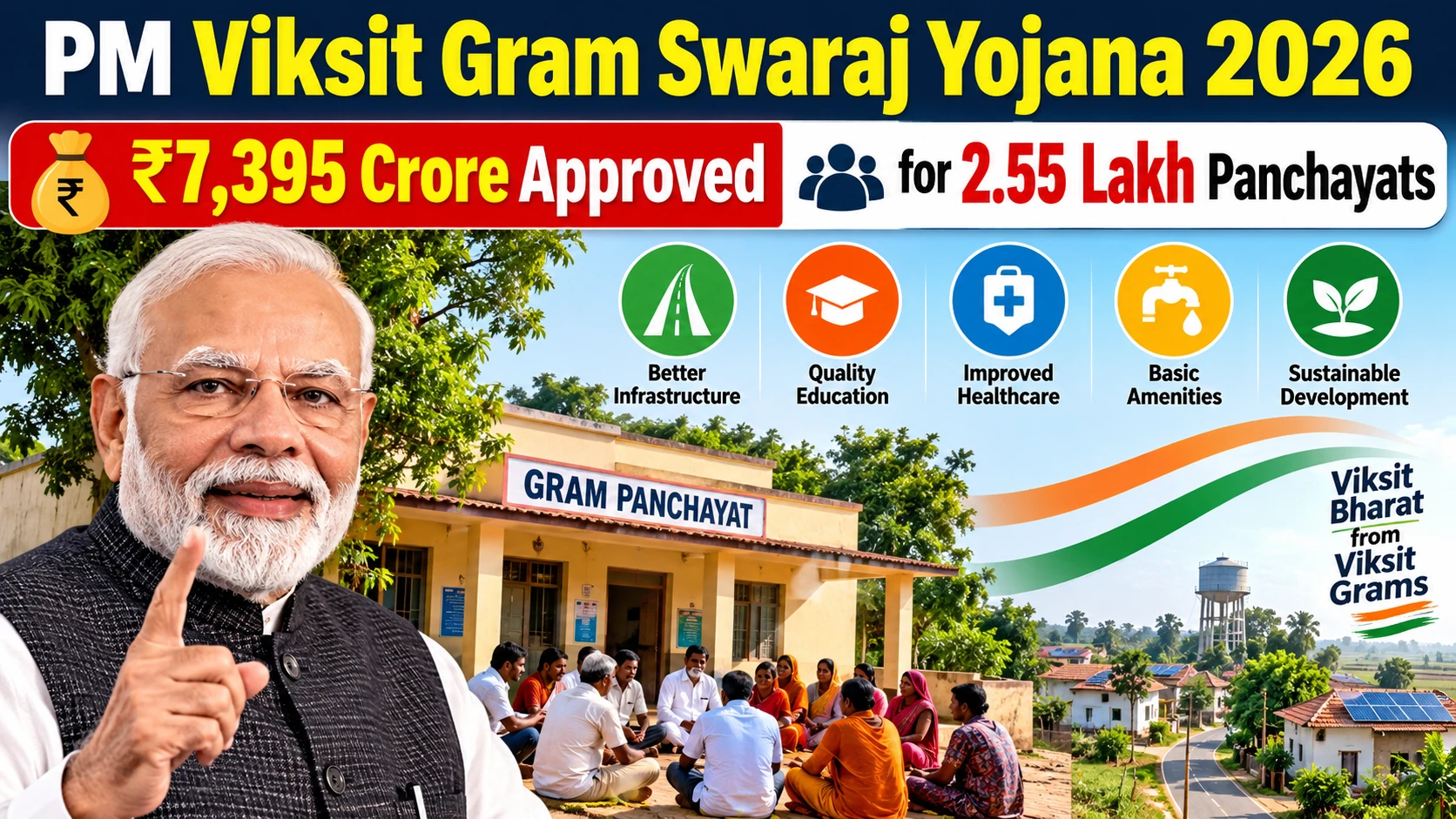
The Union Cabinet has approved the Pradhan Mantri Viksit Gram Swaraj Yojana (PM VGSY), a ₹7,395.55 crore programme aimed at strengthening rural local governance, financial transparency and village development planning across India.
Summary
- The Union Cabinet approved PM Viksit Gram Swaraj Yojana on October 28, 2026.
- Total financial allocation: ₹7,395.55 crore.
- Central Government contribution: ₹4,869.48 crore.
- State Government contribution: ₹2,526.07 crore.
- Implementation period: FY 2026–27 to FY 2030–31.
- Coverage: More than 2.55 lakh Panchayats and traditional rural local bodies.
- Around 32 lakh governance stakeholders are targeted for annual capacity building.
- Annual targets include more than 2.55 lakh village development plans and online audit plans.
PM Viksit Gram Swaraj Yojana is a Centrally Sponsored Scheme designed to strengthen local self-government institutions.
Gram Panchayats play an important role in village-level governance. Their responsibilities can include planning local development activities, managing certain public resources and coordinating government initiatives.

- TWS Earbuds with 13mm Dynamic Driver to produce Immersive Stereo Sound | Smart Touch Controls & 50 Hours of Non-stop Pla…
- Lightweight Wireless Earbuds with Ergo-Fit Design | Built-in HD Mic for Clear Call Quality | In-Ear Design Blocks Extern…
- Control Music/Call thru Touch Sensors | IPX4 Water/Sweatproof Earbuds | Instant Access to Device’s Voice Assistant
However, effective administration requires reliable information, trained functionaries, financial accountability and public participation.
The new scheme seeks to improve these capabilities through training, digital platforms, coordinated planning and stronger monitoring.
It also aims to connect national development priorities with the specific requirements of individual villages.
PM VGSY 2026: Financial Allocation
The scheme has a total approved outlay of ₹7,395.55 crore.
| Funding component | Amount |
|---|---|
| Central Government share | ₹4,869.48 crore |
| State Government share | ₹2,526.07 crore |
| Total outlay | ₹7,395.55 crore |
This allocation covers the programme period from 2026–27 to 2030–31.
The approved outlay does not mean that the entire amount has already been spent or directly transferred to village residents.
The programme will be implemented through the applicable administrative and financial procedures.
1. More Than 2.55 Lakh Panchayats Covered
The programme is intended to cover over 2.55 lakh Panchayats and eligible traditional rural local government institutions.
Its geographical scope includes all States and Union Territories.
In certain areas where the conventional Panchayati Raj structure does not operate, eligible traditional rural local bodies are also included.
This broad coverage is designed to strengthen planning and governance capabilities across diverse rural administrative systems.
However, programme coverage does not mean that every village will receive an identical financial allocation.
Activities and resource requirements will depend on approved plans and applicable guidelines.
2. Training for Around 32 Lakh Governance Stakeholders
A major objective is to strengthen the capabilities of elected Panchayat representatives, officials and other local governance stakeholders.
The scheme targets approximately 32 lakh stakeholders annually through capacity-building and digital support activities.
These may help participants improve local planning, financial management, citizen communication and the use of government platforms.
For example, a Panchayat representative may need to understand how to review a development proposal, prepare planning information and monitor progress.
Training can help local bodies carry out these tasks more effectively.
The figure of 32 lakh refers to targeted governance stakeholders, not newly created permanent jobs.
Read Also: Bihar Manufacturing City 2026: ₹4,200 Crore Investment MoUs Signed, Over 16,000 Jobs Expected
3. Annual Gram Panchayat Development Plans
The scheme aims to support preparation of more than 2.55 lakh Gram Panchayat Development Plans (GPDPs) every year through the eGramSwaraj portal.
A GPDP is a local development-planning document prepared using applicable participatory processes.
It can help identify village priorities and coordinate available government schemes and resources.
For example, residents may identify problems relating to drinking water, local roads, sanitation, drainage or other public services.
The relevant proposals can then be assessed within the applicable planning framework.
The purpose is to improve the connection between village needs and approved development activities.
Not every proposal raised during a Gram Sabha will automatically be funded or completed.
4. Digital Panchayat and eGramSwaraj Integration
Digital governance is one of the scheme’s major components.
The government intends to build on the existing eGramSwaraj and e-Panchayat systems.
These systems support functions such as planning, budgeting, accounting, monitoring and reporting.
Under the new initiative, information about government schemes, beneficiaries, community assets and available resources is intended to become more accessible through connected digital platforms.
This could help local authorities identify gaps and avoid unnecessary duplication of activities.
It may also improve the availability of information for monitoring and public scrutiny.
However, the effectiveness of digital systems depends on reliable data, connectivity, training and continued maintenance.
5. Stronger Financial Accountability and Online Audits
The programme emphasises transparency in the use of public resources.
The official announcement includes a target to support at least 2.55 lakh online audit plans annually.
It also seeks timely completion of the related audits through the AuditOnline platform.
Online accounting and disclosure can help make expenditure information more transparent.
For residents, better access to reliable information may improve their ability to understand how development funds are being used.
For Panchayat officials, consistent accounting procedures can support improved financial control.
Nevertheless, digital records alone cannot guarantee that every irregularity will be prevented.
Effective auditing, follow-up and institutional oversight remain necessary.
6. AI and Multilingual Citizen Communication
The government has identified PANCHAM, an AI-enabled multilingual communication platform, as one of the tools supporting citizen engagement.
According to the official backgrounder, PANCHAM can support two-way communication in 17 Indian languages.
The aim is to explain government initiatives and local development priorities in accessible language.
This could be useful where residents are more comfortable receiving information in regional languages rather than through complex administrative documents.
For example, clearer communication may help Gram Sabha participants understand proposed village-level projects and relevant public schemes.
However, AI-generated communication must still be accurate, accessible and appropriately supervised.
7. Greater Participation Through Gram Sabhas
Community participation is an important element of local development planning.
Gram Sabhas provide a forum where eligible residents can discuss village matters and raise concerns under the applicable framework.
The scheme seeks to improve public understanding of government initiatives through coordinated awareness programmes.
Each such awareness-generation exercise is intended to reach at least one crore citizens.
This is an outreach target rather than a promise that one crore individuals will receive direct monetary assistance.
The success of these activities will depend on local implementation, information quality and genuine opportunities for citizen participation.
What Does the Scheme Mean for Villagers?
The most direct objective is better institutional governance.
Residents could benefit indirectly if Panchayats become more effective at identifying needs, coordinating programmes and monitoring development work.
Potential improvements could include more transparent planning and better visibility into the use of available resources.
However, individual projects will still depend on applicable schemes, budgets, technical approvals and implementation.
It would be misleading to describe PM VGSY as a new scheme providing a fixed cash amount to every rural household.
Does PM VGSY Create Government Jobs?
The government’s official announcement states that no permanent posts will be created under the scheme.
Need-based contractual personnel may be engaged at State, district or block levels to provide technical support.
This distinction matters for jobseekers.
The approval does not establish a new permanent recruitment drive for lakhs of applicants.
Any future contractual opportunities would need to be confirmed through separate official recruitment notices.
Connection With the Sixteenth Finance Commission
The scheme operates during the period corresponding to the Sixteenth Finance Commission.
According to the Cabinet announcement, the Commission has recommended approximately ₹4.35 lakh crore in grants for rural local bodies over 2026–27 to 2030–31.
PM VGSY aims to strengthen Panchayat capacity to plan and use available resources effectively.
The ₹4.35 lakh crore grant recommendation is separate from the ₹7,395.55 crore scheme outlay.
The two figures must not be combined or described as a single direct-benefit allocation.
More Stories

Hindalco Q2 Results 2026: Profit Jumps 59% to ₹7,533 Crore, Copper EBITDA Surges 164% — 5 Key Investor Takeaways
XLOOKUP in Excel: 3 Powerful Tricks for Multiple Columns (Hindi)
ChatGPT in Excel: 5 Powerful AI Tricks to Save Time (Hindi Tutorial)
GST REG-14 OTP Verification 2026: New 3-Day Rule, ARN Not Generated and Registration Amendment Steps


How Will the Scheme Be Implemented?
State Governments and Union Territory administrations will participate in the implementation process.
They will prepare Annual Action Plans describing proposed activities, priorities and resource requirements.
A designated Central Empowered Committee will examine and approve plans under the relevant procedures.
Existing administrative, training, digital and communication arrangements will support implementation.
Progress will depend on coordination among government departments, local institutions and technical-support systems.
Important Questions for Rural Residents
Will I receive ₹7,395 crore under this scheme?
No. This is the programme’s nationwide approved outlay, not a payment to individuals.
Will every household receive money?
No direct household cash-transfer entitlement has been announced through this scheme.
When does the programme operate?
From FY 2026–27 through FY 2030–31.
What is the main purpose?
To strengthen Panchayat planning, digital administration, training, financial accountability and citizen participation.
How many Panchayats are covered?
More than 2.55 lakh Panchayats and traditional rural local bodies.
Does the scheme guarantee permanent government employment?
No. The Cabinet announcement explicitly states that no permanent posts will be created.
How can villagers participate?
Residents can follow their local Gram Sabha processes and official Panchayat communications to understand development plans and raise appropriate issues.
Conclusion
The Pradhan Mantri Viksit Gram Swaraj Yojana represents a significant investment in strengthening the institutions responsible for rural development.
Its ₹7,395.55 crore allocation is intended to support Panchayat training, digital governance, village planning and stronger accountability.
The programme’s success will depend on whether these measures improve actual planning, public participation and the use of available resources.
Villagers should understand that the scheme supports local governance rather than providing automatic personal cash benefits.
Sources
- Press Information Bureau — Cabinet approves Pradhan Mantri Viksit Gram Swaraj Yojana, 28 October 2026.
- Press Information Bureau — PM VGSY Backgrounder: Strengthening Governance at the Grassroots, 28 October 2026.
- Prime Minister of India — Official Cabinet approval announcement, 28 October 2026.
Disclaimer: EduTaxTuber provides content for general educational and informational purposes only. While we make reasonable efforts to keep the information accurate and updated, laws, regulations, market conditions, software features, and other information may change. Some content may be created or assisted by AI tools and may contain errors or omissions. Readers should verify important information with official sources or qualified professionals before making any tax, legal, financial, investment, business, or other decisions. EduTaxTuber does not guarantee the completeness or accuracy of the information and does not provide professional advice.