









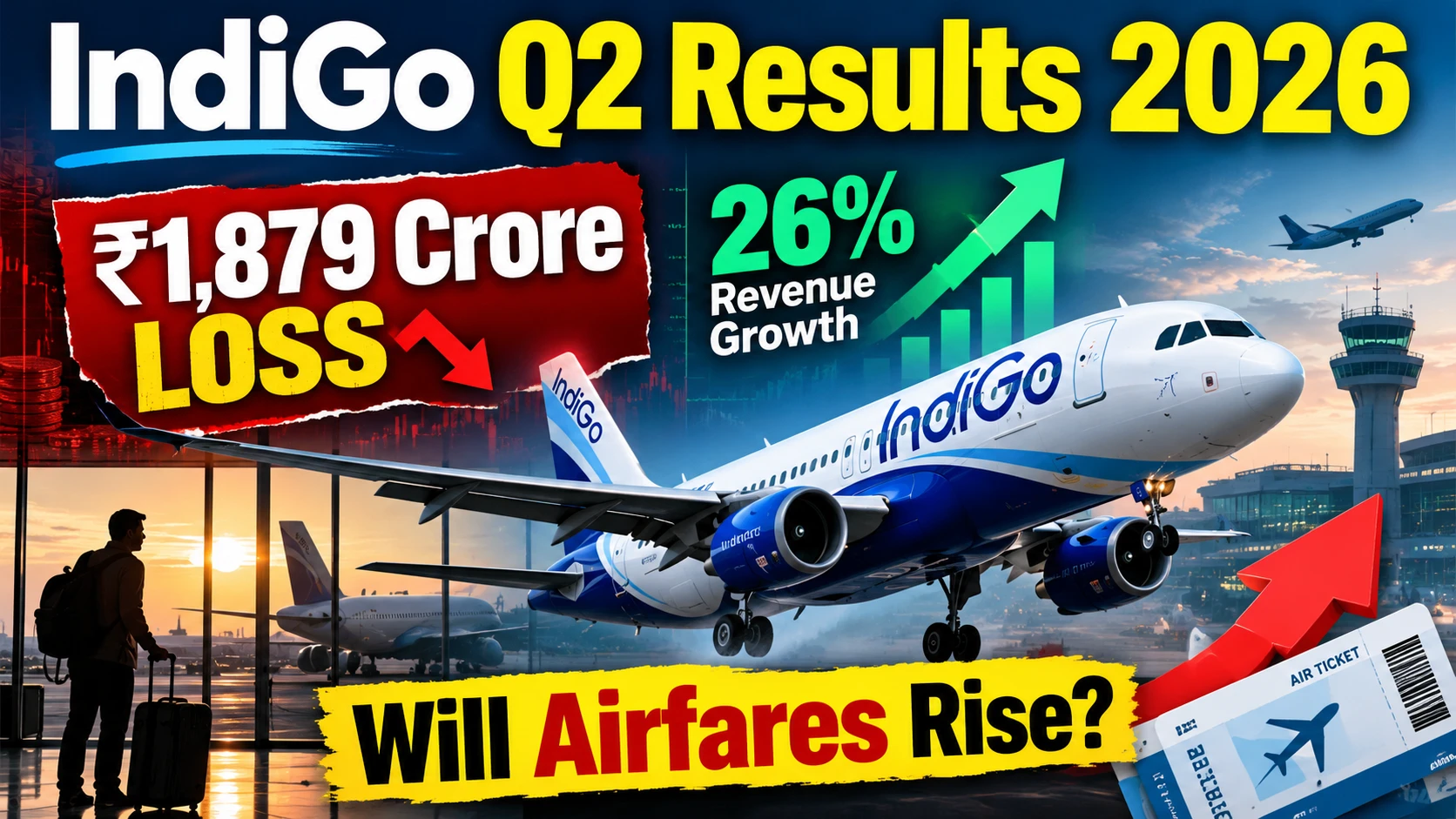
India’s largest airline, IndiGo, has reported a consolidated net loss of approximately ₹1,879 crore for the second quarter of FY 2026–27, despite recording strong revenue growth.
Summary
- IndiGo reported a consolidated net loss of approximately ₹1,879 crore in Q2 FY27.
- The loss narrowed 27.2% from approximately ₹2,582 crore a year earlier.
- Revenue from operations grew 25.9% to ₹23,364 crore.
- Passenger traffic declined 4.7% to 2.75 crore.
- Passenger yield increased 34.3% to ₹6.30.
- Load factor declined from 82.5% to 80.3%.
- Fuel cost per available seat kilometre increased 68.9%.
- Higher fuel prices and currency movements remain major risks for future airfares.
IndiGo Q2 FY27 Financial Results
The September 2026 quarter illustrates the difference between strong revenue growth and actual profitability.
IndiGo earned considerably more revenue than in the same period last year, but expenses remained high enough to produce a substantial net loss.

Financial Results at a Glance
| Indicator | Q2 FY27 | Q2 FY26 |
|---|---|---|
| Revenue from operations | ₹23,364 crore | ₹18,555 crore |
| Consolidated net loss | ₹1,879 crore | ₹2,582 crore |
| Passengers carried | 2.75 crore | 2.88 crore |
| Load factor | 80.3% | 82.5% |
| Passenger yield | ₹6.30 | ₹4.69 |
| Available seat kilometres | 40.8 billion | 41.2 billion |
Source: InterGlobe Aviation’s October 29, 2026 results announcement. Figures rounded.
The revenue improvement is significant, particularly because the number of passengers carried declined during the period.
Higher ticket yields helped the airline generate additional revenue from its available capacity.
However, this revenue increase was not sufficient to fully offset rising costs.
Why Did IndiGo Report a Loss?
The company identified exceptionally elevated aviation fuel costs and rupee depreciation as major factors.
Fuel is one of the largest expenses for an airline.
Aircraft require substantial quantities of aviation turbine fuel, and changes in international energy prices can significantly affect operating economics.
The impact can become more severe when the domestic currency weakens against the US dollar.
Some airline costs, including fuel and aircraft-related obligations, are directly or indirectly exposed to foreign currencies.
Higher dollar-denominated costs can increase expenses when translated into rupees.
As a result, an airline can increase ticket prices and still face profitability pressure.
Read Also: HUL Q2 FY27 Results: 15% Sales Growth, ₹19 Dividend and 7% Volume Growth
Fuel Costs Rise Sharply
IndiGo reported a 68.9% increase in fuel cost per available seat kilometre.
This indicates that fuel-related operating expenses increased substantially relative to the airline’s capacity.
International crude oil prices and the price of aviation turbine fuel influence the cost environment for airlines.
However, the relationship is not always immediate or uniform.
Taxes, supply arrangements, currency movements and other factors can affect the final expense.
The company has been attempting to mitigate higher costs through fare adjustments and operating decisions.
Nevertheless, aviation fuel remains an important risk to profitability.
What Does Rupee Depreciation Mean for Airlines?
A weaker rupee can make certain overseas expenses more expensive.
Suppose a company must pay an obligation denominated in US dollars.
If the rupee weakens, more rupees may be required to meet the same dollar amount.
Airlines often have international financial obligations linked to aircraft leases, maintenance or other operating arrangements.
As a result, currency fluctuations can affect both cash costs and accounting results.
IndiGo’s reported figures include foreign-exchange effects.
Excluding those effects, the company reported a net loss of approximately ₹724 crore, compared with a profit of approximately ₹104 crore in the corresponding quarter a year earlier.
This demonstrates that underlying profitability was also under pressure, even before considering currency effects.
Revenue Jumps 26% Despite Fewer Passengers
One of the most striking aspects of IndiGo’s results is that revenue rose while passenger traffic declined.
The airline carried approximately 27.5 million passengers during the quarter, compared with 28.8 million a year earlier.
This represents a 4.7% decline.
Capacity, measured in available seat kilometres, declined 1%.
Yet passenger yield increased significantly.
Higher yields allowed the airline to generate more revenue from the traffic it carried.
This indicates that pricing decisions played an important role in revenue performance.
However, higher ticket revenue does not automatically translate into higher profits when costs are also rising.
What Is Passenger Yield?
Passenger yield measures passenger revenue relative to the distance travelled by paying passengers.
It is commonly expressed in rupees per passenger kilometre.
IndiGo reported a yield of ₹6.30 in the September quarter.
This represented a 34.3% year-on-year increase.
Yield is not identical to the advertised ticket price for an individual flight.
Actual fares depend on factors such as route, travel date, booking time, ticket conditions and demand.
Nevertheless, higher average yields suggest that airlines are generating more passenger revenue for each unit of passenger traffic.
Load Factor Falls to 80.3%
Load factor is another important operational indicator.
It measures the proportion of available passenger capacity utilised by paying passengers.
IndiGo’s load factor declined to 80.3%, compared with 82.5% a year earlier.
This indicates that, on average, a smaller share of available capacity was occupied.
A lower load factor can influence profitability because the airline must bear many operational expenses regardless of whether every seat is sold.
But load factor should not be evaluated alone.
Higher ticket yields can sometimes compensate for lower occupancy.
Read Also: Tata Consumer Q2 FY27 Results: Profit Rises 16% to ₹470 Crore, Revenue Jumps 14%
The ideal combination depends on route economics, costs, demand and the airline’s pricing strategy.
More Stories

ChatGPT in Excel: 5 Powerful AI Tricks to Save Time (Hindi Tutorial)
GST REG-14 OTP Verification 2026: New 3-Day Rule, ARN Not Generated and Registration Amendment Steps
SEBI NRI KYC Rules 2026: Open Investment Accounts From Abroad Without Visiting India — 7 Major Changes
GST Rule 14B Registration 2026: How Online Sellers Can Register in Another State Without Their Own Office




Will IndiGo Increase Flight Ticket Prices?
This is one of the most important implications for travellers.
Following the results, the airline indicated that sustained increases in fuel costs could make higher fares necessary.
The company has already taken pricing measures to manage its operating expenses.
However, this is not a guarantee that every domestic or international route will experience the same fare increase.
Airlines typically adjust prices based on demand, competition, seat availability, booking lead times and route-specific costs.
A route experiencing high demand may behave differently from one with excess capacity.
Passengers should therefore evaluate actual published fares rather than relying on a general prediction.
How Could Travellers Be Affected?
Higher airline operating costs can eventually influence ticket prices.
For families planning holidays, students travelling for education and professionals making work-related journeys, airfare changes can affect travel budgets.
However, the cost of a ticket can vary substantially even on the same route.
Travellers may find it useful to compare dates, understand baggage allowances and review cancellation conditions.
It is also important to compare the total cost rather than focusing only on the initial fare displayed.
The latest quarterly results do not establish a universal airfare increase effective on a particular date.
Why Is the September Quarter Difficult for Airlines?
The July–September period can be seasonally weaker for air travel in India.
It falls after the main summer travel period and includes the monsoon season.
The travel pattern can influence demand and operational performance.
In addition, international geopolitical developments and volatile fuel prices can create further uncertainty.
IndiGo’s management highlighted these challenges in explaining its financial results.
The performance of the December quarter will depend partly on festive-season demand and the evolution of fuel prices.
December Quarter Outlook
IndiGo expects low-single-digit year-on-year capacity growth during the December quarter.
The airline has indicated that it will assess routes individually and manage capacity according to demand and operating conditions.
Management also expects strong year-on-year growth in passenger revenue per available seat kilometre, based on recent pricing and demand trends.
These are forward-looking expectations.
Actual performance may differ due to fuel prices, currency movements, weather conditions, competition and consumer demand.
What Do the Results Mean for Investors?
The results offer a mixed picture.
On the positive side, IndiGo achieved substantial revenue growth and reduced its reported year-on-year loss.
Higher yields also demonstrate the airline’s ability to recover more revenue from the passengers it serves.
However, the continuing net loss shows that cost pressures remain significant.
Investors should monitor fuel prices, currency exposure, operating margins, route profitability and debt obligations.
A narrower loss does not necessarily mean that the company has returned to profitability.
Similarly, a high-growth revenue quarter does not automatically mean that its stock is attractively valued.
Five Indicators to Watch
1. Aviation Fuel Prices
Will fuel costs stabilise or continue rising?
2. Rupee Exchange Rate
How will currency movements affect dollar-linked expenses?
3. Passenger Demand
Can the airline maintain ticket yields while restoring passenger growth?
4. Load Factor
Will seat occupancy recover as capacity and routes are adjusted?
5. Profitability
Can higher revenue translate into sustainable operating and net profits?
Read Also: Powerful PF Balance and Claim Status Check on WhatsApp
Frequently Asked Questions
1. What was IndiGo’s Q2 FY27 net loss?
Approximately ₹1,879 crore on a consolidated basis.
2. How much revenue did IndiGo report?
Approximately ₹23,364 crore, up 25.9% year-on-year.
3. Why is IndiGo making losses despite revenue growth?
Higher aviation fuel costs, currency movements and other operating expenses continue to pressure profitability.
4. How many passengers did IndiGo carry?
Approximately 2.75 crore during the September quarter.
5. Did passenger traffic increase?
No. Passenger traffic declined 4.7% year-on-year.
6. Will IndiGo fares increase?
The airline has indicated that higher fuel costs could require further pricing actions. Actual fares will vary by route and booking conditions.
7. Does a narrower loss mean the airline is profitable?
No. The company continued to report a net loss.
Conclusion
IndiGo’s Q2 FY27 results reflect the challenges of operating a large airline during a period of expensive fuel and currency volatility.
Revenue grew nearly 26%, and the company’s net loss narrowed compared with the previous year.
However, fewer passengers, lower seat occupancy and higher operating costs show that the improvement has not yet translated into profitability.
For travellers, the biggest issue is the potential effect on airfares.
For investors, the important indicators will be cost control, yield sustainability, capacity management and the airline’s ability to generate consistent profits.
Sources
- InterGlobe Aviation Limited — Official Q2 FY27 press release and investor presentation, 29 October 2026.
- Reuters — IndiGo quarterly results and fare outlook, 29–30 October 2026.
- Moneycontrol — IndiGo Q2 earnings, 29 October 2026.
- Business Standard — IndiGo’s fuel costs and financial performance, 29 October 2026.
Disclaimer: EduTaxTuber provides content for general educational and informational purposes only. While we make reasonable efforts to keep the information accurate and updated, laws, regulations, market conditions, software features, and other information may change. Some content may be created or assisted by AI tools and may contain errors or omissions. Readers should verify important information with official sources or qualified professionals before making any tax, legal, financial, investment, business, or other decisions. EduTaxTuber does not guarantee the completeness or accuracy of the information and does not provide professional advice.