









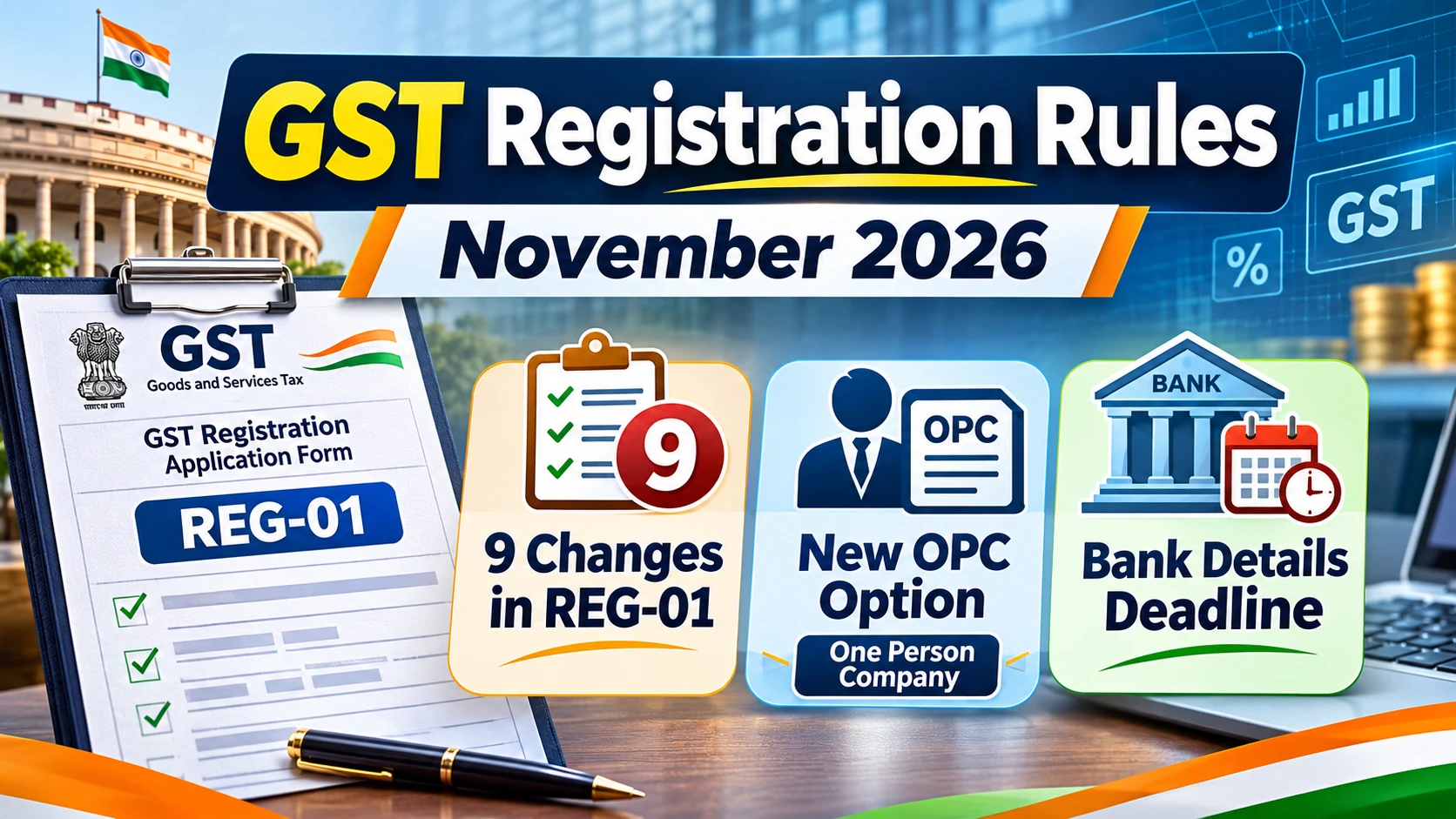
The Goods and Services Tax Network (GSTN) has introduced important changes to FORM GST REG-01, the application used by businesses seeking GST registration.
The changes were announced through GSTN Advisory No. 681, dated 1 November 2026, following Notification No. 05/2026–Central Tax and Circular No. 257/03/2026-GST, both dated 26 October 2026.
Summary
- GSTN issued Advisory No. 681 on 1 November 2026.
- FORM GST REG-01 has been revised on the GST portal.
- One Person Company (OPC) is now a separate business-constitution category.
- SEZ applicants must provide an SEZ Entity ID.
- Specific e-commerce operators must provide additional registration information.
- Business-premises possession categories and documentary requirements have been standardised.
- Additional types of business activity can now be declared.
- Up to ten bank accounts can be reported, where applicable.
- Applicants without bank details at registration must comply with the applicable 30-day post-registration requirement.
What Is FORM GST REG-01?
FORM GST REG-01 is the prescribed application form used by eligible persons seeking registration under GST.
The form collects information about the applicant’s identity, constitution of business, place of business, authorised persons, bank accounts and business activities.
It is used in accordance with the relevant registration rules.
Once an application is successfully submitted, an Application Reference Number (ARN) is generated through the prescribed process.
The latest revision aims to standardise information and supporting documents and strengthen the validation of business details.
Importantly, the revised form does not by itself increase GST rates or remove the need for registration where registration is legally required.
Nine Important Changes in GST REG-01
1. Separate GST Registration Category for One Person Companies
One of the most notable changes is the introduction of a separate One Person Company (OPC) category under the constitution-of-business options.
An OPC is a company incorporated under the Companies Act framework with a single member, subject to applicable requirements.
Previously, applicants may have needed to select a broader company-related category in the registration interface.
The revised form now provides explicit recognition of an OPC.
When selecting this category, applicants should keep the company’s incorporation and other prescribed supporting documents ready.
The option does not mean that a person operating an ordinary proprietorship automatically becomes an OPC.
Business constitution must reflect the entity’s actual legal status.
2. SEZ Entity ID for SEZ Applicants
The revised form includes a field for an SEZ Entity ID for applicants registering as an SEZ Unit or SEZ Developer.
These applicants must provide the applicable identifying information and supporting documents.
Businesses should verify that their SEZ information matches the relevant official records.
This requirement does not apply automatically to every ordinary domestic business.
3. Additional Fields for Certain E-Commerce Operators
Applicants registering as e-commerce operators liable to pay tax under Section 9(5) of the CGST Act now have a separate section in the form.
The additional details concern physical presence in the State or Union Territory and, where applicable, authorised representatives.
This is distinct from the registration provisions for ordinary sellers supplying goods through e-commerce operators.
Businesses must identify which GST provisions apply to their actual activities rather than assuming that every online seller falls under Section 9(5).
4. Revised Disclosure of Existing Registrations
The registration form includes revised fields for existing statutory registrations.
These may include GSTIN, Professional Tax Registration Number and Professional Tax Enrolment Registration Number, as applicable.
Applicants should review which identifiers must be disclosed.
Incorrect information or inconsistencies between different records may delay processing.
A business should not invent an identification number for a registration it does not hold.
5. Standardised Proof of Business Premises
GSTN has revised the classification of possession of the principal and additional places of business.
The form accommodates different possession arrangements, including owned, rented or leased, consent-based, co-working, SEZ-related and other prescribed categories.
Supporting documents depend on the selected category.
For example, an applicant using rented premises should review the relevant rent or lease documents and any additional prescribed proof.
A business using a co-working space should select the category that accurately describes its legal arrangement.
Documents should correspond with the address and possession arrangement disclosed in the application.
Read Also: Edutaxtuber GST HUB
6. Additional Nature-of-Business Activities
The list of business activities has been expanded.
New or more specific entries include certain factory-registration particulars, Authorised Economic Operator information, co-working spaces, health and fitness clubs, and renting or leasing activities involving immovable property, vehicles, vessels or aircraft.
The applicant should select activities that accurately describe the business.
Choosing an unrelated business activity merely to complete the form can create future compliance complications.
7. Bank Account Information and 30-Day Requirement
The revised form provides for reporting details of up to ten bank accounts, where applicable.
Applicants should furnish available bank account details during registration.
Where those details are unavailable at the time of application, they must be provided within 30 days from issuance of the GST registration certificate in FORM GST REG-06, subject to the applicable requirements.
This should not be interpreted as a universal 30-day extension for every GST registration obligation.
Businesses should use accurate account information and monitor the specific deadline following registration.
8. DIN of Designated Partners in LLPs
For a Limited Liability Partnership (LLP), the form requires the Director Identification Number or applicable identification details specified for designated partners.
Applicants should verify the information against official corporate records.
Incorrect identifiers may cause validation problems.
LLPs should also ensure that the business information agrees with their incorporation records and relevant statutory filings.
9. Online Validation of Corporate Identification Numbers
The portal provides online validation for certain identifiers, including:
- Corporate Identification Number (CIN).
- Foreign Company Registration Number (FCRN).
- Limited Liability Partnership Identification Number (LLPIN).
- Foreign Limited Liability Partnership Identification Number (FLLPIN).
The ARN is generated only after the required information successfully passes the prescribed validation.
Applicants should therefore verify their identification information before submitting the form.
GST Registration Document Checklist
Before starting a new application, businesses should prepare the information relevant to their legal structure.
| Applicant category | Documents or details to prepare |
|---|---|
| One Person Company | Incorporation documents and required company information |
| Private or other company | Relevant incorporation details and statutory identification |
| LLP | LLP identification and designated-partner details |
| Partnership | Partnership deed and prescribed partner information |
| Rented premises | Relevant lease/rent and prescribed premises proof |
| Co-working premises | Supporting documentation applicable to that possession arrangement |
| SEZ Unit / Developer | SEZ Entity ID and other required SEZ documents |
The table is an explanatory checklist, not an exhaustive legal list. The documents ultimately required depend on the applicant category and the updated registration form.
More Stories

ChatGPT in Excel: 5 Powerful AI Tricks to Save Time (Hindi Tutorial)
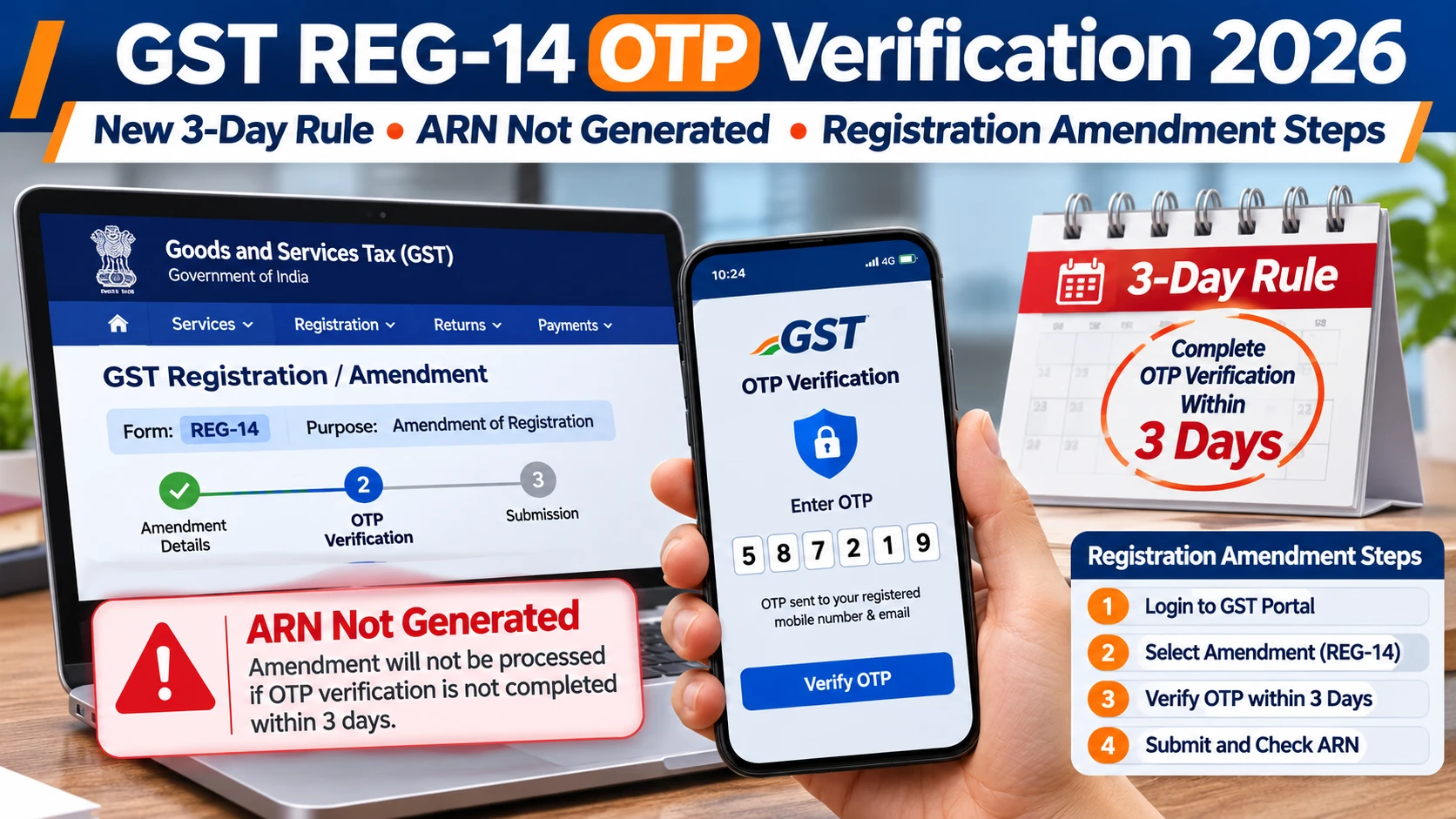
GST REG-14 OTP Verification 2026: New 3-Day Rule, ARN Not Generated and Registration Amendment Steps
SEBI NRI KYC Rules 2026: Open Investment Accounts From Abroad Without Visiting India — 7 Major Changes
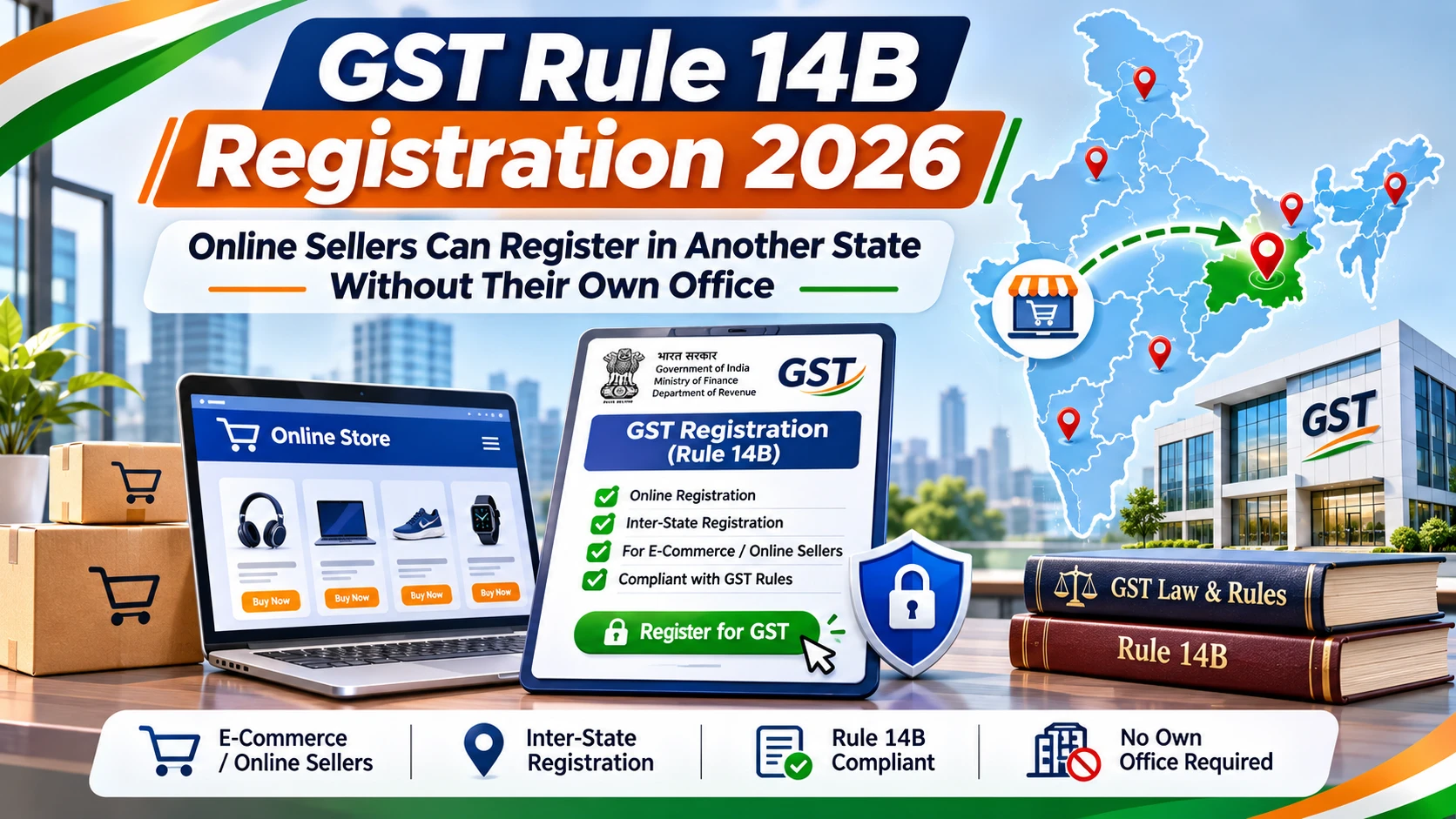
GST Rule 14B Registration 2026: How Online Sellers Can Register in Another State Without Their Own Office


How to Apply Using the Revised GST REG-01
The general online process remains centred on the official GST portal.
Step 1: Open the GST Portal
Visit https://www.gst.gov.in/ and select the registration service for a new application.
Step 2: Complete Initial Registration Details
Enter the information requested in Part A, including the business’s legal name, PAN and relevant contact details.
Complete the required verification.
Step 3: Select the Correct Business Constitution
Choose the actual legal structure of the business.
If the entity is incorporated as an OPC, use the appropriate OPC category in the revised form.
Step 4: Enter Business and Premises Details
Provide the principal and additional business addresses, as applicable, and select the correct possession arrangements.
Upload supporting documents corresponding to the selected categories.
Step 5: Complete Additional Registration Fields
Provide the relevant existing statutory registrations, nature-of-business activities, authorised-person details, bank information and any additional information required for the particular business.
Step 6: Check Identification Validation
Ensure that corporate or LLP identification numbers match official records where online validation applies.
Step 7: Submit and Save the ARN
Complete the prescribed verification and submission process.
After successful submission and validation, retain the generated ARN for tracking.
The precise sequence and screen labels should be checked on the live GST portal, as interface details may change.
Will These Changes Make GST Registration Faster?
The changes seek to standardise the information collected and improve automated verification.
Accurate data and supporting documents can reduce avoidable errors.
However, this does not mean every registration application will receive automatic approval.
Processing depends on the applicable rules, risk parameters, verification requirements and any further action required by the proper officer.
Other simplification provisions, including those under Rule 14B for eligible e-commerce sellers, have separate eligibility conditions.
Businesses should distinguish those rules from the general revision to REG-01.
What Happens if an Applicant Selects the Wrong Business Category?
Selecting an incorrect constitution of business can lead to inconsistencies in uploaded documents and validation.
For example, an OPC should not be described as a sole proprietorship if its legal incorporation is that of a company.
Applicants should correct mistakes through the available permitted procedures and follow any official notices or clarification requests.
The ability to change a specific field after submission depends on the relevant rules and application status.
Does This Affect Existing GST Registrations?
Advisory 681 focuses on changes to the registration application form.
A separate GSTN advisory addresses changes in the registration-amendment process.
Existing registered businesses should therefore avoid assuming that every change to REG-01 requires them to file a fresh registration.
They should examine whether a particular change to their business particulars requires an amendment under the applicable rules.
Is There Any Increase in GST Rates?
No GST rate increase is announced by Advisory 681.
The changes concern business-information requirements, documentation and registration procedures.
Read Also: GST Changes From November 1, 2026: Government Notifies New Discount and Refund Rules
They should not be confused with GST rate notifications, return-filing deadlines or refund amendments.
Frequently Asked Questions
1. When were the new GST REG-01 changes announced?
GSTN issued Advisory No. 681 on 1 November 2026.
2. Is OPC now a separate category?
Yes. The revised registration form includes One Person Company as a distinct business-constitution option.
3. Are bank account details mandatory at the time of registration?
Applicants should furnish available details. Where they are unavailable, the applicable post-registration requirement must be met within the prescribed period.
4. What is the 30-day deadline?
It concerns furnishing bank details where they were not available during registration, measured from issuance of the relevant REG-06 registration certificate.
5. Is there a new GST rate under Advisory 681?
No. The advisory concerns registration information and procedures.
6. Does every new GST application get automatic approval?
No. Approval and verification depend on the applicable rules and circumstances.
7. Where can applicants read the advisory?
On the official GST portal under Advisory No. 681.
Conclusion
The revised FORM GST REG-01 introduces important operational changes to India’s GST registration process.
The separate OPC category, clearer premises documentation, expanded business information and stronger online validation can help standardise applications.
However, accurate completion remains essential.
Applicants should review their business constitution, registration identifiers, premises documents and bank information before submission.
For businesses and tax practitioners, the most practical response is to use an updated registration checklist and consult the official GSTN advisory whenever uncertain.
Sources
- GSTN Advisory No. 681, dated 1 November 2026.
- Notification No. 05/2026–Central Tax, dated 26 October 2026.
- CBIC Circular No. 257/03/2026-GST, dated 26 October 2026.
Disclaimer: EduTaxTuber provides content for general educational and informational purposes only. While we make reasonable efforts to keep the information accurate and updated, laws, regulations, market conditions, software features, and other information may change. Some content may be created or assisted by AI tools and may contain errors or omissions. Readers should verify important information with official sources or qualified professionals before making any tax, legal, financial, investment, business, or other decisions. EduTaxTuber does not guarantee the completeness or accuracy of the information and does not provide professional advice.
