






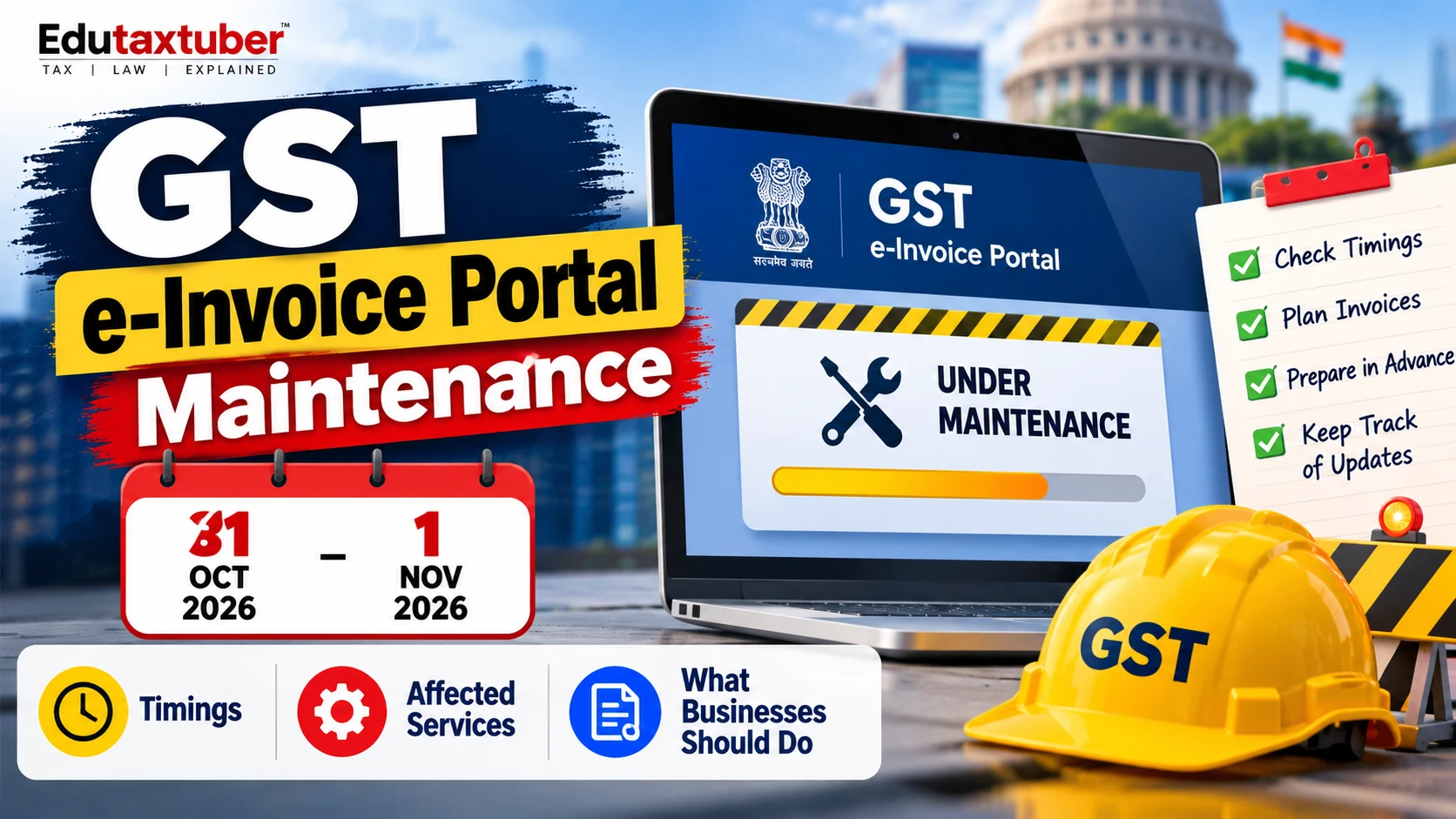
The scheduled GST e-Invoice infrastructure maintenance window ran from October 31 at 9:00 AM IST to November 1 at 1:00 PM IST, according to GSTN Advisory No. 679.
The announced window has ended. However, successful restoration of every affected function has not been independently confirmed in this update.
Three Services to Verify
- e-Invoice data retrieval: Check whether invoices from the relevant IRP can be retrieved and processed.
- GSTR-1 auto-population: Reconcile available invoice information with the original accounting records.
- JSON and API downloads: Confirm that the required data can be downloaded without errors.
What If a Service Is Still Not Working?
Check the official GSTN portal and the service status of the authorised IRP or software provider. Retain invoice records and relevant error information while investigating discrepancies.
Do not assume that the entire GST portal is unavailable or that statutory compliance deadlines have been extended.
Summary
- GSTN issued Advisory No. 679 on October 28, 2026.
- Maintenance is scheduled from October 31 at 9:00 AM to November 1 at 1:00 PM IST.
- The scheduled duration is 28 hours.
- Retrieval and processing of e-invoice data from IRPs through the affected services will be interrupted.
- Automatic population of e-invoice details in GSTR-1 will be affected.
- JSON downloads through the specified portal and APIs will be unavailable during the window.
- Businesses should save essential records and plan reconciliation activities before maintenance.
- The advisory does not explicitly establish that all independent IRP invoice-generation services will stop.
Status as of the morning of November 1, 2026: Scheduled maintenance is still within its announced 28-hour window.
According to GSTN Advisory No. 679, selected e-invoice services are scheduled for maintenance from October 31 at 9:00 AM IST until November 1 at 1:00 PM IST.
The affected functions include e-invoice data retrieval and processing, GSTR-1 auto-population and specified JSON/API downloads.
This advisory does not confirm a complete shutdown of every GST service or independent Invoice Registration Portal.
What Businesses Should Check After 1 PM
Businesses should verify that the affected services are functioning before relying on them for GST reconciliation.
Review pending e-invoice information, compare GSTR-1 auto-populated details with source records and check any failed or delayed JSON downloads.
If a problem continues, consult official GSTN updates and your authorised IRP or software provider.


GST e-Invoice Maintenance: Date and Time
| Particular | Schedule |
|---|---|
| Advisory number | GSTN Advisory 679 |
| Advisory issued | 28 October 2026 |
| Maintenance starts | 31 October 2026, 9:00 AM IST |
| Expected completion | 1 November 2026, 1:00 PM IST |
| Total scheduled duration | 28 hours |
| Official information | gst.gov.in and einvoice.gst.gov.in |
This is scheduled maintenance, not evidence of a cybersecurity attack or an unexpected tax-system failure.
The services are expected to resume after the upgrade, but businesses should verify actual availability before depending on them.
Businesses should download essential information before the maintenance window if they know it will be needed during that period.
Which GST e-Invoice Services Were Affected?
GSTN Advisory 679 identified interruptions to selected e-invoice retrieval and processing functions, GSTR-1 auto-population and JSON/API downloads during the scheduled maintenance window of 31 October–1 November 2026.
The scheduled window has ended. This does not independently establish that every affected service is functioning normally.
Does This Mean e-Invoice Generation Will Completely Stop?
The GSTN advisory lists specified services relating to retrieval, processing, auto-population and downloads.
It does not explicitly confirm that every independent Invoice Registration Portal will stop generating invoice reference numbers for the entire window.
This distinction matters for businesses using Tally, ERP software or direct IRP integrations.
The availability of invoice generation may depend on the particular IRP and integration involved.
Taxpayers should verify operational status directly with their authorised IRP or service provider.
They should not treat a general website message as permission to bypass legal requirements.
What Should Tally and ERP Users Do?
Businesses that use Tally or other accounting software should identify how their software communicates with the GST e-invoice system.
Some workflows generate data locally before transmitting it to an IRP.
Others rely on APIs to obtain invoices, status information or copies of JSON records.
Before maintenance begins, finance and IT teams should review the workflows that may depend on affected services.
Important data should be backed up in accordance with the business’s record-retention and information-security policies.
It is also sensible to confirm which services are provided by the ERP vendor and which are operated directly by GSTN.
No single workaround should be assumed to work for every software package.
These are practical preparation recommendations rather than additional legal requirements created by the advisory.
Five Checks After GST e-Invoice Maintenance
- Confirm that invoices can be retrieved from the authorised IRP.
- Reconcile auto-populated GSTR-1 information with accounting records.
- Retry any failed e-invoice JSON downloads.
- Check Tally, ERP and API integrations for outstanding errors.
- Preserve error details and follow official GSTN or IRP support guidance if problems continue.
No blanket GST return-filing deadline extension was announced through the maintenance advisory.
What About E-Way Bills?
The advisory concerns specified e-invoice-related services.
It does not announce a general shutdown of all e-way bill services.
Businesses should continue to observe applicable e-way bill and e-invoicing requirements.
An e-way bill and an e-invoice are different compliance records, and one should not automatically be treated as a legal replacement for the other.
Where a particular system is unavailable, taxpayers should consult the relevant official guidance for that service rather than assume a blanket exemption.
More Stories

ChatGPT in Excel: 5 Powerful AI Tricks to Save Time (Hindi Tutorial)
GST REG-14 OTP Verification 2026: New 3-Day Rule, ARN Not Generated and Registration Amendment Steps
SEBI NRI KYC Rules 2026: Open Investment Accounts From Abroad Without Visiting India — 7 Major Changes
GST Rule 14B Registration 2026: How Online Sellers Can Register in Another State Without Their Own Office

Will the GSTR-1 Due Date Be Extended?
The maintenance advisory does not itself extend any GSTR-1 filing deadline.
Any change to a statutory compliance date would require an appropriate separate notification or official announcement.
Businesses should plan their filing and reconciliation activities around existing obligations unless an applicable extension is formally communicated.
What Happens After Maintenance?
GSTN expects the affected services to resume after the infrastructure upgrade.
Once the maintenance window ends, businesses can check whether the relevant portal functions are operational.
They should verify whether pending data retrieval and automatic population have completed successfully.
If discrepancies remain, the business may need to reconcile the underlying invoice records and follow appropriate support procedures.
The planned completion time does not guarantee that every user or integration will experience identical restoration times.
Read Also: GST Fraud Notices 2026: CBIC’s 7 Important Rules on Evidence, SCNs and Taxpayer Rights
Frequently Asked Questions
When will the GST e-invoice maintenance begin?
Saturday, October 31, 2026, at 9:00 AM IST.
When will it end?
The expected completion time is Sunday, November 1, at 1:00 PM IST.
What is the total duration?
28 hours.
Will GSTR-1 auto-population be affected?
Yes. It is one of the specifically listed affected functions.
Will all GST services be unavailable?
No blanket shutdown of all GST services is announced.
Can businesses continue generating IRNs?
The advisory does not establish the operational status of every independent IRP’s invoice-generation function. Check the authorised service directly.
Does this extend tax-return deadlines?
No deadline extension is announced in the maintenance advisory.
Conclusion
GSTN’s scheduled e-invoice maintenance is an important operational update for businesses using automated invoicing and GST reconciliation systems.
The key preparation step is to identify which business processes rely on the affected functions.
Downloading essential records, checking reconciliations and informing billing teams can help reduce disruption.
Taxpayers should rely on official GSTN and IRP updates for service availability and avoid interpreting the advisory as a general suspension of GST compliance requirements.
Sources
- GSTN Advisory No. 679, dated 28 October 2026.
- GSTN e-Invoice Portal.
Disclaimer: EduTaxTuber provides content for general educational and informational purposes only. While we make reasonable efforts to keep the information accurate and updated, laws, regulations, market conditions, software features, and other information may change. Some content may be created or assisted by AI tools and may contain errors or omissions. Readers should verify important information with official sources or qualified professionals before making any tax, legal, financial, investment, business, or other decisions. EduTaxTuber does not guarantee the completeness or accuracy of the information and does not provide professional advice.

