










GST Registration: What Officers Can No Longer Ask, and the 7-Day Rule
Short answer
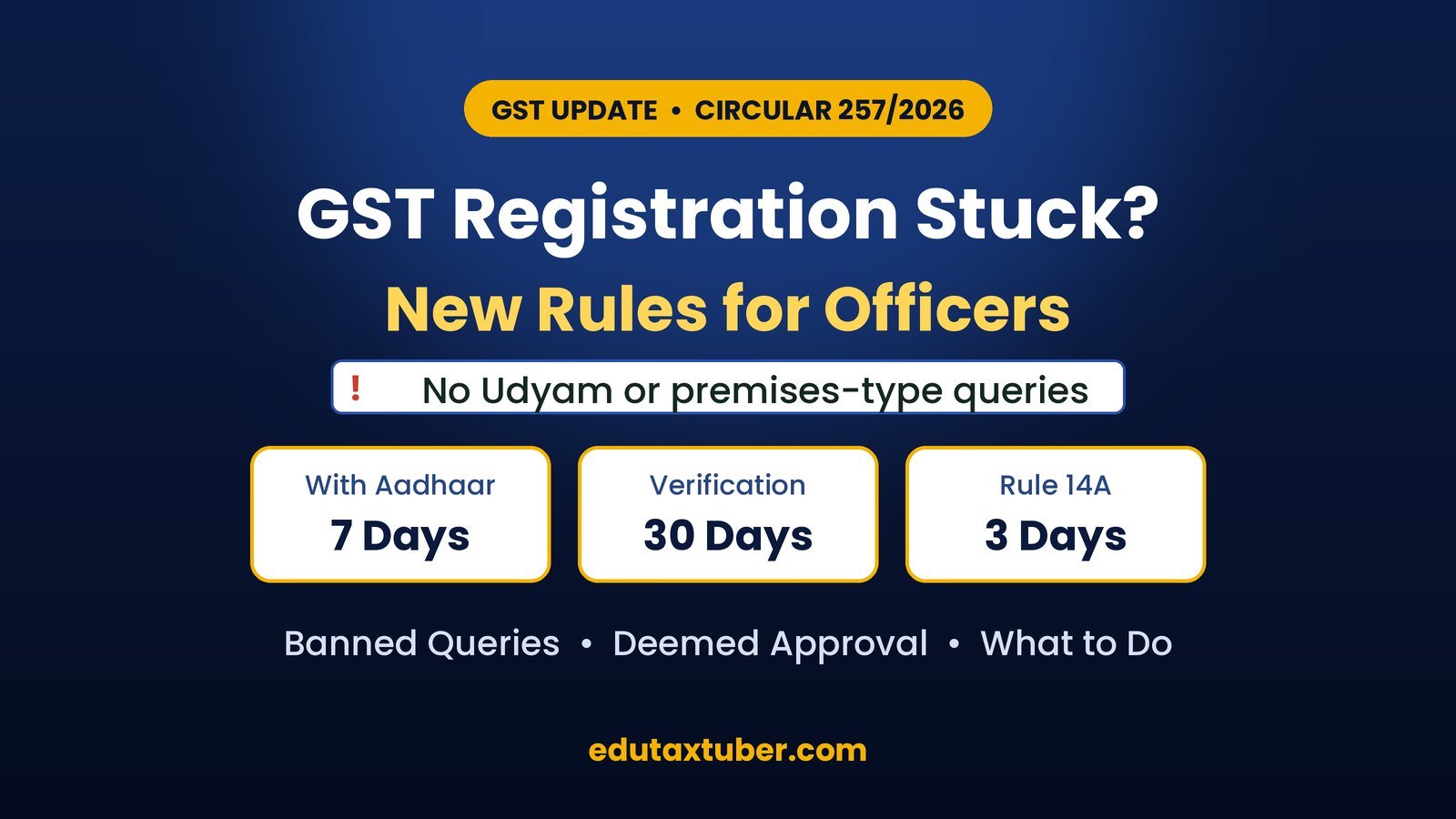
CBIC’s Circular 257/03/2026-GST, issued on 26 October 2026, lists exactly which documents GST registration needs and tells officers not to ask for anything else. With Aadhaar authentication, the application should be decided in 7 working days, or 30 if physical verification is needed. If the officer doesn’t act in time, registration is deemed approved.
At a glance
| Circular | 257/03/2026-GST, dated 26 October 2026 |
| Decision time | 7 working days with Aadhaar authentication; 30 days if physical verification applies |
| Officer queries | Only through FORM GST REG-03, and only on the prescribed list |
| Your reply | FORM GST REG-04 within 7 working days |
| If the officer misses the deadline | Registration is deemed approved |
Ask anyone who started a small business in the last few years what held them up, and GST registration comes up a lot: queries about whether the premises “looks like” a shop, requests for documents that aren’t in any rule. This circular is the government’s attempt to stop that. For the other circulars and updates, see our GST section.
What does the circular actually change?
Honestly, it doesn’t change the law. The timelines already sit in Rule 9 of the CGST Rules, and officers had internal instructions since April 2025. What’s new is that applicants now have the same rulebook in hand: a checklist of documents for each type of premises, 51 FAQs, and standard formats for a consent letter, a rent-free undertaking and a legal heir’s affidavit.
That matters more than it sounds. When an officer raises a query the circular discourages, you now have an official document to point to.
Which queries should officers no longer raise?
- Whether your premises is “suitable” for the business, or residential.
- Whether your electricity connection is domestic or commercial.
- A Udyam certificate, or other documents outside the prescribed list.
- Details on a utility bill or tax receipt beyond your name and address.
Any genuine deficiency has to be raised in FORM GST REG-03 on the portal, not by phone or email.
Also read: GSTR-9 due date for FY 2025-26: who must file and the late fee
How long should registration take?
| Your situation | Time limit |
|---|---|
| Aadhaar authentication done, not flagged as risky | 7 working days |
| No Aadhaar authentication, or physical verification triggered | 30 days |
| Simplified registration under Rule 14A (small suppliers) | 3 working days |
| After you reply in REG-04 | 7 working days for the officer to decide |
Complete Aadhaar authentication if you can. It’s the single biggest factor in whether you wait one week or a month. You also don’t need bank details at the application stage. Add them within 30 days of registration, or before you file your first GSTR-1, whichever comes first.
What should you do if your application is stuck?
- Check the application status on the GST portal. If the time limit has passed with no action, check whether it shows as approved.
- If you get a REG-03, read the query carefully and reply in REG-04 within 7 working days, answering only what’s asked.
- If the query asks for something outside the prescribed list, say so politely in your reply and cite Circular 257/03/2026-GST.
- If the delay or the demands continue, use the grievance route the circular sets out: escalate to the Chief Commissioner (central) or the Commissioner (state) for your jurisdiction.
- Keep the acknowledgement of every reply. If the application is rejected, you’ll need them for an appeal.
What else did CBIC issue the same day?
Circular 257 was one of eight issued on 26 October 2026. Two others are worth knowing about if you deal with GST notices. Circular 258 says a show cause notice must set out its full case, and that fraud or suppression has to be backed by specific evidence, not just a mismatch in returns. Circular 259 sets the pre-deposit for an appeal at 10% of the disputed tax and makes refunds of that deposit easier after a favourable order.
Update history: [date of publishing], first published. We’ll update this article if CBIC amends the circular or the registration rules.
Quick answers
Can GST registration be refused because I work from home?
Not on that ground alone. Officers are told not to question whether a residential premises is suitable. You still need the prescribed address proof and, for a rented or family-owned home, the consent document.
What is deemed approval in GST registration?
If the officer neither approves, rejects nor raises a query within the time limit, the registration is treated as approved.
Do I need a Udyam certificate for GST registration?
No. It isn’t on the prescribed list, and officers are told not to ask for it.
Related guides
Sources
- CBIC Circular No. 257/03/2026-GST, 26 October 2026: guidelines for handling applications for GST registration (cbic-gst.gov.in)
- CBIC Circulars No. 258/04/2026-GST and 259/05/2026-GST, 26 October 2026
- CGST Rules, 2017: Rules 9, 10A and 14A
Disclaimer: This article explains GST rules for general information and is not legal or tax advice. Read the circular in full or consult a GST practitioner for your case. Full disclaimer
