










22K vs 24K vs 18K Gold: Which One Should You Buy?
Short answer
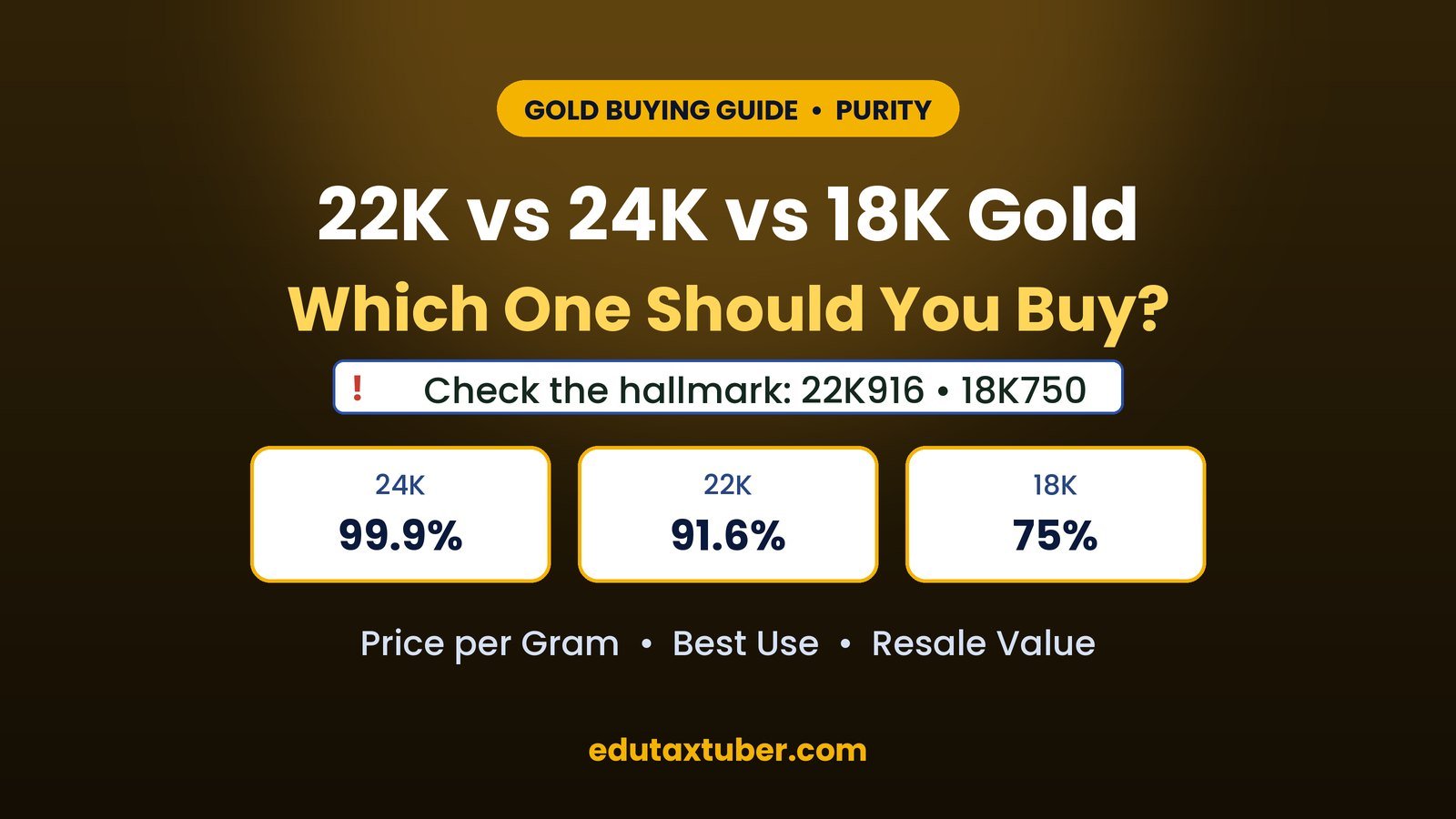
Buy 24K only as coins or bars, because it’s too soft to wear. 22K (91.6% gold) is the right choice for most jewellery and keeps the most value when you sell. 18K (75% gold) is harder, so it suits diamond and stone settings, but you get less gold for your money.
At a glance
| 24K | 99.5–99.9% gold; coins, bars, investment |
| 22K | 91.6% gold; standard for ornaments, hallmark 22K916 |
| 18K | 75% gold; diamond and stone jewellery, hallmark 18K750 |
| 14K and 9K | 58.5% and 37.5% gold; budget and daily-wear pieces |
| How to check | BIS logo, purity mark and 6-digit HUID, verifiable on the BIS CARE app |
Carat, written K, is simply a measure of how much of the metal is gold out of 24 parts. The rest is copper, silver or zinc, which makes the piece harder and changes its colour slightly. For daily gold rates and more buying guides, see our money section.
How much does each type cost per gram?
Prices move in step with purity. Using the benchmark rates from 19 November 2026, before GST and making charges:
| Purity | Gold content | Price per gram | 10 grams |
|---|---|---|---|
| 24K | 99.9% | ₹13,069 | ₹1,30,690 |
| 22K | 91.6% | ₹11,980 | ₹1,19,800 |
| 18K | 75% | ₹9,802 | ₹98,020 |
| 14K | 58.5% | about ₹7,650 | about ₹76,500 |
| 9K | 37.5% | about ₹4,900 | about ₹49,000 |
The 14K and 9K figures are worked out from the 24K rate; jewellers quote their own. Notice that 18K isn’t cheaper because it’s a worse deal. It’s cheaper because a quarter of what you’re paying for isn’t gold.
Which one should you buy?
For investment, buy 24K coins or bars, or skip physical gold. Pure gold bends and scratches easily, which is why almost nobody makes everyday jewellery from it. As a coin or bar that doesn’t matter, and there’s no real making charge. Gold ETFs and gold mutual funds avoid the storage question altogether.
For plain gold jewellery, 22K is still the sensible default. It’s durable enough for chains, bangles and wedding sets, and because it’s over 90% gold, it holds its value when you sell or exchange it. This is what most Indian families buy, and there’s a good reason for that.
For diamond or stone jewellery, 18K makes sense. The harder metal grips stones more securely, and most branded diamond jewellery is made in 18K for that reason. Just remember you’re buying it for the design and stones, not as a store of gold value.
14K and 9K are for budget, everyday pieces. They’re cheaper, tougher and easier to design. But when you sell, you’re paid only for the gold inside, so a 9K ring returns far less than its shop price suggests. Treat it as fashion jewellery, not savings.
Also read: How gold price is calculated in India: duty, GST and making charges
How do you check the purity before you buy?
- Look for three marks on the piece: the BIS logo, the purity mark, and a 6-digit alphanumeric HUID code.
- Read the purity mark. It shows carat and fineness together: 22K916, 18K750, 14K585, 20K833, 23K958 or 24K995.
- Enter the HUID in the “Verify HUID” option of the BIS CARE app. It should show the same purity and item type as the shop says.
- Make sure the bill states the carat, net weight and HUID. That’s your proof if there’s ever a dispute.
Hallmarking is mandatory for six grades: 14K, 18K, 20K, 22K, 23K and 24K. According to BIS, 9K can also be hallmarked, but it’s currently a voluntary grade, so check for the hallmark rather than assuming it.
Does purity change what you get when you sell?
Yes, and this is where the choice really shows. A jeweller buying back or exchanging your gold values it on the gold content alone. Making charges and GST you paid at purchase don’t come back. So a higher-carat piece with a lower making charge returns more of what you spent. If resale matters to you, 22K with simple designs is hard to beat.
Quick answers
What does 916 mean on gold?
It means 91.6% pure gold, which is 22 carat. It appears on the hallmark as 22K916.
Can 24K gold be used for jewellery?
It can, but it’s soft and dents or bends easily, so it’s rarely used for pieces worn every day.
Is 18K gold real gold?
Yes. It’s 75% gold mixed with other metals, and it must carry a BIS hallmark like any other mandatory grade.
Related guides
Sources
- BIS statement on mandatory hallmarking grades and HUID, March 2026 (via News On AIR)
- Bureau of Indian Standards: hallmark marks and HUID explained
- Benchmark gold rates for 19 November 2026 as published in our daily gold rate article
Disclaimer: This article is for general information and is not investment advice. Gold rates change during the day and differ by city and jeweller; prices shown use one day’s benchmark rates. Full disclaimer