









Selling or Exchanging Old Gold? What You’ll Get, Tax and Cash Rules
Short answer
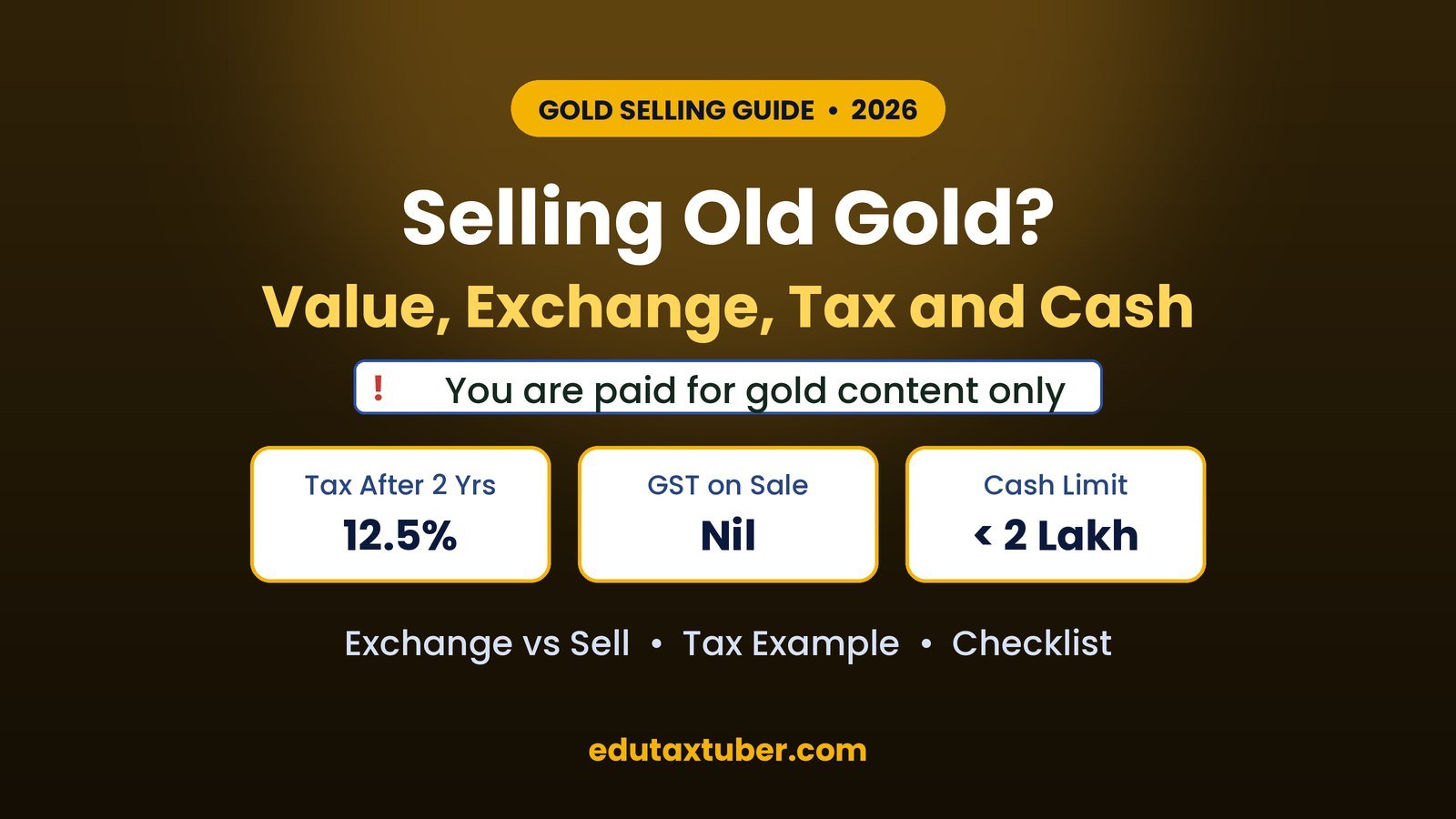
You’re paid only for the gold content, at that day’s rate, minus whatever the jeweller deducts. Making charges and GST you paid earlier don’t come back. Profit on gold held over 24 months is taxed at 12.5%, even in an exchange, and you can’t take ₹2 lakh or more in cash.
At a glance
| What you’re paid for | Net gold weight × purity × that day’s rate, minus deductions |
| GST when you sell | None, if you’re an individual selling personal jewellery |
| Tax on profit | Held over 24 months: 12.5%, no indexation. 24 months or less: your slab rate |
| Cash limit | You can’t receive ₹2 lakh or more in cash in one day or transaction |
| Purity test | Any BIS-recognised hallmarking centre: ₹200 for up to 4 items |
Most families have old gold that’s out of fashion, broken or simply unused, and the question is whether to sell it, exchange it for something new, or leave it alone. Here’s what actually happens at the counter. For daily rates and more gold guides, see our money section.
How does a jeweller value your old gold?
The jeweller weighs the piece, removes the weight of stones, beads or wax, and tests the purity, usually with an XRF machine at the counter. The value is the gold content at that day’s buying rate. Then most shops deduct something for melting loss or refining. That deduction varies a lot between shops, and it’s the number worth asking about.
Take 20 grams of 22-carat jewellery at the 19 November 2026 rate of ₹11,980 a gram:
| Item | Amount |
|---|---|
| Gold value (20 g × ₹11,980) | ₹2,39,600 |
| Deduction, if the shop takes 2% | −₹4,792 |
| You receive | ₹2,34,808 |
The 2% is only an example; ask each jeweller for their figure in writing. What you don’t get back is everything you paid on top of the gold when you bought it, including making charges and GST. That’s why heavily designed, high-making jewellery is the worst kind to sell.
Is exchanging better than selling for cash?
Often, yes. Many jewellers deduct less when you exchange old gold for new jewellery than when you sell for money, because they keep the sale. But a better exchange rate can be swallowed by high making charges on the new piece. Compare the full bill, not just the exchange value. If you don’t actually want new jewellery, selling and keeping the money is usually cleaner.
One thing people miss: an exchange still counts as a sale for income tax. The value the jeweller gives your old gold is your sale price, even though no cash changes hands.
Also read: How gold price is calculated: duty, GST and making charges
How much tax do you pay on the profit?
Gold jewellery is a capital asset. The new Income-tax Act, 2025, in force from 1 April 2026, kept the same rules for it:
- Held for more than 24 months: long-term gain, taxed at 12.5% plus cess, without indexation.
- Held for 24 months or less: short-term gain, added to your income and taxed at your slab rate.
- Inherited gold, or gold gifted by relatives or on your wedding: no tax when you receive it. When you sell, the previous owner’s purchase cost and holding period count as yours. Gifts from non-relatives worth over ₹50,000 in a year can be taxed when received.
Say the 20-gram set above was bought for ₹70,000 several years ago. The gain is ₹1,64,808, and tax at 12.5% plus 4% cess comes to about ₹21,425. Note that the ₹1.25 lakh tax-free limit people talk about applies to listed shares and equity funds, not to gold.
Two practical points. Keep the old purchase bill if you have it, because without one it’s hard to prove your cost. And if you put the sale money into buying or building a house, you may be able to claim an exemption on the long-term gain; check the conditions with a CA before you sell.
How should you get paid?
By bank transfer for anything large. Under section 186 of the Income-tax Act, 2025 (earlier section 269ST), nobody can receive ₹2 lakh or more in cash from one person in a day, in one transaction, or for one event. That applies to you as the seller. Jewellers also tend to pay bigger amounts by bank because their own tax rules discourage large cash payments. A bank transfer gives you a clean record of the sale, which helps when you report the gain in your return.
What should you do before you sell?
- Check the day’s rate for the right purity before you go.
- If the piece isn’t hallmarked, consider a purity test at a BIS-recognised assaying and hallmarking centre. It costs ₹200 for up to four items, and the test report gives you something to show the jeweller.
- Watch the weighing and the purity test, and ask for the net weight and purity in writing.
- Get quotes from two jewellers, for both selling and exchanging.
- Take a proper purchase invoice from the jeweller, and the payment by bank transfer.
Quick answers
Do I pay GST when I sell my old gold jewellery?
No. An individual selling personal jewellery isn’t running a business, so no GST applies to your sale.
Can I sell old gold that isn’t hallmarked?
Yes. Hallmarking rules apply to jewellers selling new jewellery. Your old piece will simply be tested for purity before it’s valued.
Is tax due if I exchange old gold for new jewellery?
Yes. An exchange counts as a sale, so any gain over your purchase cost is taxable as capital gains.
Related guides
Sources
- Income Tax Department: section 186, Income-tax Act, 2025 (cash receipts of ₹2 lakh or more)
- Bureau of Indian Standards: testing of consumers’ jewellery at recognised hallmarking centres
- Income-tax Act, 2025: capital gains provisions for assets other than listed securities (12.5% on long-term gains)
Disclaimer: This article is for general information and is not tax or investment advice. The deduction and tax figures are examples; your jeweller’s terms and your tax position may differ. Consult a CA for large sales. Full disclaimer