








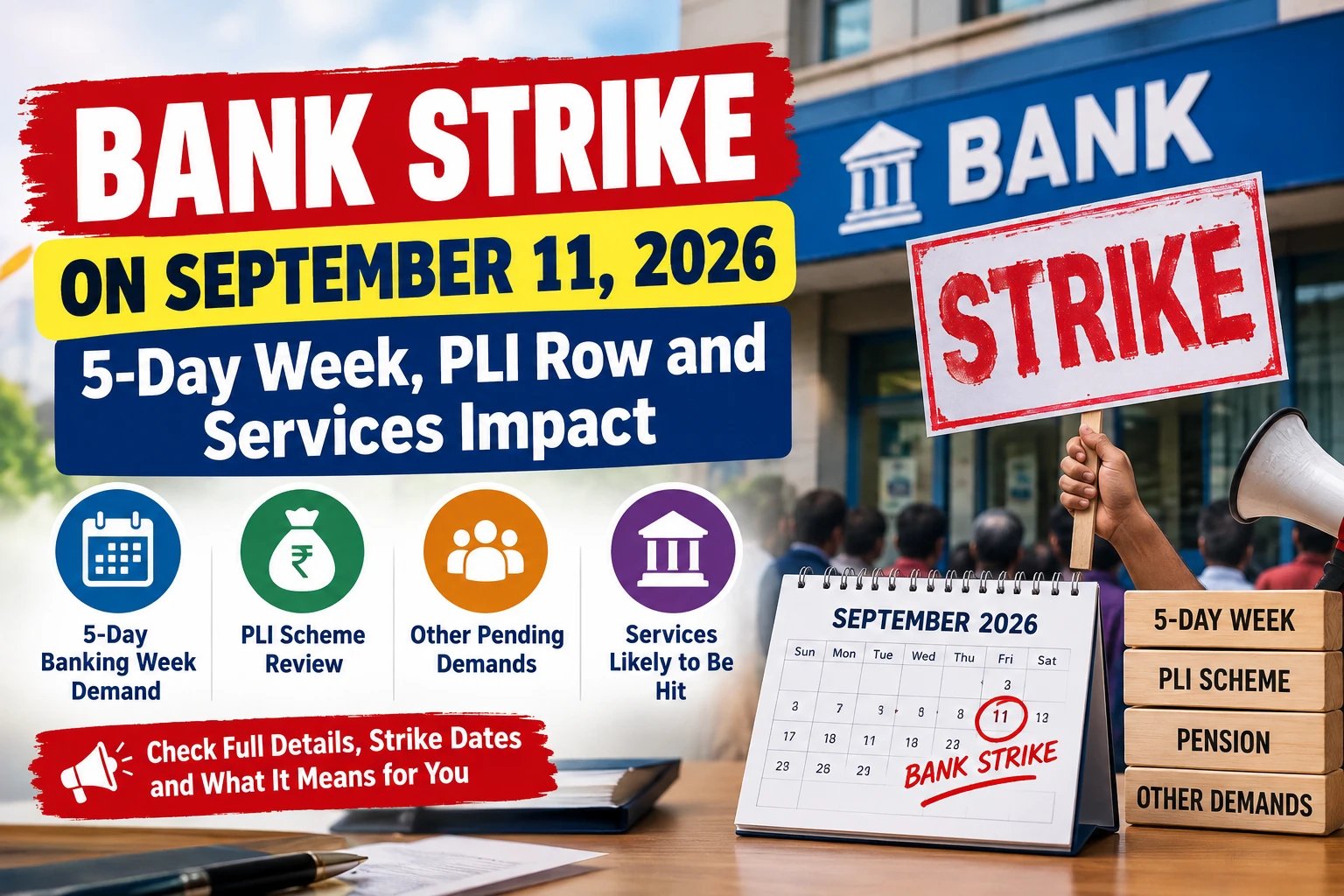
Bank Strike on September 11, 2026: 5-Day Week Demand
Summary
- Bank employees are set to strike nationwide on September 11, 2026, led by the United Forum of Bank Unions (UFBU).
- The key demands include implementation of a five-day banking week and changes to the Performance Linked Incentive (PLI) scheme.
- The Centre has decided to keep the proposed PLI scheme for FY 2025-26 in abeyance, but the five-day banking issue remains unresolved.
Bank Strike on September 11: Why Are Employees Going on Strike?
The United Forum of Bank Unions (UFBU), an umbrella organisation representing major bank employee and officer unions, has called the September 11 strike over several unresolved issues.
The most prominent demand is the implementation of a five-day banking week. Bank unions have argued that the proposal was agreed upon as part of the March 2024 bipartite settlement and subsequently recommended to the government, but it has still not been implemented.
The unions are also opposing the revised Performance Linked Incentive (PLI) structure and have raised pension-related and other pending employee issues.
Key demands of bank unions
The major issues raised by the unions include:
- Implementation of a five-day banking week.
- Withdrawal or modification of the existing PLI scheme.
- Bilateral discussions with unions before changes to the incentive structure.
- Resolution of pending pension and other employee-related issues.
The unions have described the delay in addressing these issues as unacceptable and have decided to escalate their agitation through a series of strikes.
Five-Day Banking Week: What Are Bank Unions Demanding?
The five-day banking week is one of the oldest and most prominent demands of bank employees.
Under the arrangement discussed in the 12th Bipartite Settlement/9th Joint Note, Saturdays would be declared holidays while working hours on weekdays would be increased by around 40 minutes from Monday to Friday. The proposal was subsequently recommended to the government for approval.
However, the proposal has not yet received the required government approval.
The UFBU has therefore made implementation of the five-day banking week its principal demand and has indicated that it will continue the agitation unless there is a favourable decision or a definite timeline.
For customers, implementation of a five-day banking week would mean that bank branches would generally operate from Monday to Friday, with Saturdays becoming regular holidays. Digital banking services would continue to play an important role on non-working days.
PLI Scheme for Bank Employees: What Is the Dispute?
Another major issue behind the strike is the government’s Performance Linked Incentive scheme for public sector bank employees and officers.
Bank unions have objected to the revised structure, arguing that it creates significant differences in the incentives available to different categories of employees.
The unions particularly objected to the structure applicable to senior officers and argued that PLI should instead be linked to the overall performance of the individual bank and applied more uniformly across employee and officer categories.
Recent discussions have not resolved the disagreement, keeping the issue among the central demands of the strike.
More Stories

ixigo Q2 Results: Profit Reaches ₹63.42 Crore, Revenue Rises 13% as Hotels Business Expands
FPI Outflows October 2026: Foreign Investors Withdraw ₹52,100 Crore From Indian Stocks

Paras Healthcare IPO 2026: ₹1,450 Crore Issue, Price Band, Dates and Review
57th GST Council Meeting 2026: Major Reforms Proposed for Taxpayers and Businesses



Will Banks Be Closed on September 11, 2026?
Bank branches are expected to be affected by the September 11 nationwide strike, particularly where employees participate in the industrial action.
State Bank of India has also advised customers to complete important banking transactions ahead of the strike and use digital banking channels for routine transactions.
However, the actual impact can vary between banks and locations. Customers should therefore check their individual bank’s advisory before assuming that every service will be unavailable.
Which banking services could be affected?
Customers may experience delays or disruption in services such as:
- Cash deposits and withdrawals at branches
- Cheque deposits and processing
- Cheque clearing
- KYC-related work
- Account-related branch services
- Loan processing and documentation
- Passbook-related services
- Other counter-based banking facilities
Read Also: Free Online PDF Tools: Merge, Compress, Split, Rotate & Convert (No Signup)
Digital channels such as UPI, mobile banking and internet banking are generally expected to remain available, although individual services can be affected by technical issues or scheduled maintenance.
Therefore, customers with urgent branch-related work should complete it before the strike.
Bank Strike Dates in September and October 2026
The September 11 strike is not the only industrial action announced by the UFBU.
The current strike programme includes:
| Date | Strike programme |
|---|---|
| September 11, 2026 | One-day nationwide bank strike |
| September 28–30, 2026 | Three-day nationwide bank strike |
| From October 26, 2026 | Indefinite strike warning if issues remain unresolved |
The three-day strike at the end of September is particularly significant because it coincides with the half-yearly closing period, when banks normally handle a high volume of financial and accounting-related work.
Why September 11 Bank Strike Could Cause Longer Disruption
The strike itself is scheduled for Friday, September 11. The following day is the Second Saturday, which is already a bank holiday, followed by Sunday.
This creates a potential stretch of consecutive non-working days for branch customers.
In some states, September 14 is also a holiday because of Ganesh Chaturthi, meaning the practical disruption could extend further depending on the location and the services required.
This does not necessarily mean that every banking service will stop for four days. Digital banking facilities can continue to provide many routine services, while branch operations depend on employee participation and local holiday schedules.
What Should Bank Customers Do Before September 11?
Customers who need physical bank services should avoid waiting until the last moment.
It would be sensible to complete important transactions such as:
- Cash deposits or withdrawals
- Cheque submission
- KYC updates
- Account documentation
- Loan-related paperwork
- Demand drafts or other branch services
- Other urgent counter-based transactions
For routine payments, customers can use UPI, internet banking, mobile banking and other digital payment facilities where available.
Those expecting cheque clearance should also consider possible delays because branch operations and clearing-related processes may be affected during the strike period.
What Happens If the Government and Unions Fail to Reach an Agreement?
The September 11 strike is the first major stage of the current agitation.
If the issues remain unresolved, the UFBU has announced a further three-day strike from September 28 to September 30.
The unions have also warned of an indefinite nationwide strike from October 26, 2026 if their demands continue to remain unaddressed.
The eventual outcome will depend on discussions between the government, IBA and bank unions. The government’s decision to keep the PLI scheme in abeyance could provide room for further negotiations, but the five-day banking week remains a major point of disagreement.
Disclaimer: EduTaxTuber provides content for general educational and informational purposes only. While we make reasonable efforts to keep the information accurate and updated, laws, regulations, market conditions, software features, and other information may change. Some content may be created or assisted by AI tools and may contain errors or omissions. Readers should verify important information with official sources or qualified professionals before making any tax, legal, financial, investment, business, or other decisions. EduTaxTuber does not guarantee the completeness or accuracy of the information and does not provide professional advice.