








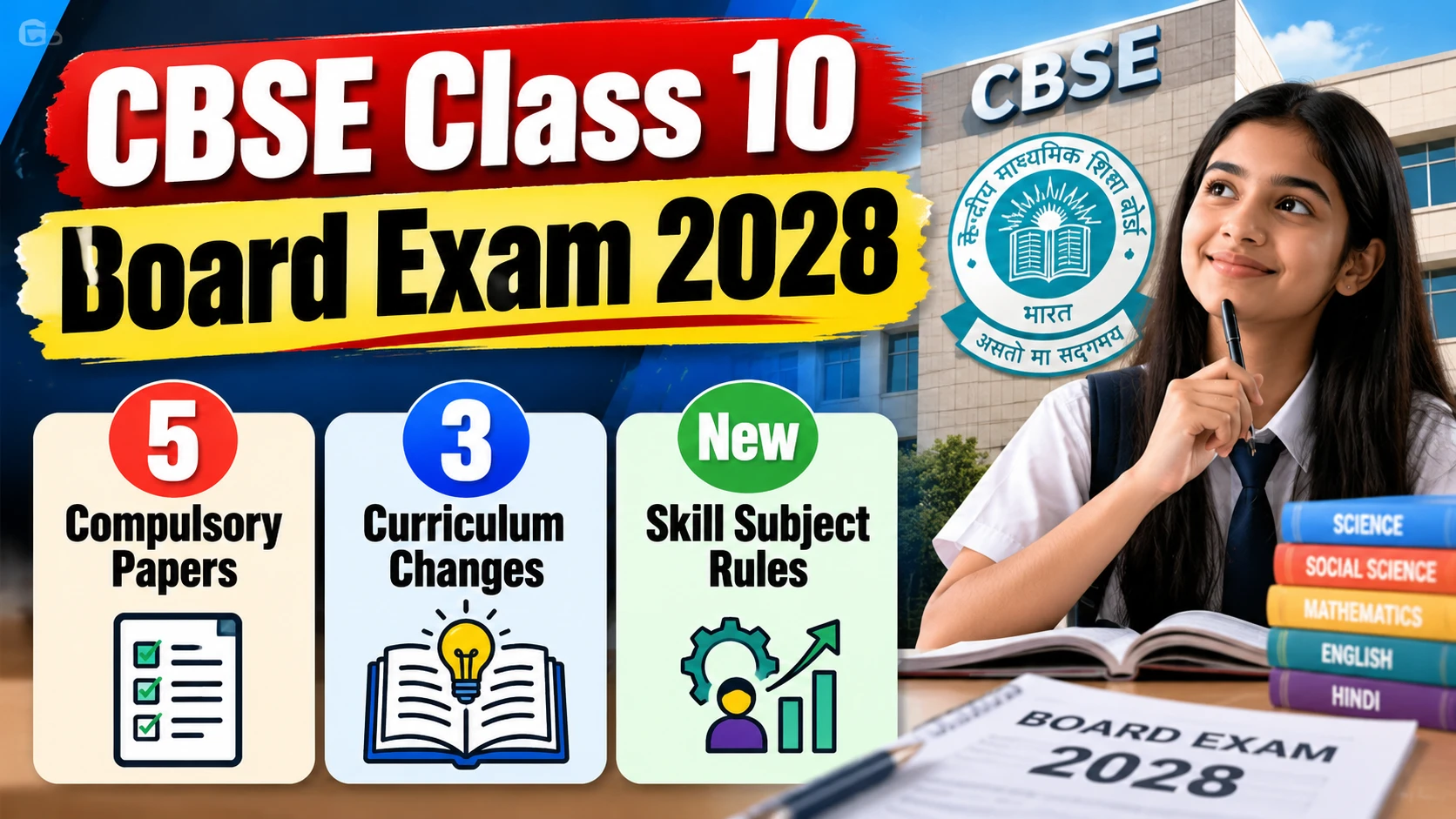
The Central Board of Secondary Education (CBSE) has issued an important clarification about the subjects and assessment requirements for students currently studying in Class 9 during the 2026–27 academic session.
Summary
- CBSE issued Circular Acad-70/2026 on October 29, 2026.
- The changes apply to students in Class 9 in 2026–27 who will take Class 10 examinations in 2028.
- Five core board subjects remain: two languages, Mathematics, Science and Social Science.
- Students continue studying nine compulsory curricular areas.
- Vocational Education remains compulsory.
- Students may choose Kaushal Vikas or one of 22 notified skill subjects.
- Selected skill subjects may require a board examination instead of only school-based assessment.
- Three specific curricular components are excluded for this batch.
- Students currently in Class 10 in 2026–27 remain under their existing scheme.
What Has CBSE Changed?
CBSE has clarified the implementation of the Scheme of Studies for the affected Class 9 batch.
The changes are intended to align the introduction of newer curricular areas with their planned implementation schedule and avoid unnecessary confusion about assessment requirements.
The board has clarified that the following will not form part of the curriculum for the specified batch:
- Individuals in Society, for Class 9 in 2026–27.
- Modules of Computational Thinking and Artificial Intelligence, for Class 9 in 2026–27.
- Environmental Education, for Class 10 in 2027–28.
This does not mean CBSE has abandoned AI education or environmental learning generally.
The exclusion applies to the specified curricular components and implementation period described in the circular.
Schools and students should follow the prescribed curriculum for the applicable academic session.
Five Core Class 10 Board Subjects
The five main board-examination subjects are:
| Core subject | Board examination |
|---|---|
| Language R1 | Yes |
| Language R2 | Yes |
| Mathematics | Yes |
| Science | Yes |
| Social Science | Yes |
These form the five core subjects for the relevant Class 10 examinations.
However, it would be incorrect to say that no student can have any additional board paper.
The applicable rules permit selected additional and vocational subjects with different assessment arrangements.
Nine Compulsory Curricular Areas Explained
The Scheme of Studies continues to include nine compulsory curricular areas:
- Language R1
- Language R2
- Mathematics
- Science
- Social Science
- Language R3
- Art Education
- Physical Education and Well-being
- Vocational Education
Read Also: CBSE School-to-Work Summit 2026: 4 Key Priorities for Students and Future Careers
The important distinction is between subjects students must study and subjects assessed through the board examination.
For example, the third language is included in the compulsory curriculum but is assessed through the applicable school-based internal assessment.
Art Education and Physical Education and Well-being also have school-based assessment requirements.
The treatment of Vocational Education depends on the option selected.
Vocational Education Remains Compulsory
CBSE has clarified that Vocational Education continues as a compulsory curricular area.
Students may choose either Kaushal Vikas or one of the 22 notified skill subjects.
Kaushal Vikas follows school-based internal assessment.
A student selecting one of the specified skill subjects will be assessed according to that subject’s prescribed examination scheme, which includes a board examination in Class 10.
This distinction is particularly important for students and parents preparing an examination schedule.
A school should communicate the available options and the relevant assessment rules before subject selection is finalised.
Which Skill Subjects Are Available?
CBSE’s published list includes subjects such as Information Technology, Artificial Intelligence, Data Science, Retail, Banking and Insurance, Agriculture, Healthcare, Marketing and Sales, Tourism and Electronics and Hardware.
A total of 22 skill subjects is notified under the applicable framework.
Not every school necessarily offers all available subjects. Availability may depend on school approval, facilities, teachers and other requirements.
Students should therefore confirm their options directly with their school.
More Stories

Hindalco Q2 Results 2026: Profit Jumps 59% to ₹7,533 Crore, Copper EBITDA Surges 164% — 5 Key Investor Takeaways
XLOOKUP in Excel: 3 Powerful Tricks for Multiple Columns (Hindi)
ChatGPT in Excel: 5 Powerful AI Tricks to Save Time (Hindi Tutorial)
GST REG-14 OTP Verification 2026: New 3-Day Rule, ARN Not Generated and Registration Amendment Steps


Is Artificial Intelligence Removed From CBSE?
No. That would be an inaccurate interpretation.
The circular excludes the specified Computational Thinking and AI modules from the curriculum for the affected Class 9 cohort during 2026–27.
At the same time, Artificial Intelligence remains on CBSE’s notified list of vocational or skill subjects.
The difference between an interdisciplinary module and a separately offered skill subject is important.
A school may continue offering an approved AI skill subject under its applicable rules even though the specified CT and AI modules have been excluded from this particular batch’s curricular implementation.
Parents should avoid headlines that suggest AI education has been discontinued across all CBSE classes.
What About Mathematics and Science at Advanced Level?
CBSE’s Scheme of Studies also provides for optional advanced-level Mathematics and Science subjects under the applicable rules.
These options have their own assessment arrangements.
Students considering advanced courses should consult their school’s subject-selection guidance and the official syllabus.
The existence of optional advanced-level subjects does not mean that all students must sit additional advanced examinations.
Does the Change Affect the 2027 Board Examination?
No. The circular specifically clarifies that the existing Scheme of Studies continues for students studying in Class 10 during the 2026–27 academic session.
Those students are not the same cohort as the Class 9 students covered by the newly clarified rules.
The new clarification is mainly relevant to the 2028 Class 10 board-examination batch.
This distinction should be explained clearly in school communications to prevent unnecessary confusion.
Why Is This Important for Parents?
When students hear that nine curricular areas are compulsory, some may assume that all nine require external board examinations.
That can create unnecessary anxiety.
The revised clarification helps families distinguish between regular coursework, school-based assessment and board-assessed subjects.
It also makes subject selection more important, particularly where vocational education or additional courses are concerned.
Parents should understand the assessment pattern before helping a student choose subjects.
What Should Schools Do?
CBSE-affiliated schools should review Circular Acad-70/2026 and the corresponding Scheme of Studies.
They should explain the assessment requirements to affected students, including the compulsory curricular areas and the consequences of choosing particular skill or optional subjects.
Schools should also avoid relying on outdated subject charts when advising parents.
Official circulars and the current academic curriculum should take precedence over informal social-media explanations.
Frequently Asked Questions
1. When did CBSE announce the revised Scheme of Studies?
CBSE issued Circular Acad-70/2026 on October 29, 2026.
2. Who will be affected?
Students currently studying in Class 9 during 2026–27 and progressing to Class 10 during 2027–28.
3. How many compulsory board subjects are there?
Five core subjects: two languages, Mathematics, Science and Social Science.
4. Do students still have to study nine curricular areas?
Yes. Nine compulsory curricular areas remain, with different assessment requirements.
5. Is Vocational Education compulsory?
Yes. Students may choose Kaushal Vikas or one of the notified skill subjects.
6. Is AI removed entirely from the curriculum?
No. Specific CT and AI modules are excluded for this batch, while AI remains among the notified skill-subject options.
7. Does this change apply to students taking Class 10 boards in 2027?
No. The existing scheme continues for the current Class 10 batch.
8. Where can parents check the official rules?
The CBSE Academic website and the official Scheme of Studies provide the applicable information.
Conclusion
CBSE’s latest clarification offers greater certainty for students preparing for Class 10 examinations in 2028.
The five core board subjects remain important, but students continue studying additional compulsory curricular areas.
Vocational Education remains compulsory, and assessment depends on the selected option.
Parents and schools should use the official Scheme of Studies when making subject choices rather than assuming that every compulsory subject requires a board examination.
Sources
- CBSE Academic Circular Acad-70/2026, dated October 29, 2026.
- CBSE Scheme of Studies, Class IX 2026–27.
- The Indian Express, October 30, 2026.
- NDTV Education, October 30, 2026.
Disclaimer: EduTaxTuber provides content for general educational and informational purposes only. While we make reasonable efforts to keep the information accurate and updated, laws, regulations, market conditions, software features, and other information may change. Some content may be created or assisted by AI tools and may contain errors or omissions. Readers should verify important information with official sources or qualified professionals before making any tax, legal, financial, investment, business, or other decisions. EduTaxTuber does not guarantee the completeness or accuracy of the information and does not provide professional advice.