









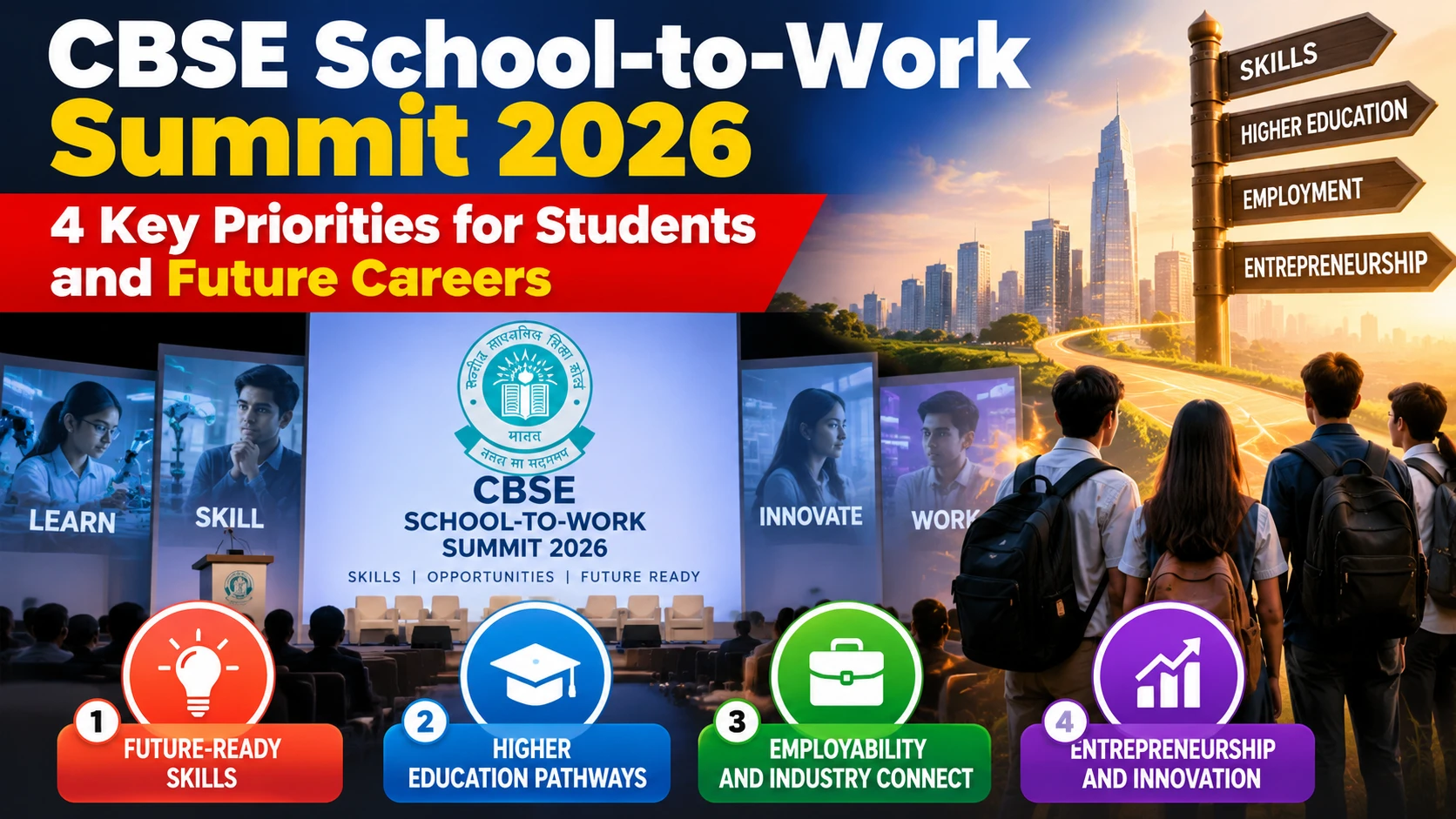
The Central Board of Secondary Education (CBSE) is organising its fourth National Summit on “Facilitating School-to-Work Transition” in New Delhi on October 26–27, 2026.
Summary
- CBSE’s fourth National Summit is being held on October 26–27, 2026.
- The event focuses on connecting school education with skills, higher education and employment.
- Digital literacy and online safety are among the priorities.
- The National Credit Framework is being discussed as a mechanism for recognising learning and skills.
- Career guidance and equitable access to opportunities are important themes.
- The summit itself does not announce changes to CBSE board examinations or mandatory subjects.
What Is the CBSE School-to-Work Summit 2026?
The summit is an education-focused event organised by CBSE in association with the Sahodaya School Complexes of Delhi/NCR.
Its purpose is to explore how students can make a smoother transition from school education to vocational training, higher education and employment.


Traditional classroom education provides essential subject knowledge. However, students also need opportunities to develop communication, critical thinking, problem-solving and digital skills.
The summit encourages discussion about integrating these competencies into everyday teaching.
Education Secretary T. K. Anil Kumar and CBSE Chairman Dr. Mandeep Bhandari attended the inaugural session on October 26.
The programme includes expert discussions and presentations of educational practices from CBSE-affiliated schools.
1. Technology, Digital Safety and Practical Skills
Technology has become an important part of education and professional life.
Students increasingly use digital platforms for research, assignments, communication and learning.
But familiarity with mobile phones and social media does not necessarily mean that students possess strong digital skills.
Digital literacy also involves evaluating online information, protecting personal data, identifying fraud and using productivity tools responsibly.
For example, a student who knows how to prepare spreadsheets, create presentations and analyse simple datasets may find it easier to manage academic projects.
Similarly, understanding online privacy can help students avoid phishing, suspicious links and misuse of personal information.
The summit identifies technology, digital safety and skills as one of its major priorities.
This does not mean CBSE has announced a new compulsory digital-skills subject for every student.
2. Creativity, Design and Innovation
The second major priority concerns creativity and innovation.
Students benefit when schools encourage them to identify problems, explore possible solutions and explain their thinking.
Such learning can happen through practical assignments, science projects, presentations and collaborative activities.
Consider a group of students investigating water wastage in their school.
They might collect information, study patterns, prepare charts and suggest improvements.
This process involves mathematics, science, teamwork and communication.
Activities like these illustrate how practical learning can complement traditional textbooks.
The summit’s discussion of innovation aims to encourage broader consideration of these approaches.
3. National Credit Framework and Skill Recognition
The National Credit Framework seeks to support recognition of learning across different education and skill-development pathways.
It is relevant to discussions about integrating academic and vocational education.
Under applicable frameworks, credits can help record recognised learning achievements.
The broader objective is to provide students with more flexible opportunities to develop qualifications and skills.
However, students should understand that participation in a private workshop or online course does not automatically generate recognised academic credits.
Credit recognition depends on the applicable institutional requirements and approved framework.
The summit is discussing how recognition mechanisms can support transitions between different forms of learning.
4. Career Guidance and Equal Opportunities
Career decisions can be difficult for school students.
Many students know about a limited number of occupations and may lack reliable information about other career paths.
Effective guidance can help them understand available courses, entrance requirements, scholarships, vocational training and industry expectations.
Students interested in technology, for example, may benefit from learning about software development, data analysis, cybersecurity and related educational pathways.
Other students may prefer careers in healthcare, education, manufacturing, skilled trades, finance or creative industries.
Career counselling should help students make informed decisions rather than pressure everyone towards the same profession.
Equitable access is particularly important because students from different socioeconomic backgrounds may not have equal exposure to educational opportunities.
Read Also: Tamil Nadu Assembly Passes NEET Abolition Resolution: Vijay Govt’s Historic Education Move Explained
Why Is the Summit Important for Students?
The relationship between educational qualifications and practical skills has become increasingly important.
Academic performance remains valuable, but students also benefit from the ability to communicate, adapt, work in teams and solve unfamiliar problems.
Digital technology is changing how many industries operate.
At the same time, career pathways continue to evolve.
The summit provides an opportunity for educators and policymakers to explore how schools can prepare students for this changing environment.
It should be viewed as a discussion about improving future readiness, not as an announcement guaranteeing employment.
More Stories

Hindalco Q2 Results 2026: Profit Jumps 59% to ₹7,533 Crore, Copper EBITDA Surges 164% — 5 Key Investor Takeaways
XLOOKUP in Excel: 3 Powerful Tricks for Multiple Columns (Hindi)
ChatGPT in Excel: 5 Powerful AI Tricks to Save Time (Hindi Tutorial)
GST REG-14 OTP Verification 2026: New 3-Day Rule, ARN Not Generated and Registration Amendment Steps



What Does the Summit Mean for Teachers?
Teachers play an important role in connecting classroom knowledge with practical applications.
The summit includes case-based presentations and posters highlighting teaching approaches adopted by CBSE-affiliated schools.
These discussions may help teachers exchange ideas about skill education, assessment and the use of digital resources.
For example, mathematics teachers may incorporate real-world budgeting exercises, while science teachers may encourage students to investigate local environmental issues.
The appropriate approach will depend on student needs, educational resources and applicable school requirements.
What Should Parents Do?
Parents can support students by encouraging balanced skill development.
This may include reading, mathematics, communication, responsible technology use and participation in practical activities.
They should also help children explore interests without expecting an immediate career decision at a very young age.
When reviewing courses or training programmes, parents should verify the credibility of the institution, fees, recognition and expected outcomes.
The summit does not require parents to enrol children in any newly announced paid training scheme.
Has CBSE Announced Changes to Board Exams?
No examination-pattern change is established by the summit announcement.
The Ministry of Education release focuses on skills, educational pathways and career readiness.
Students should rely on separate official CBSE circulars for board examination schedules, registration requirements, syllabuses and assessment rules.
Frequently Asked Questions
1. When is the CBSE School-to-Work Summit 2026?
The summit is being held on October 26–27, 2026, in New Delhi.
2. Who organised the event?
CBSE, in association with the Sahodaya School Complexes of Delhi/NCR.
3. What are the four main priorities?
Technology and digital safety, creativity and innovation, recognition of skills through the National Credit Framework, and career guidance.
4. Does the summit introduce new mandatory CBSE subjects?
No such change has been announced through the summit release.
5. Does the summit guarantee jobs for students?
No. Its purpose is to improve education-to-career pathways, not provide employment guarantees.
6. Where can students check official CBSE announcements?
Students can visit the official CBSE website at https://www.cbse.gov.in/.
Conclusion
CBSE’s School-to-Work Summit 2026 highlights the growing importance of combining academic education with practical skills and informed career planning.
The four priorities could help guide discussions on preparing students for future opportunities.
However, students and parents should distinguish policy discussions from formally announced changes to examinations or curriculum requirements.
Sources
- Ministry of Education, Press Information Bureau, October 26, 2026.
- CBSE official website and education circulars.
- Education Times, October 26, 2026.
- Careers360, October 26, 2026.
Disclaimer: EduTaxTuber provides content for general educational and informational purposes only. While we make reasonable efforts to keep the information accurate and updated, laws, regulations, market conditions, software features, and other information may change. Some content may be created or assisted by AI tools and may contain errors or omissions. Readers should verify important information with official sources or qualified professionals before making any tax, legal, financial, investment, business, or other decisions. EduTaxTuber does not guarantee the completeness or accuracy of the information and does not provide professional advice.