









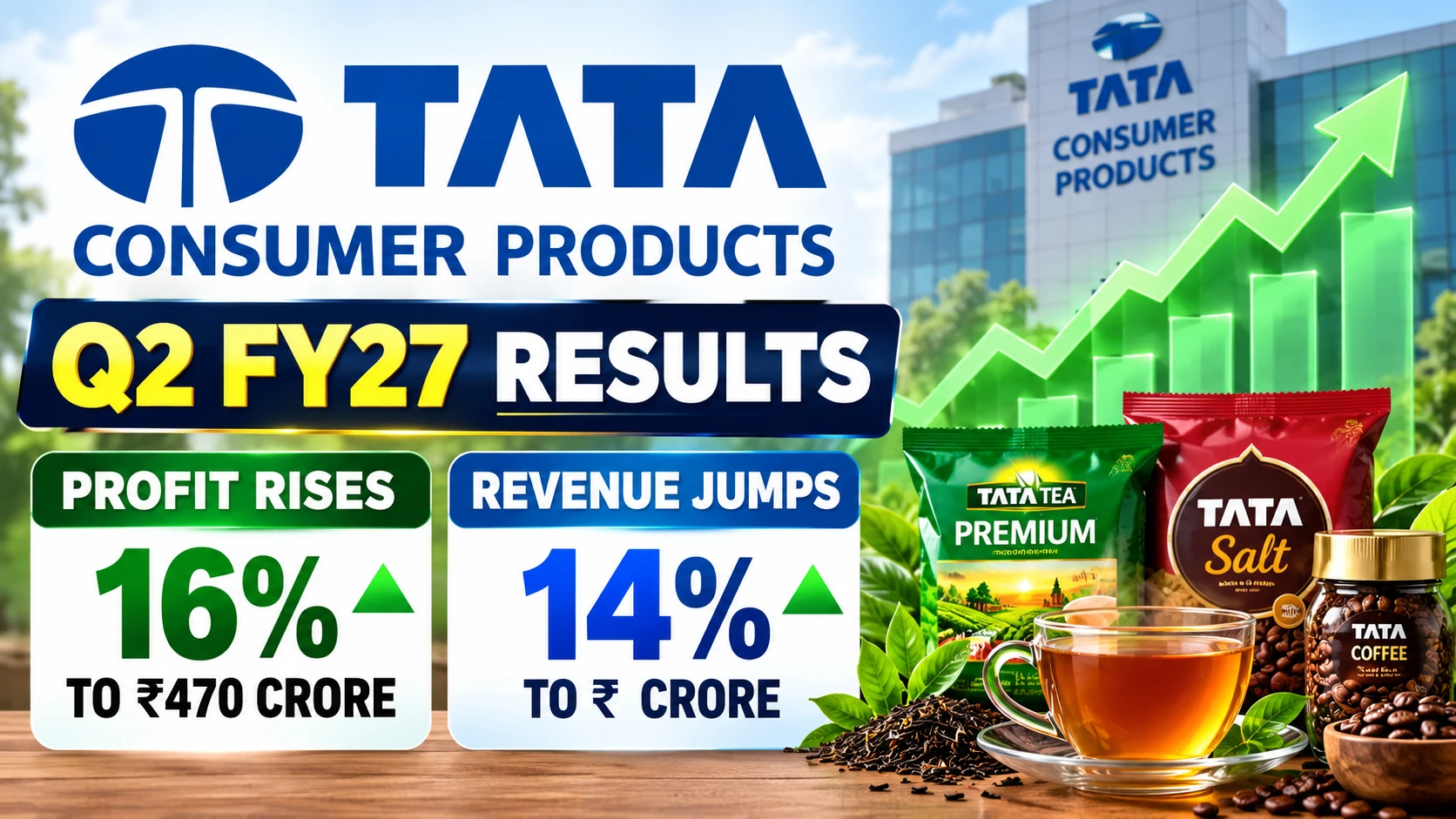
Tata Consumer Products Limited reported a strong performance for the quarter ended September 30, 2026, supported by higher sales in its India branded business, growing demand for packaged foods and ready-to-drink beverages, and improving profitability.
Summary
- Consolidated revenue increased 14% to ₹5,661 crore.
- Group net profit rose approximately 16% to ₹470 crore.
- Consolidated EBITDA increased 18% to ₹794 crore.
- India branded business recorded 11% underlying volume growth.
- Growth businesses expanded 40% and contributed 38% of the India business.
- Tata Sampann revenue increased 57%, while ready-to-drink beverages grew 47%.
- Tata Starbucks revenue rose 15%, with 505 stores across 81 Indian cities at quarter-end.
Tata Consumer Q2 FY27 Financial Performance
Tata Consumer Products reported continued revenue and profit growth during the September quarter.
The company’s performance reflected a combination of higher underlying volumes, product innovation and growth in newer categories.
Q2 FY27 Results at a Glance

| Financial Indicator | Q2 FY27 | Year-on-Year Change |
|---|---|---|
| Revenue from operations | ₹5,661 crore | +14% |
| Consolidated EBITDA | ₹794 crore | +18% |
| Group net profit | ₹470 crore | +16% |
| India branded underlying volume growth | 11% | Reported quarterly growth |
| Growth businesses revenue growth | — | +40% |
Source: Tata Consumer Products’ official quarterly results announcement.
EBITDA, or earnings before interest, tax, depreciation and amortisation, is commonly used to assess operational profitability.
It is not the same as net profit or cash generated from operations.
The 18% increase in EBITDA exceeded the company’s 14% revenue growth, suggesting that operational earnings grew faster than sales during the period.
However, a full assessment of profitability also requires examining product mix, costs, capital expenditure and cash flows.
India Branded Business Records 11% Volume Growth
India’s branded business remained a major contributor to the company’s financial performance.
Underlying volume growth reached 11%, reflecting stronger demand across several product categories.
Volume growth is an important indicator because it helps distinguish higher sales arising from increased product consumption from revenue growth driven mainly by higher selling prices.
The quarter demonstrated that demand remained healthy in several parts of Tata Consumer’s domestic portfolio.
Salt Revenue Rises 15%
The salt business recorded 15% revenue growth during the September quarter.
The company attributed the performance to strong volume growth.
Salt is a frequently purchased household product, and its performance is closely connected to distribution reach, brand penetration and consumer demand.
For Tata Consumer, growth in this established category provided support alongside faster-growing packaged-food businesses.
Tea Volumes Remain Flat
The India tea business faced a comparatively difficult quarter.
According to the official announcement, tea volumes remained flat amid subdued category demand.
Revenue declined marginally as the gap between volume growth and revenue growth narrowed following pricing actions.
This is important because tea is one of the company’s established categories.
The weakness indicates that not every part of the consumer portfolio experienced the same momentum.
Investors should examine whether tea demand improves in subsequent quarters and how selling prices affect profitability.
Tata Sampann Revenue Jumps 57%
Tata Sampann was among the strongest-performing businesses during the quarter.
Revenue increased 57%, supported by growth in its core products and expansion into newer categories.
The brand’s product portfolio includes pulses, spices, cold-pressed oils and dry fruits.
Its performance suggests that packaged-food categories continue to offer significant growth opportunities.
Changing purchasing preferences, distribution expansion and product availability can influence demand for branded food products.
However, a high quarterly growth rate does not automatically mean that the business contributes the largest amount of revenue or profit.
The absolute size and profitability of the category should also be considered.
Read Also: Supreme Court to Examine EY US ₹24.06 Crore Employee Secondment Tax Dispute
Ready-to-Drink Business Grows 47%
Tata Consumer reported 47% revenue growth in its ready-to-drink business.
The company attributed this growth to distribution expansion, premiumisation and product innovation.
Ready-to-drink beverages are an important category because they enable the company to participate in consumption occasions beyond traditional packaged tea and coffee.
Expansion into different formats and price points may help the business reach additional consumers.
Nevertheless, competition, seasonal demand and distribution costs will remain important factors affecting long-term profitability.
Growth Businesses Expand 40%
One of the most significant developments in the quarter was the performance of the company’s growth businesses.
These operations recorded 40% revenue growth and represented 38% of the India business.
The portfolio includes newer and expanding categories such as Tata Sampann, ready-to-drink beverages and other branded food and beverage products.
This increasing contribution indicates a broader diversification of the company’s India business.
More Stories

Hindalco Q2 Results 2026: Profit Jumps 59% to ₹7,533 Crore, Copper EBITDA Surges 164% — 5 Key Investor Takeaways
XLOOKUP in Excel: 3 Powerful Tricks for Multiple Columns (Hindi)
ChatGPT in Excel: 5 Powerful AI Tricks to Save Time (Hindi Tutorial)
GST REG-14 OTP Verification 2026: New 3-Day Rule, ARN Not Generated and Registration Amendment Steps




Why Is This Important?
An established consumer company can become less dependent on any single product category by expanding into adjacent markets.
For Tata Consumer, growth in packaged foods and beverages helps balance the performance of traditional categories such as tea.
But investors should also monitor whether faster-growing categories deliver sustainable profitability, rather than focusing only on revenue expansion.
Capital Foods and Organic India Performance
Capital Foods and Organic India recorded combined revenue growth of 15%.
The company reported that shipping disruptions affected export performance.
Domestic revenue from these businesses grew 24%, indicating stronger momentum in India than in their combined overall sales.
The results show how international logistics conditions can influence the performance of consumer companies even when domestic demand is improving.
Export costs, supply-chain disruptions and foreign-market conditions can affect sales and operating margins.
Tata Starbucks Revenue Rises 15%
Tata Starbucks reported 15% revenue growth during the September quarter.
The company described its same-store sales growth as a multi-quarter high.
Same-store sales growth measures sales performance at comparable established outlets and is useful because it helps separate existing-store demand from expansion through new locations.
Tata Starbucks also completed its fifth consecutive quarter of positive same-store sales growth.
At the end of September 2026, the business operated 505 stores across 81 cities in India.
Seven net new stores were added during the quarter, including two Reserve stores.
What Does This Mean?
A rise in same-store sales can be an encouraging indicator of customer demand and store productivity.
However, revenue growth alone does not establish the business’s net profitability.
Factors such as rent, employee expenses, input costs and operating leverage influence the economic performance of restaurant and café operations.
International Business Revenue Grows 7%
Tata Consumer’s international business recorded 7% reported revenue growth.
However, revenue declined approximately 2% in constant-currency terms.
This distinction is important.
Reported revenue reflects changes in exchange rates, while constant-currency growth seeks to show business performance without the effect of currency translation.
A business may therefore report higher revenue in rupees even when underlying sales decline in local-currency terms.
The company noted that its international operations were comparing against a strong prior-year base.
In the United Kingdom, unusually hot weather affected category consumption.
Tetley nevertheless outperformed the broader category.
The Canadian business grew ahead of its market in regular and specialty segments, according to the company.
Product Innovation: 22 New Launches
Tata Consumer introduced 22 products during the quarter.
The launches focused on areas such as health and wellness, convenience and premiumisation.
Product innovation is an important component of the company’s strategy to broaden its portfolio and reach consumers across different categories.
However, launching more products does not guarantee higher profitability.
New products require investment in product development, distribution, marketing and inventory.
Investors should watch whether new offerings achieve repeat purchases and sustainable margins.
What Did Management Say?
Managing Director and CEO Sunil D’Souza highlighted the company’s second consecutive quarter of double-digit revenue growth in FY27.
Management attributed the performance to strong underlying volumes in India, improved operating execution and expanding growth businesses.
The company also discussed its investment in AI-led initiatives across sales and operations.
According to management, these initiatives are intended to improve productivity and strengthen the company’s operating capabilities.
The next few quarters will help indicate whether these projects generate measurable efficiency improvements.
What Do the Results Mean for Investors?
Tata Consumer’s September-quarter performance contains several encouraging indicators.
Revenue increased at a double-digit rate, EBITDA grew faster than revenue, and newer categories recorded strong growth.
The expanding contribution of growth businesses may improve diversification over time.
However, investors should also consider weaker tea demand, international currency effects, competition and the profitability of new products.
A company’s financial results do not independently establish whether its stock is attractively valued.
The investment decision also depends on the market price, expected future earnings, valuation multiples and individual risk tolerance.
What Should Investors Watch Next?
Several operating indicators deserve attention over the coming quarters.
First, whether India volume growth remains strong.
Second, whether tea demand recovers and pricing conditions stabilise.
Third, the contribution of Tata Sampann and ready-to-drink categories to future revenue and profitability.
Fourth, whether Tata Starbucks can sustain positive same-store sales growth while expanding its network.
Finally, whether international revenue improves on a constant-currency basis.
These measures will help investors assess whether the company’s current momentum is sustainable.
Frequently Asked Questions
1. What was Tata Consumer’s Q2 FY27 net profit?
The company reported group net profit of approximately ₹470 crore, up 16% year-on-year.
2. What was its total revenue?
Consolidated revenue from operations reached ₹5,661 crore, an increase of 14%.
3. How much did EBITDA grow?
Consolidated EBITDA rose 18% to ₹794 crore.
4. Which business recorded the strongest reported growth?
Among the selected categories highlighted in the announcement, Tata Sampann recorded 57% revenue growth.
5. How many Tata Starbucks stores were operating?
Tata Starbucks operated 505 stores across 81 Indian cities at the end of September 2026.
6. Did the tea business grow?
India tea volumes were flat, while revenue declined marginally.
7. Does strong quarterly growth mean the stock will rise?
Not necessarily. Share-price performance depends on valuations, expectations, market conditions and other factors.
Conclusion
Tata Consumer Products delivered solid revenue and profit growth in Q2 FY27, supported by strong domestic volumes and rapidly expanding packaged-food and beverage categories.
The rise in EBITDA, growth in Tata Sampann and continued improvement at Tata Starbucks were important highlights.
Nevertheless, flat tea volumes and subdued constant-currency international growth indicate that operating conditions remain mixed across the portfolio.
Future results will show whether the business can sustain its momentum while improving profitability across its expanding operations.
Sources
- Tata Consumer Products — Official Q2 FY27 Results, October 26, 2026.
- Tata Consumer Products — Investor and stock-exchange disclosures.
- Mint — Tata Consumer Q2 profit rises 16%, October 26, 2026.
Disclaimer: EduTaxTuber provides content for general educational and informational purposes only. While we make reasonable efforts to keep the information accurate and updated, laws, regulations, market conditions, software features, and other information may change. Some content may be created or assisted by AI tools and may contain errors or omissions. Readers should verify important information with official sources or qualified professionals before making any tax, legal, financial, investment, business, or other decisions. EduTaxTuber does not guarantee the completeness or accuracy of the information and does not provide professional advice.