










ITR Deadline 21 November 2026 for Audit Cases: Who Must File, Penalty If You Miss It and Last-Minute Checklist
Summary
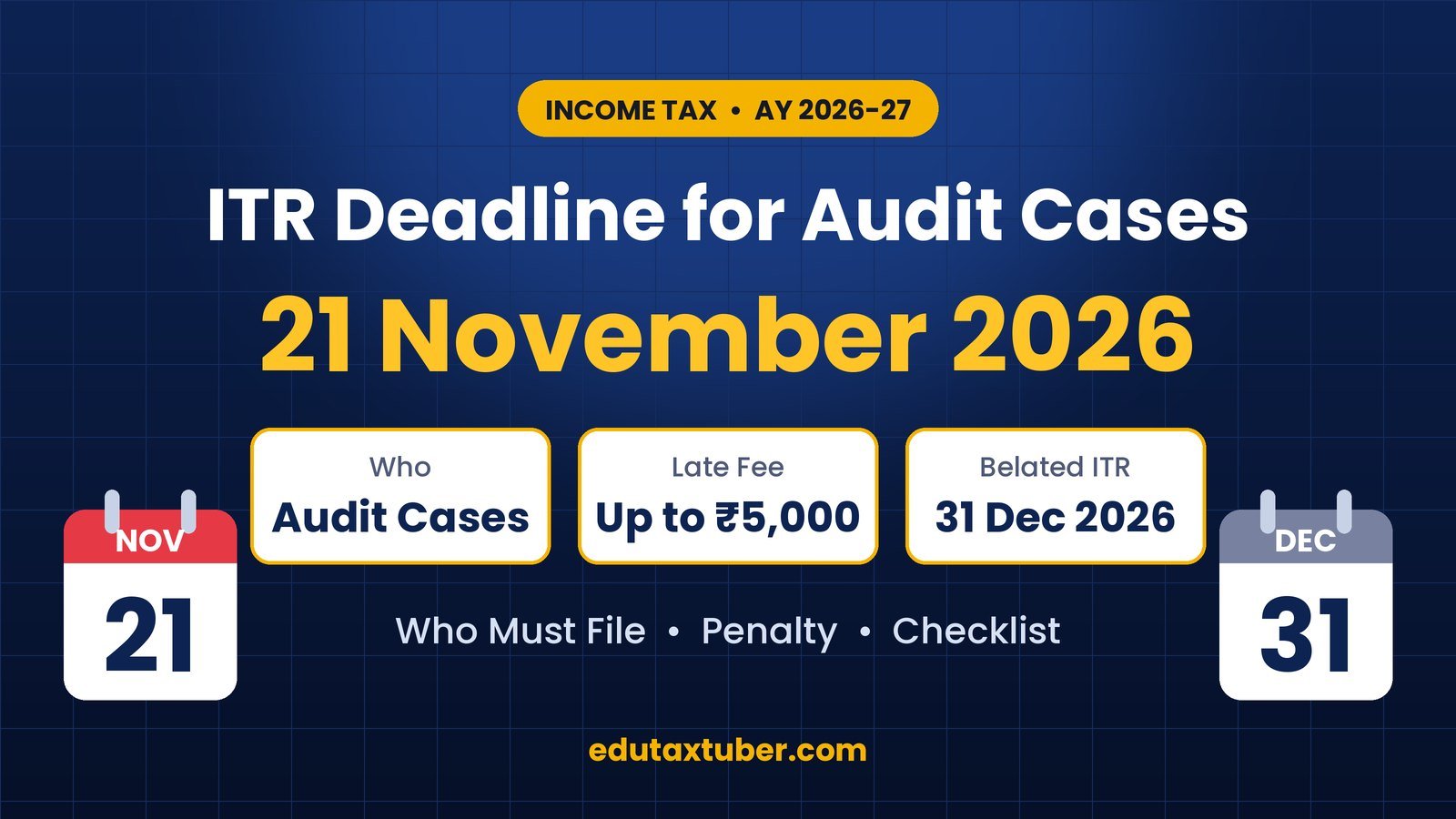
- 21 November 2026 (Saturday) is the last date to file ITR for AY 2026-27 for companies, audited businesses and partners of audited firms.
- The date comes from CBDT Circular No. 07/2026 dated 28 September 2026, which extended it from 31 October.
- Not covered: transfer pricing cases under section 92E (due date 30 November) and non-audit taxpayers (their date has already passed).
- Missing it means a late fee of up to ₹5,000, 1% monthly interest on unpaid tax, and — most costly — losing the right to carry forward business and capital losses.
- Last chance after that: a belated return by 31 December 2026.
The ITR deadline 21 November 2026 is the last date for companies, audited businesses and partners of audited firms to file their return for AY 2026-27 — and it falls this Saturday. This ITR due date for audit cases was set by CBDT Circular 07/2026, which pushed the tax audit ITR deadline from 31 October. Below, you’ll find who it applies to, the ITR late filing penalty if you miss it, and a simple checklist to get the return filed without last-minute trouble.
Why Is the Deadline 21 November This Year?
Normally, audit-case returns are due on 31 October. On 28 September 2026, CBDT issued Circular No. 07/2026 and gave these taxpayers 21 extra days for both steps:
| Compliance | Original due date | Extended due date |
|---|---|---|
| Tax audit report (Form 3CA/3CB-3CD) | 30 September 2026 | 21 October 2026 (already passed) |
| Income tax return (audit cases) | 31 October 2026 | 21 November 2026 |
One point people often get confused about: AY 2026-27 is for income earned in FY 2025-26, so this return is still filed under the Income-tax Act, 1961 — not the new Income-tax Act, 2025, which applies from tax year 2026-27 onwards.
Read Also: CBDT Extends ITR and Tax Audit Deadline for AY 2026-27: Who Gets More Time and Who Is Excluded?
Who Must File by 21 November 2026?
The extension covers the taxpayers listed at serial number 2 of Explanation 2 to section 139(1), provided section 92E does not apply to them. In plain terms:
- Companies (usually ITR-6)
- Individuals, HUFs, firms and LLPs whose accounts must be audited — under section 44AB or any other law (usually ITR-3 or ITR-5)
- Working partners of an audited firm — even if the partner personally has no business audit
- The spouse of such a partner, where section 5A (Portuguese civil code, applicable in Goa, Daman and Diu) applies
Who Is NOT Covered?
| Taxpayer | Due date for AY 2026-27 |
|---|---|
| Transfer pricing cases (Form 3CEB under section 92E) | 30 November 2026 |
| Non-audit business/professionals | Already passed — file a belated return by 31 Dec 2026 |
| Salaried and other non-audit individuals | Already passed — file a belated return by 31 Dec 2026 |
If you’re not in the audit category, you can’t “borrow” the 21 November date. Your return is already late.
Read Also: Missed the 31 August ITR Deadline? Know Your Options Now
What Happens If You Miss 21 November?
Most people think the only cost is a ₹5,000 fee. For businesses, the real damage is usually somewhere else.
1. Late filing fee (section 234F)
₹5,000 if total income is above ₹5 lakh; ₹1,000 if it is ₹5 lakh or less.
2. Interest on unpaid tax (section 234A)
1% per month (or part of a month) on any tax still unpaid after TDS, TCS and advance tax. Pay your self-assessment tax before filing to stop this from growing.
3. You lose the right to carry forward losses
This is the big one. If you file late, business losses and capital losses for the year can’t be carried forward to set off against future profits. Only house property loss and unabsorbed depreciation survive a late return. For a business that had a bad year, this can cost far more than the late fee.
4. You may get stuck in the new tax regime
Individuals and HUFs with business income who want the old tax regime must file Form 10-IEA on or before the due date under section 139(1). Miss the due date, and the new regime applies by default for that year.
5. Certain deductions are lost
Profit-linked deductions such as those under sections 80-IA, 80-IB and 80-IC are allowed only if the return is filed by the due date.
A quick example
Ramesh runs a trading business. His accounts were audited, he made a ₹6 lakh business loss in FY 2025-26, and he files his ITR on 10 December instead of 21 November.
- Late fee: ₹1,000 or ₹5,000 depending on his total income
- Interest: nil if no tax is payable
- Loss carry-forward: ₹6 lakh gone. If he makes ₹6 lakh profit next year, he pays tax on all of it instead of setting off the old loss. At a 30% slab, that’s roughly ₹1.8 lakh plus cess in extra tax.
Twenty days’ delay, ₹1.8 lakh lost. That’s why this date matters.
Missed It? Your Options After 21 November
| Option | Last date (AY 2026-27) | Cost |
|---|---|---|
| Belated return – section 139(4) | 31 December 2026 | 234F fee + 234A interest; losses can’t be carried forward |
| Revised return – section 139(5) | 31 March 2027 | Free till 31 Dec; ₹1,000/₹5,000 fee (section 234-I) from 1 Jan to 31 Mar 2027 |
| Updated return (ITR-U) | Up to 48 months from end of AY | Additional tax on top of normal tax |
Good news from Budget 2026: revised returns for AY 2026-27 can now be filed till 31 March 2027, and even a belated return can be revised. So if you rush and make a mistake, you still have time to fix it.
Last-Minute Checklist Before You File
- Confirm the tax audit report is uploaded and accepted on the e-filing portal. The ITR pulls figures from it.
- Match turnover across books, audit report (Form 3CD), GST returns and the ITR. Keep a reconciliation sheet for any difference.
- Check AIS and Form 26AS. TDS credit is allowed only up to what appears in 26AS. Don’t copy AIS blindly — verify each entry.
- Old or new regime? If you want the old regime with business income, file Form 10-IEA before the ITR.
- Pay self-assessment tax (Challan 280 through e-Pay Tax) and enter the challan details in the return.
- Test your DSC today. Companies and audited taxpayers usually verify with a Digital Signature Certificate. An expired DSC or emSigner error on 21 November is a common last-day disaster.
- Verify the return — filing isn’t complete until it’s verified. Save the acknowledgement (ITR-V) PDF.
Read Also: Why AIS, TDS and GST Figures May Not Match Your ITR — and How to Reconcile Them
Frequently Asked Questions
Is 21 November 2026 the ITR deadline for everyone?
No. It applies only to companies, taxpayers whose accounts must be audited, and partners of audited firms (where section 92E doesn’t apply). Transfer pricing cases have until 30 November 2026. Everyone else’s deadline has already passed.
I’m a partner in an audited firm but have no business of my own. Does 21 November apply to me?
Yes. A working partner of a firm whose accounts must be audited is covered, even if they have no personal audit.
What is the penalty for filing an audit-case ITR after 21 November?
A late fee of ₹5,000 (₹1,000 if income is up to ₹5 lakh), 1% monthly interest on unpaid tax, and loss of carry-forward for business and capital losses.
What is the last date for a belated return for AY 2026-27?
31 December 2026, or before assessment is completed, whichever is earlier.
Can I revise my return if I find a mistake after filing?
Yes, until 31 March 2027. Revisions after 31 December 2026 attract a fee of ₹1,000 or ₹5,000 under section 234-I.
21 November is a Saturday. Will the portal work?
Yes, the e-filing portal works on weekends. But don’t count on bank-based tax payments or CA availability on the last day — finish by Friday.
Read Also: How to File Your ITR for AY 2026-27: Step-by-Step Online Guide
Sources
- CBDT Circular No. 07/2026 dated 28 September 2026 (incometaxindia.gov.in)
- Income-tax Act, 1961 — sections 139(1), 139(4), 139(5), 234A, 234F, 234-I, 80, 115BAC
- TaxGuru — AY 2026-27 Audit-Case ITR Due 21 November 2026
Disclaimer: EduTaxTuber provides content for general educational and informational purposes only. Tax laws, deadlines and portal procedures may change. Please verify with the Income Tax Department’s official portal or consult a qualified tax professional before filing. EduTaxTuber does not provide professional advice.