









Anthropic IPO: Can Indians Invest? How to Buy Anthropic Shares in India, LRS Limit and Tax Explained
Summary
- Anthropic, the company behind the Claude AI assistant, is listing on Nasdaq under the ticker ANT.
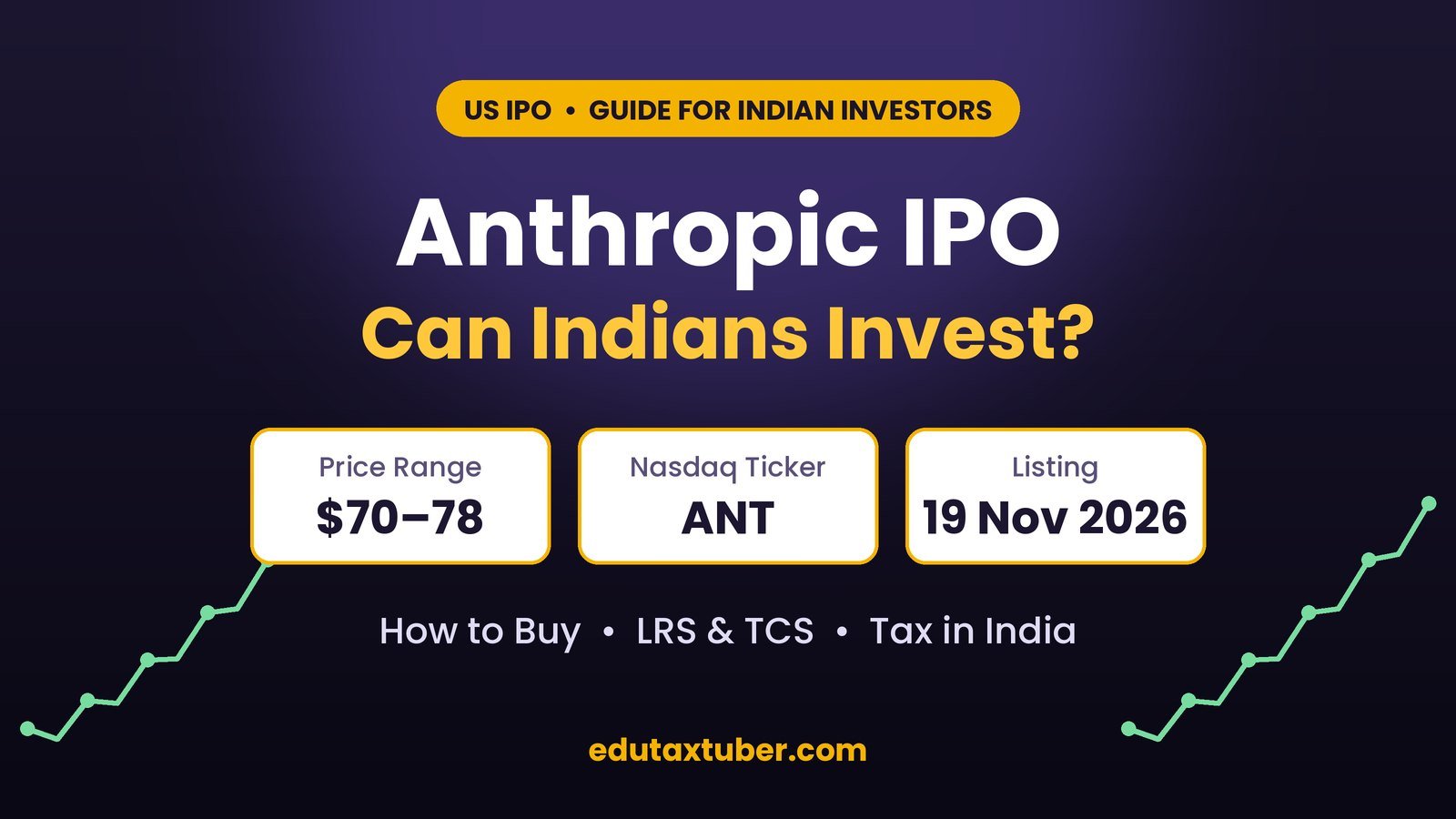
- Final IPO price: $83 per share (above the $70–78 range). About 980 million shares sold. Trading from 19 November 2026 (US time).
- Indian residents can’t apply through Zerodha, Groww or UPI like an Indian IPO. The practical route is buying after listing through a US-stock platform under RBI’s LRS.
- Tax points: 20% TCS on investment remittances above ₹10 lakh a year, 12.5% LTCG after 24 months, and mandatory Schedule FA disclosure in your ITR.
Update, 19 November: Anthropic priced its IPO at $83 per share, above the $70–78 range, raising about $81.3 billion — the largest IPO on record. The Anthropic IPO starts trading on Nasdaq tonight from 8 PM IST, and searches for “Anthropic IPO India” have jumped this week. If you’re wondering how to buy Anthropic shares in India, what the Anthropic share price will be in rupees, and how Anthropic IPO tax in India works — this guide covers it step by step, without the hype.
Anthropic IPO: Key Details
| Company | Anthropic, PBC (maker of Claude AI) |
| Exchange / Ticker | Nasdaq Global Select Market / ANT |
| Marketed price range | $70 – $78 per share |
| Final IPO price | $83 per share (set on 18 November, above the range) |
| Shares sold | About 980 million Class A shares (upsized from 825 million) |
| Amount raised | About $81.3 billion — the largest IPO on record |
| Valuation | About $1.5 trillion (fully diluted) |
| First trading day | Thursday, 19 November 2026 (US Eastern time) |
Reports also say Anthropic is keeping around 20% of the issue for retail investors — but that’s for US brokerage customers, not Indian investors.
Read Also: SpaceX IPO Raises $75 Billion in Biggest Debut of All Time
Can Indians Apply for the Anthropic IPO?
Short answer: not in the way you apply for an Indian IPO.
- There’s no ASBA, no UPI mandate and no NSE/BSE retail quota — this is a US listing.
- Your Indian demat account (Zerodha, Upstox, Angel One etc.) can’t hold US shares.
- US IPO allocations at the offer price go mostly to institutions and US brokerage clients. Indian residents generally won’t get shares at the IPO price.
What you can do is buy the shares once they start trading on Nasdaq.
How to Buy Anthropic Shares in India (After Listing)
- Open a US investing account on a platform that serves Indian residents — for example INDmoney, Vested or Groww’s US stocks section, or a global broker like Interactive Brokers. KYC uses your PAN and Aadhaar.
- Send money abroad under LRS. The platform will guide you to remit rupees from your bank; it gets converted to US dollars. You’ll fill a simple A2 form declaration.
- Wait for trading to begin. Nasdaq opens at 9:30 AM US Eastern, which is 8:00 PM IST. Big IPOs usually start trading a few hours after the opening bell, so the first trade may happen late at night in India.
- Place a limit order, not a market order. First-day prices can swing wildly. A limit order makes sure you don’t pay far more than you planned.
- Buy fractional shares if you want. Most platforms let you invest a fixed rupee/dollar amount instead of a whole share.
Anthropic Share Price in Rupees
At roughly ₹94 per US dollar, one share at the final IPO price — and at the earlier range — works out to:
| Price per share | Approx. in ₹ (at ₹94/$) |
|---|---|
| $83 (final IPO price) | ₹7,802 |
| $78 (old upper end) | ₹7,332 |
| $70 (old lower end) | ₹6,580 |
Remember: the price you actually pay on listing day may be very different from the IPO price — higher or lower. Your bank or platform will also charge a currency conversion spread and possibly a remittance fee.
LRS Limit and TCS: What It Costs to Send Money
- LRS limit: $2,50,000 per person per financial year, across all purposes.
- TCS: no TCS on the first ₹10 lakh you send abroad in a financial year. Above that, 20% TCS applies on investment remittances.
- TCS is not a cost — it’s advance tax. You get credit for it when you file your ITR (or a refund if you’ve paid extra). But it does block your cash until then.
Example: Priya has already sent ₹9 lakh abroad this year for her son’s college fees. Now she sends ₹3 lakh to buy US shares. TCS applies only on the amount above ₹10 lakh — ₹2 lakh — so ₹40,000 TCS is collected. She can claim it back in her ITR.
Anthropic IPO Tax in India: How Your Gains Will Be Taxed
| Income | Tax in India | Tax in US |
|---|---|---|
| Sold after more than 24 months | LTCG at 12.5% (no ₹1.25 lakh exemption) | Nil for Indian residents |
| Sold within 24 months | STCG at your slab rate | Nil for Indian residents |
| Dividends (if any) | Taxed at your slab rate | 25% withheld; claim credit in India using Form 67 |
A key difference from Indian shares: US stocks are treated like unlisted shares under Indian tax law. So the long-term holding period is 24 months (not 12), and the ₹1.25 lakh LTCG exemption for listed Indian equity doesn’t apply. Gains are calculated in rupees using the exchange rate on the buy and sell dates, so a weaker rupee can increase your taxable gain.
Read Also: Budget 2027 LTCG Tax Cut: Government Weighs Relief From 12.5% Rate
Don’t Forget Schedule FA in Your ITR
This is where many first-time US investors slip up. If you hold any foreign shares at any time during the calendar year (January–December), you must report them in Schedule FA of your ITR — even if you didn’t sell anything and even if the amount is small. You’ll need ITR-2 or ITR-3; ITR-1 can’t be used.
Missing this can attract a penalty of ₹10 lakh under the Black Money Act. Small investors get some relief — the penalty doesn’t apply if the total value of such foreign assets (other than immovable property) is up to ₹20 lakh — but the disclosure itself is still compulsory.
Risks to Keep in Mind
- Valuation: at well over $1 trillion, a lot of future growth is already in the price.
- Listing-day volatility: hot IPOs can open far above the offer price and then fall — buying in the first hour is risky.
- Founder control: according to the filing, a special share class held by the co-founders carries a majority of voting power, so public shareholders will have limited say.
- Currency risk: your returns in rupees depend on the dollar–rupee rate too.
- Competition: the AI industry is moving fast, with several well-funded rivals.
- Scams: ignore WhatsApp/Telegram offers for “pre-IPO Anthropic shares”. Only use regulated platforms.
Read Also: AI Compliance Market in India: 173 Companies, $45.1 Million Raised
Frequently Asked Questions
When does the Anthropic IPO list?
Shares are expected to start trading on Nasdaq on Thursday, 19 November 2026 (US time), under the ticker ANT. In India, that’s from 8 PM IST onwards.
Can I buy Anthropic shares on Zerodha or Groww?
Not through your regular Indian demat account. You need a US-stock investing account — some Indian apps offer this as a separate section — funded through LRS.
Is there TCS on buying US shares?
Only if your total LRS remittances in the financial year cross ₹10 lakh. Above that, 20% TCS applies on investment remittances, which you can adjust against your tax.
How is profit on Anthropic shares taxed in India?
Held more than 24 months: 12.5% LTCG. Held 24 months or less: taxed at your slab rate. The US doesn’t tax capital gains of Indian residents on such shares.
Is there an Anthropic ETF or mutual fund in India?
Not specifically. Some Nasdaq-linked funds may add the stock later if it enters their index, but that depends on index rules and timing.
Sources
- Anthropic Form S-1 and amendments (SEC EDGAR); Anthropic IPO website
- Yahoo Finance — Anthropic sets IPO price range at $70 to $78
- RBI Master Direction on LRS; Income-tax Act provisions on TCS and capital gains
Disclaimer: This article is for educational and informational purposes only and is not investment advice or a recommendation to buy or sell any security. Investing in foreign stocks involves market, currency and regulatory risks. IPO details may change. Please consult a SEBI-registered investment adviser and a tax professional before investing. EduTaxTuber is not responsible for losses arising from decisions based on this information.