








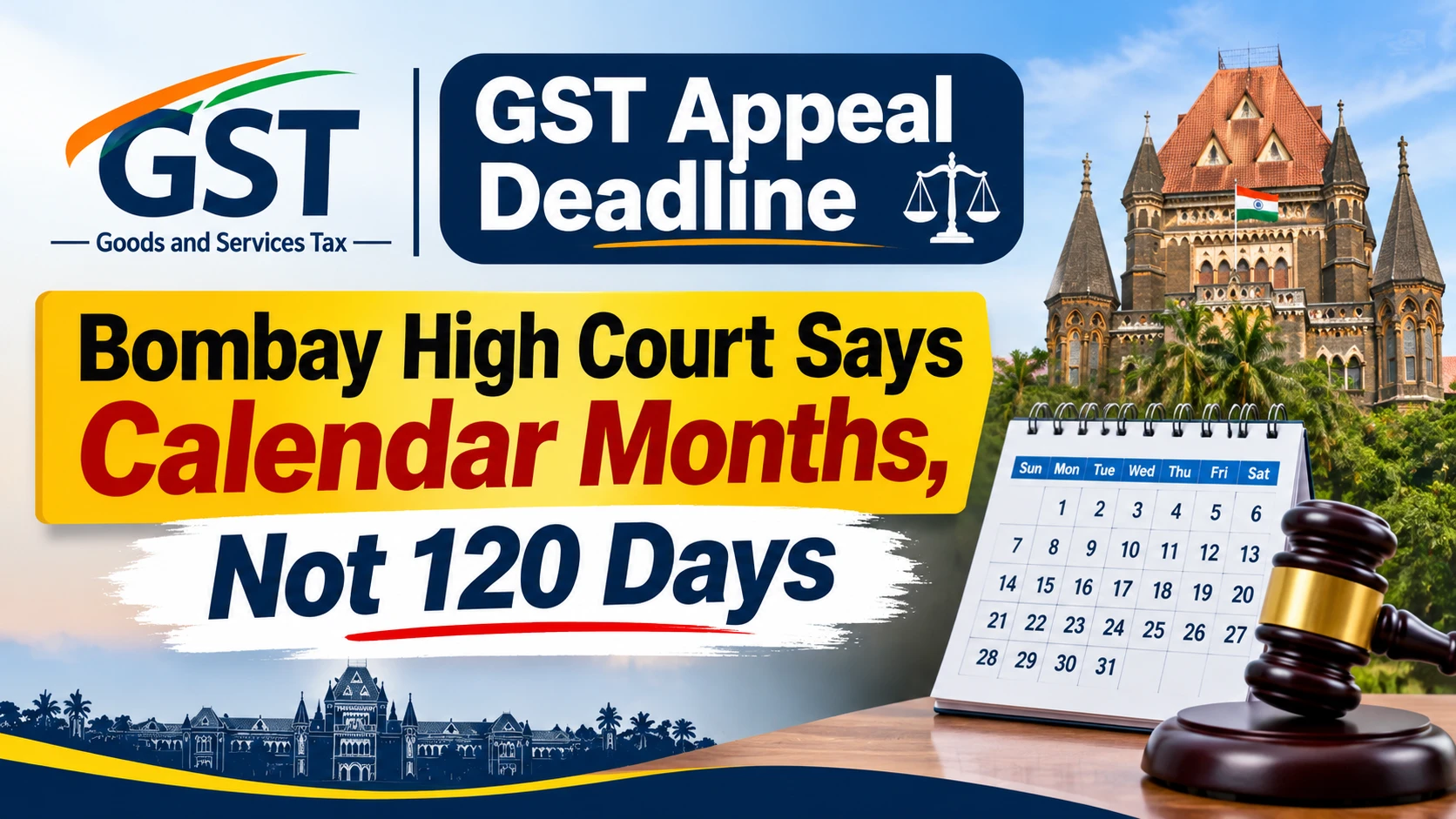
A recent Bombay High Court ruling has clarified an important point for businesses and taxpayers involved in GST disputes: the statutory time limit for filing an appeal under Section 107 of the Central Goods and Services Tax (CGST) Act must be calculated in calendar months, not by mechanically converting the total period into 120 days.
The ruling came in the case of United India Insurance Company Ltd. v. Union of India and Others, decided on 3 November 2026. The company’s GST appeal had been rejected as two days late because the authority treated three months plus the possible additional month as a fixed 120-day period.
Summary
- Section 107(1) of the CGST Act provides three months to file an appeal against an adjudication order.
- Section 107(4) permits a further one month where the appellate authority is satisfied that sufficient cause prevented timely filing.
- The Bombay High Court held that these periods must be calculated in calendar months, not treated as a fixed aggregate of 120 days.
- The case involved an order communicated on 11 August 2025 and an appeal filed on 11 December 2025.
- The Court quashed the order rejecting the appeal and directed the authority to hear it on merits.
- The ruling does not create an automatic four-month extension for every taxpayer.
1. Why Is the GST Appeal Limitation Ruling in the News?
The issue arose because the GST appellate authority calculated the limitation period by treating three months and the additional condonable month as 90 days plus 30 days.
That approach can produce a shorter period than the actual calendar-month calculation because months do not all contain the same number of days.
In the case before the Bombay High Court, the authority concluded that United India Insurance Company had filed its appeal two days beyond the permitted period. The company challenged that rejection before the High Court.
The Court examined the language used in Section 107(1) and Section 107(4) of the CGST Act. Both provisions use the word “months”, rather than prescribing a fixed number of days.
The Court therefore rejected the approach of treating the combined period as an inflexible 120-day limit.
2. What Does Section 107 of the CGST Act Say?
Section 107 deals with appeals to the GST Appellate Authority against decisions or orders passed by an adjudicating authority.
Two provisions are particularly important.
Section 107(1): Three months to file an appeal
Under Section 107(1), a person aggrieved by an adjudication order may appeal to the prescribed Appellate Authority within three months from the date on which the order is communicated.
The communication date is therefore an important starting point for calculating the limitation period.
Section 107(4): Further one month for sufficient cause
Section 107(4) gives the Appellate Authority limited power to condone delay.
If the authority is satisfied that the appellant was prevented by sufficient cause from presenting the appeal within the original three-month period, it may allow the appeal to be presented within a further period of one month.
This additional period is not an unconditional extension. The taxpayer must establish sufficient cause to the satisfaction of the authority.
The distinction is important: the law provides three months for the ordinary appeal and a possible additional month for condonation. It does not simply grant every taxpayer four months without conditions.
3. What Happened in United India Insurance Company’s Case?
The dispute concerned the rejection of a GST appeal filed by United India Insurance Company Limited.
The important dates were:
| Particulars | Date |
|---|---|
| Original order communicated | 11 August 2025 |
| GST appeal filed | 11 December 2025 |
| Appellate rejection order | 7 May 2026 |
| Bombay High Court decision | 3 November 2026 |
The appellate authority calculated the combined period as 120 days. On that basis, it treated the company’s appeal as delayed by two days and rejected it.
The company challenged this decision before the Bombay High Court through Writ Petition (L) No. 33751 of 2026.
The company argued that Section 107 refers to months, not a fixed 120-day period. Therefore, the statutory limitation period should be calculated using calendar months.
The High Court accepted the substance of this argument.
4. What Did the Bombay High Court Decide?
The Division Bench of Justice M.S. Karnik and Justice Sandesh D. Patil examined the wording of Section 107(1) and Section 107(4).
The Court noted that Section 107(4) does not prescribe an additional period of 30 days. It provides for a further period of one month.
Similarly, Section 107(1) specifies three months rather than 90 days.
Read Also: GST Reforms From November 1, 2026: Easier Registration, Faster Refunds and Lower Compliance Burden
The Court held that there is a clear distinction between a period expressed in days and a period expressed in months. The statutory period must therefore be calculated in calendar months rather than mechanically treating the combined period as 120 days.
The Court consequently held that the company’s appeal was within the limitation period under Section 107.
What was the final order?
The Bombay High Court:
- Allowed the writ petition.
- Quashed and set aside the appellate authority’s order dated 7 May 2026.
- Directed the appellate authority to hear the company’s GST appeal on merits and in accordance with law.
The Court did not decide the underlying GST demand itself. It addressed the limitation calculation and the rejection of the appeal.
5. Calendar Months vs 120 Days: Why Does the Difference Matter?
The ruling matters because a calendar month is not always equal to 30 days.
Depending on the months involved, a period of four calendar months may contain more or fewer than 120 days.
The case itself illustrates the issue:
- The original order was communicated on 11 August 2025.
- The company filed its appeal on 11 December 2025.
- The authority treated the filing as two days late using a fixed 120-day calculation.
- The High Court held that the statutory period had to be calculated in calendar months.
The practical lesson is that taxpayers should not automatically calculate a limitation period by multiplying the number of months by 30.
The statutory wording matters. Where the law prescribes months, the calculation must respect that wording.
6. What Should GST Taxpayers Do After This Judgment?
Businesses, tax professionals and GST practitioners should review their appeal-calculation procedures.
More Stories


Step 1: Record the date of communication
Keep documentary evidence showing when the adjudication order was communicated.
This may include the GST portal record, electronic communication, email or other relevant proof of service.
Step 2: Calculate the ordinary three-month period
For a first appeal under Section 107(1), calculate the ordinary limitation period in calendar months from the legally relevant communication date.
Do not automatically use 90 days.
Step 3: Assess whether condonation is required
If the ordinary three-month period has expired, examine whether the case falls within the additional one-month period under Section 107(4).
The taxpayer must be able to explain the sufficient cause that prevented timely filing. The additional month should not be treated as an automatic extension.
Step 4: Check the remaining appeal requirements
A correct limitation calculation alone does not complete an appeal.
Taxpayers must also comply with the applicable GST appeal procedure, prescribed forms, supporting documents and statutory pre-deposit requirements under Section 107(6), wherever applicable.
Step 5: Preserve the filing evidence
Maintain the appeal acknowledgement, filing date, supporting documents and proof of communication of the original order.
These records may become important if the department disputes whether the appeal was filed within time.
7. Does This Judgment Automatically Give Every GST Taxpayer Four Months?
No. This is an important qualification.
The Bombay High Court interpreted the words used in Section 107(1) and Section 107(4). It did not remove the requirement to file within the ordinary three-month period.
The further one-month period remains subject to the Appellate Authority being satisfied that sufficient cause prevented the taxpayer from filing within the original period.
The judgment also does not mean that every delayed appeal must be accepted. The facts, communication date, filing date and explanation for delay will remain relevant.
Read Also: GST Fraud Notices 2026: CBIC’s 7 Important Rules
It is a decision about how the statutory period is calculated—not a blanket waiver of limitation requirements.
8. Does the Judgment Change the GST Law?
No. The Bombay High Court has interpreted the existing language of Section 107; it has not amended the CGST Act.
The decision is significant for GST litigation because it clarifies that a period expressed in months should not be mechanically converted into a fixed number of days.
Taxpayers outside the Bombay High Court’s jurisdiction should also consider the territorial applicability and precedential value of the ruling, along with any later judgments or contrary decisions. Professional advice may be necessary before relying on it in a particular dispute.
Frequently Asked Questions
1. What is the normal time limit for filing a GST appeal under Section 107?
Section 107(1) provides three months from the date on which the adjudication order is communicated to the taxpayer.
2. Can the GST appeal period be extended by another month?
Yes. Under Section 107(4), the Appellate Authority may allow a further period of one month if it is satisfied that sufficient cause prevented the taxpayer from filing within the original period.
3. Has the Bombay High Court ruled that the GST appeal period is 120 days?
No. The Court held that the statutory periods expressed in months must be calculated in calendar months, rather than being mechanically treated as a fixed 120 days.
4. Which case resulted in this GST appeal limitation ruling?
The decision was delivered in United India Insurance Company Ltd. v. Union of India and Others, Writ Petition (L) No. 33751 of 2026, on 3 November 2026.
5. Did the High Court cancel the GST demand against United India Insurance Company?
The Court did not decide the underlying GST demand. It quashed the order rejecting the appeal and directed the appellate authority to hear the appeal on merits.
6. Does this ruling automatically protect every delayed GST appeal?
No. The additional one-month period under Section 107(4) remains subject to sufficient cause. Taxpayers must also satisfy the other applicable appeal requirements.
Conclusion
The Bombay High Court’s decision in the United India Insurance Company case is an important clarification for GST taxpayers and professionals dealing with appellate proceedings.
The key point is that Section 107 uses calendar-month language. The ordinary appeal period is three months, with a possible further one month where sufficient cause is established. It should not be mechanically reduced to a fixed 120-day calculation.
Businesses should review their limitation-date calculations, maintain proof of communication of GST orders and ensure that appeals are filed with all applicable procedural requirements.
The judgment may help prevent appeals from being rejected solely because an authority has applied an incorrect fixed-day calculation. However, taxpayers should not treat it as an automatic extension or a substitute for timely filing.
Sources
- Bombay High Court, United India Insurance Company Ltd. v. Union of India and Others, Writ Petition (L) No. 33751 of 2026, order dated 3 November 2026 — Read the judgment
- Central Board of Indirect Taxes and Customs — Central Goods and Services Tax Act, 2017, Section 107
Disclaimer: EduTaxTuber provides content for general educational and informational purposes only. While we make reasonable efforts to keep the information accurate and updated, laws, regulations, market conditions, software features, and other information may change. Some content may be created or assisted by AI tools and may contain errors or omissions. Readers should verify important information with official sources or qualified professionals before making any tax, legal, financial, investment, business, or other decisions. EduTaxTuber does not guarantee the completeness or accuracy of the information and does not provide professional advice.