










Summary
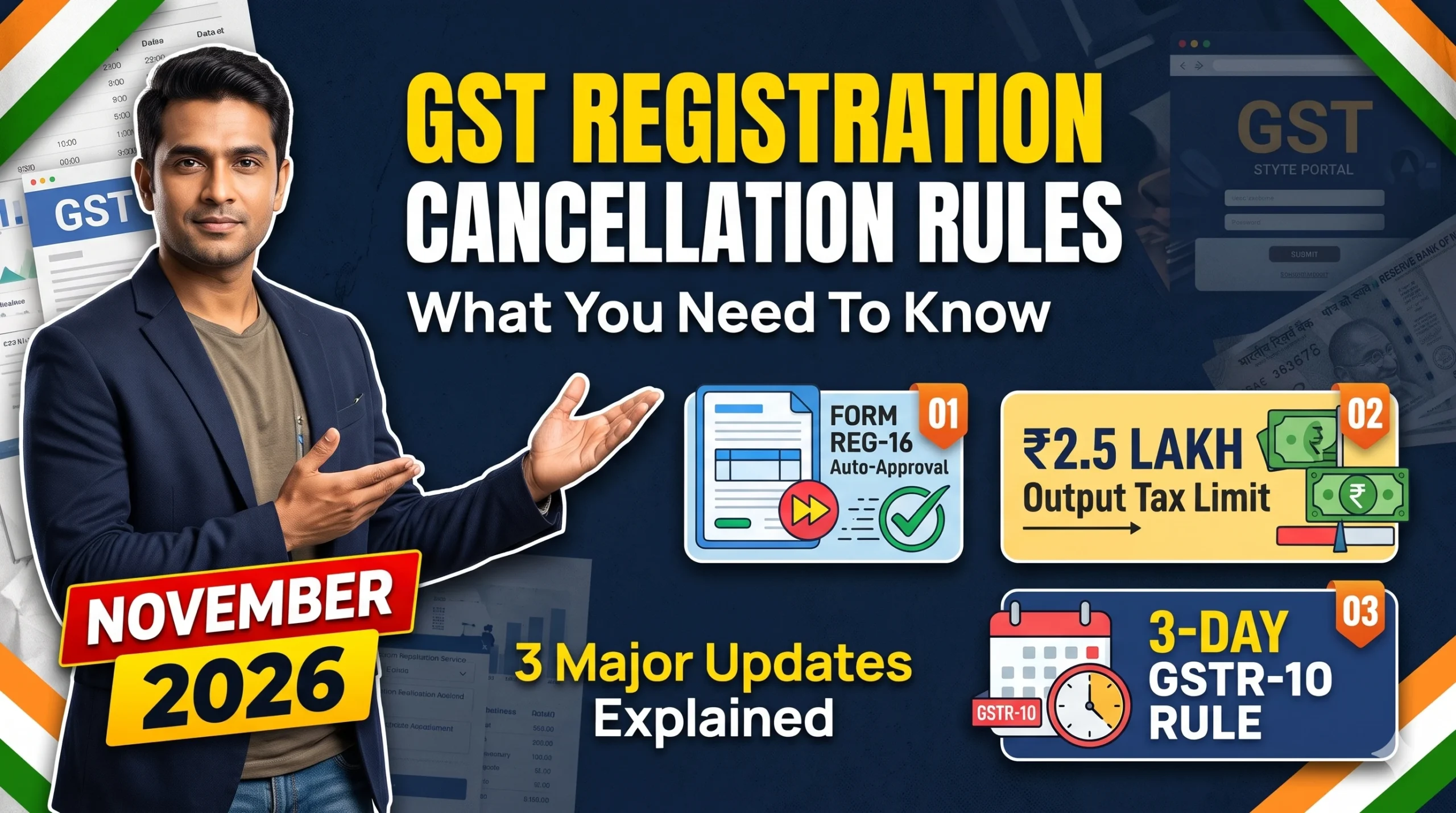
- Effective 1 November 2026: Under GSTN Advisory No. 683 and substituted Rule 20 of the CGST Rules, 2017 (CBIC Notification No. 05/2026-Central Tax), Form GST REG-16 cancellation applications now undergo automated system validation and eligible electronic auto-approval.
- 3-Day vs. 90-Day Form GSTR-10 Rule: Where an application exceeds the ₹2.5 lakh threshold under the electronic route, the taxpayer gets just 3 days to file final return Form GSTR-10 for instant auto-cancellation; if cancelled by a tax officer, the traditional 90-day GSTR-10 window continues to apply.
New Delhi: The Goods and Services Tax Network (GSTN) has revised the voluntary GST registration cancelation workflow in Form GST REG-16 with effect from 1st November 2026. The upgraded system operationalizes the substituted Rule 20 of CGST Rules, 2017 notified by CBIC Notification No. 05/2026 – Central Tax dated 26 October 2026. This has been issued through GSTN Advisory No. 683 dated 1 November 2026.
Read Also: GST Appeal Deadline: Bombay High Court ruling
Post rollout of the new GST portal, Chartered Accountants, tax practitioners and MSME business owners surrendering inactive or closed GSTINs have found themselves at the receiving end of some new and unfamiliar portal validations. These include auto generated “Pending for Returns Filing” holds, “Pending for Final Return” prompts and instant e-cancellation orders without manual hearing notices. Well, it is important to know how these automated checks work so that you can prevent trapped Application Reference Numbers (ARNs) or unexpected police inspection.
What Changed in GST Registration Cancellation From 1 November 2026?
Earlier, almost all applications for voluntary cancelation filed in Form GST REG-16 were subject to manual verification and approval by the jurisdictional tax officer, which often left compliant small businesses waiting for weeks for a cancelation order, during which recurring return obligations kept piling up.
As per the replaced Rule 20 and GSTN Advisory No. 683, The GST site has an automatic compliance process triggered as soon as a taxpayer uploads Form GST REG-16:
Deemed Suspension upon Submission: Upon filing of Form GST REG-16, the registration is deemed to be suspended from the date of submission (or the requested effective date of cancelation, whichever is later). Fresh business invoicing shall not be allowed during processing.
Automated Return Completeness Check: The portal verifies whether all applicable returns (including GSTR-1/IFF and GSTR-3B) due as on the date of application or effective date of cancelation have been filed. If there are pending returns, the application status will change to “Pending for Returns Filing” until the returns are filed.
System-Driven Auto-Approval vs. Officer Routing: After return filing checks are passed, the system looks at the taxpayer’s category and the history of output tax liability to determine if it can approve the cancelation electronically or it must be directed to the jurisdictional tax officer.
Important Two-Stage Effective Date Distinction: Substituted Rule 20 and the automated REG-16 portal workflow are effective from 1 November 2026 while revised Form GST REG-16 form fields and amended Rule 44 Input Tax Credit (ITC) reversal reporting tables are effective from 1 December 2026 (new Forms REG-34 to REG-37 are effective from 1 April 2027).
Comparison Table: Old vs New Form GST REG-16 Cancellation Process
The table below summarizes how voluntary GST cancellation before 1 November 2026 compares with the live system-driven workflow under GSTN Advisory No. 683:
| Parameter | Earlier Process (Before 1 Nov 2026) | New Process (From 1 Nov 2026) |
|---|---|---|
| Legal & Portal Basis | Unamended Rule 20; manual verification by jurisdictional proper officer. | Substituted Rule 20 (Notification No. 05/2026-CT) & GSTN Advisory No. 683. |
| Pending Return Check | Officer raised manual notice (REG-17/REG-03) if returns were incomplete. | System automatically holds ARN under “Pending for Returns Filing” until due returns are filed. |
| Output Tax Liability Threshold | No automated ₹2.5 lakh electronic filter. | ₹2.5 lakh per tax period (B2B outward supplies) for Regular, Casual & SEZ taxpayers. |
| Final Return (Form GSTR-10) Window | 90 days from the date of cancellation order (or date of order, whichever is later). | 3 days under electronic auto-approval route (when > ₹2.5 lakh in any period); 90 days if cancelled by tax officer. |
| Approval Authority | Jurisdictional GST Officer in nearly all cases. | System Electronic Auto-Approval for eligible cases; Tax Officer only for exceptions or missed 3-day GSTR-10 window. |
The ₹2.5 Lakh Output Tax Threshold: Not an Annual Turnover Limit
One of the main errors made among small firms and junior accounting personnel, since 1 November 2026, is about the ₹2.5 lakh amount being an annual turnover criterion. In essence, it is a per-tax-period examination of production tax liability.
Read Also: GST Registration Rules November 2026: 9 Changes in REG-01
For Regular, Casual and SEZ taxpayers, the GST portal verifies the output tax due declared on outward deliveries made to registered people for each individual tax period (month or quarter) from the date of registration up to the application for cancelation:
- If Output Tax Was ₹2.5 Lakh or Less in Every Single Period: Once all due returns are filed, the portal approves the cancellation electronically without requiring advance GSTR-10 filing or officer intervention.
- If Output Tax Exceeded ₹2.5 Lakh in Even One Historical Period: Even if your business had zero sales over the past six months, a single historical month where B2B output tax crossed ₹2.5 lakh disqualifies the application from immediate auto-approval and triggers the special 3-day Form GSTR-10 condition.
- Composition Taxpayers & Non-Core Categories: Composition taxpayers (CMP-08/GSTR-4 filers) and specific non-business/TDS/TCS categories follow streamlined return-clearance validation without the regular B2B ₹2.5 lakh output-tax trigger, provided no statutory mismatch or proceeding is flagged.
More Stories


How the New 3-Day Form GSTR-10 Rule Works (vs the 90-Day Rule)
To understand when Form GSTR-10 must be filed within 3 days versus the standard 90 days, practitioners must distinguish between the two procedural branches built into Advisory No. 683:
- Branch A – Electronic Auto-Approval Route (3-day GSTR-10 window) In case of a regular, casual or SEZ taxpayer, if the output tax is more than ₹2.5 lakh in any relevant tax period, the portal places the application in “Pending for Final Return” status and opens up Form GSTR-10 in advance. The taxpayer shall file Form GSTR-10 within 3 days from the due date of the remaining returns (if ARN was originally held under “Pending for Returns Filing”) or from the date of submission of REG-16 (if all returns were already filed). If Form GSTR-10 is filed within those 3 days, the cancelation is approved automatically by the system. In case of expiry of 3 day window period, the application is immediately sent to jurisdictional tax officer for manual processing.
- Branch B – Jurisdictional Officer Approval Route (90 Day GSTR-10 Window): Where a cancelation application is assigned and approved by a jurisdictional tax officer (for example, if GSTR-10 was not filed within the 3-day period, or because of pending litigation/recovery or on account of specific risk parameters), the statutory 90 day period from the effective date of cancelation or date of order shall remain applicable under Section 45 of the CGST Act.
Read Also: GST Rule 14B Registration 2026 for online sellers
Step-by-Step Filing Checklist Before Submitting Form GST REG-16
Before initiating a voluntary GST registration cancellation request on the portal in November 2026, complete these five checks to secure smooth electronic approval:
- First, make sure that all pending GSTR-1/IFF and GSTR-3B (or GSTR-4/CMP-08) returns are filed up to the effective date of closure, so that your ARN doesn’t become stuck in “Pending for Returns Filing”.
- Closing Stock & Capital Goods ITC Reversal (Rule 44) Calculate Input Tax Credit reversal on inputs lying in stock, semi-finished/ completed goods and capital goods (on pro-rata useful-life basis) and settle the liability by Electronic Credit or Cash Ledger.
- Audit Historical Monthly Output Tax Against ₹2.5 Lakh: Look at all GSTR-1/GSTR-3B files from registration to see if any month’s B2B output tax was above ₹2.5 lakh, so your team is prepared if the 3-day GSTR-10 clock starts immediately after filing.
- Prepare Closing Stock Statements Before Clicking Submit The 3-day GSTR-10 clock starts running fast once activated, so have your closing stock valuation and CA certificate (if applicable) ready before submitting Form GST REG-16.
- 1 December 2026 Form Upgrade – Stay Alert If you plan to file cancelation on or after 1 December 2026, be mindful of the upgraded Form GST REG-16 fields and the enhanced Rule 44 ITC reporting disclosures notified by Notification No. 05/2026–Central Tax.
Frequently Asked Questions (FAQs)
Q1. From which date did the new Form GST REG-16 auto-approval rules take effect?
The revised Form GST REG-16 automated cancellation workflow took effect on 1 November 2026 under GSTN Advisory No. 683 and substituted Rule 20 of the CGST Rules, 2017 (notified via CBIC Notification No. 05/2026–Central Tax).
Q2. Is the ₹2.5 lakh limit for GST cancellation auto-approval based on annual turnover?
No. For Regular, Casual, and SEZ taxpayers, the ₹2.5 lakh threshold applies to output tax liability on outward supplies to registered persons in each individual tax period since registration, not aggregate annual turnover.
Q3. What happens if I miss the 3-day Form GSTR-10 window after applying for GST cancellation?
If your application required Form GSTR-10 within 3 days under the electronic auto-approval route and you miss that 3-day deadline, your cancellation is not rejected—instead, the portal routes the application to the jurisdictional tax officer for manual verification and approval, after which the standard 90-day GSTR-10 deadline applies.
Q4. Are there further changes coming to Form GST REG-16 on 1 December 2026?
Yes. Under CBIC Notification No. 05/2026–Central Tax, revised Form GST REG-16 form fields and amended Rule 44 ITC reversal reporting requirements will come into force separately on 1 December 2026.
Disclaimer: EduTaxTuber provides content for general educational and informational purposes only. While we make reasonable efforts to keep the information accurate and updated, laws, regulations, market conditions, software features, and other information may change. Some content may be created or assisted by AI tools and may contain errors or omissions. Readers should verify important information with official sources or qualified professionals before making any tax, legal, financial, investment, business, or other decisions. EduTaxTuber does not guarantee the completeness or accuracy of the information and does not provide professional advice.