









Summary
- The changes discussed below—reclassifying non-fraud GST penalties as “charges” and reducing the quick-settlement penalty rate from 10% to 5%—represent a proposed legislative reform slated for Parliament’s Winter Session 2026 following GST Council recommendations. As of 13 November 2026, these amendments have NOT yet been enacted or notified into force, and existing CGST Act penalty rates continue to govern active adjudication orders.
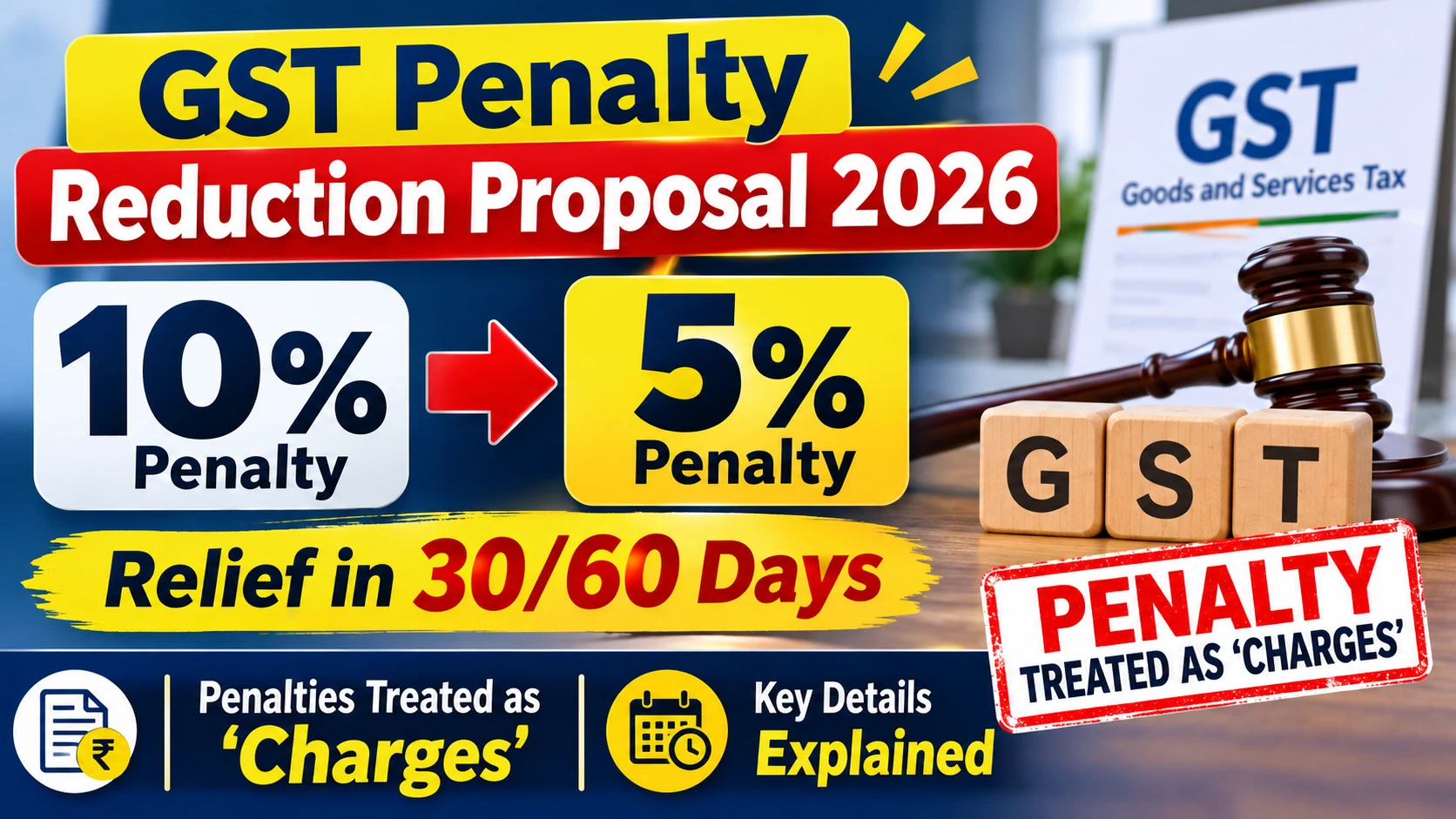
New Delhi: Businesses, Chartered Accountants and Micro, Small and Medium Enterprises (MSMEs) facing orders in regular Goods and Services Tax (GST) cases could soon obtain substantial financial and reputational relief. Ahead of the Parliament’s Winter Session 2026, tax policy reports suggest that the Central Government is planning to make statutory adjustments to the Central Goods and Services Tax (CGST) Act, 2017 to categorize non-fraud GST penalties as “charges” and lower the reduced settlement penalty rate from 10% to 5%.
A reform that would reduce the cash outflow for taxpayers who pay bona fide tax shortfalls within 30 days under Section 73 or 60 days under Section 74A of an adjudication order, while removing the commercial stigma attached to a “penalty” label during bank credit appraisals and corporate audits, if passed by Parliament and mirrored across State GST (SGST) legislatures.
Why GST Penalty Reclassification Is in the Headlines
Under the current GST compliance regime, even inadvertent clerical mistakes, minor ITC timing mismatches or interpretational categorization disagreements result in formal adjudication decisions carrying a statutory “penalty”. Earlier, the GST Council and the Finance Ministry inserted Section 74A to rationalize demand procedures for FY 2024-25 and onward. However, industry bodies such as the Federation of Indian Micro and Small & Medium Enterprises (FISME) and tax practitioners have repeatedly flagged two persistent friction points:
High Cost of Early Settlement: Even where there is no allegation of fraud, willful deception or suppression of facts, a taxpayer accepting an adjudication ruling and paying the full tax and interest within the statutory window still suffers a 10% penalty (or ₹10,000, whichever is larger).
The Collateral Effect of the Word “Penalty” Formal tax “penalty” on financial statements leads to unfavorable disclosures in statutory audit reports, invites increased scrutiny from public sector banks and NBFCs at the time of working capital renewals and, in many cases, results in disallowance arguments in corporate tax computations.
Read Also: Form GST REG-16 registration cancellation auto-approval rules
The proposed Winter Session 2026 amendment bill, after discussions at the GST Council level, seeks to address both issues simultaneously — decreasing the quick-payment rate to 5% and replacing the punitive “penalty” tag with a non-stigmatizing compensation “charge” in non-fraud cases.
What Changes Under the Proposed 10% to 5% Penalty Rule?
Briefings for practitioners issued between 10-12 November 2026, by A2Z Taxcorp LLP, KNN Bureau and Koop India, say the new legislative framework reorganizes the post-order settlement into three main pillars:
- Half of the reduced settlement rate (10% → 5%): If the taxpayer pays the demanded tax and the interest due under Section 50 within the time limit after notification of the adjudication order in non-fraud demand proceedings, the reduced liability is reduced from 10% of the amount of tax to 5%.
- Alignment With 30-Day (Section 73) and 60-Day (Section 74A) Windows: The reduced rate is applicable for legacy financial years up to FY 2023-24 covered by Section 73 when tax and interest are paid within 30 days of the order. The single Section 74A will provide for a lower 5% rate for FY 2024-25 forward if the non-fraud tax and interest are paid within 60 days of the order being communicated (increased from the former 30-day timeframe).
- Strict Carve-Out for Fraud & Suppression Cases: The 5% concessional rate and “charge” classifications only apply to non-fraud cases. Claims arising from fraud, willful misrepresentation or non-disclosure of facts (in relation to past periods under section 74 or the fraud sub-clauses to section 74A) are not covered by this relief and continue to carry the enhanced statutory penalties.
Comparison Table: Current GST Penalty Rules vs. Proposed Winter Session 2026 Framework
The table below contrasts the enforceable GST adjudication rules active today (13 November 2026) with the proposed Winter Session 2026 legislative framework:
| Compliance Parameter | Current Enforced Law (As on 13 Nov 2026) | Proposed Winter Session 2026 Framework |
|---|---|---|
| Section 73 Settlement Window (Up to FY 2023-24) | Pay tax + interest within 30 days of adjudication order. | Pay tax + interest within 30 days of adjudication order. |
| Section 74A Settlement Window (FY 2024-25 Onward) | Pay tax + interest within 60 days of communication of order. | Pay tax + interest within 60 days of communication of order. |
| Reduced Penalty / Charge Rate | 10% of tax (or ₹10,000, whichever is higher). | 5% of tax upon timely payment of tax + interest. |
| Statutory Legal Label | Classified as a statutory “Penalty”. | Reclassified as a compensatory “Charge” in non-fraud cases. |
| Fraud / Section 74 & Fraud 74A Cases | Higher penalties apply (25% / 50% / 100% depending on stage). | Excluded — higher fraud penalties continue unchanged. |
| Current Legal Status | Active & Enforceable Law across India. | Legislative Proposal — requires Parliament & State passage. |
Why Reclassifying GST Penalties as ‘Charges’ Matters for MSMEs, Bank Loans & Income Tax
Read Also: Bombay High Court ruling on GST appeal deadline in calendar months
While a 5-percentage-point rate reduction delivers immediate working-capital savings, tax experts emphasize that changing the legal nomenclature from “penalty” to “charge” carries even broader structural advantages for growing businesses:
- Cleaner Bank Loan & Credit Rating Appraisals: Lenders and credit-rating agencies routinely screen balance sheets and CARO/tax audit notes for statutory “penalties” as a red flag for governance risk. Recording a compensatory “charge” removes the punitive taint when MSMEs apply for overdraft limits, term loans, or government tenders.
- Reduced Income Tax Disallowance Litigation: Under Explanation 1 to Section 37(1) of the Income-tax Act, 1961 (and corresponding provisions of the Income-tax Act, 2025), expenditure incurred for any purpose that is an offence or prohibited by law—including statutory penalties—is disallowed as a business deduction. Treating minor non-fraud GST adjustments as compensatory “charges” rather than punitive penalties helps reduce litigation over deductibility in corporate tax assessments.
- Encouraging Voluntary Closure Over Prolonged Appeals: Many small taxpayers file appeals before the First Appellate Authority primarily to avoid having a formal penalty on their compliance record, clogging appellate dockets. A 5% compensatory charge encourages faster dispute resolution without litigation.
More Stories



5-Step Practical Checklist for Businesses With Open GST Notices Right Now
As this reform has not yet been introduced and passed in the Parliament’s Winter Session 2026, businesses with live Show Cause Notices (SCNs) or newly served adjudication orders should be careful to avoid costly procedural mistakes:
Don’t Wait for the Bill to Act. Don’t Wait for Statutory Deadlines. If you already have an adjudication order under section 73 or section 74A, your 30-day or 60-day payment clock and your 3-month appellate limitation period are running under current law. Do not wait until the Act is modified, and an order is made time-barred in the hope of some retrospective relief.
Differentiate Fraud vs. Non-Fraud Allegations in Open SCNs: Please discuss with your Chartered Accountant to check the pending notices and to find out whether the officer has invoked the non-fraud provisions (Section 73 / non-fraud Section 74A) or the suppression/fraud (Section 74 / fraud Section 74A). Only non-fraud requests are eligible for the proposed 5% rate.
Settle Pre-Notice Shortfalls on Form DRC-03 Wherever Possible: Take into account that even under existing law, payment of tax and interest before issuance of Show Cause Notice or within 30/60 days of the SCN itself, might completely wipe out penalty exposure in non-fraud circumstances.
Watch Transition Provisions When the Finance/Amendment Bill fails: Please verify whether the 5% “charge” regulation is prospective to orders issued after notification or applies to pending adjudication/appellate procedures once Winter Session 2026 amendment bill is introduced in Lok Sabha.
Track Enacted versus Proposed GST Changes Carefully: Distinguish between laws that are already in place (such Form GST REG-16 registration cancelation auto-approval and Section 15(3)(b) post-sale discount credit notes) and those that are still pending Parliamentary approval.
Frequently Asked Questions (FAQs)
Q1. Is the 5% GST penalty rate already applicable on 13 November 2026?
No. As of 13 November 2026, the reduction of the reduced GST penalty from 10% to 5% and its reclassification as a “charge” is a legislative proposal slated for Parliament’s Winter Session 2026. It will take effect only after passage by Parliament, Presidential assent, corresponding State GST amendments, and formal CBIC notification.
Q2. Which GST demands will qualify for the proposed 5% “charge” instead of a 10% penalty?
Only non-fraud cases—such as bona fide calculation errors, classification disputes, or inadvertent ITC mismatches under Section 73 or the non-fraud clauses of Section 74A—will qualify, provided full tax and applicable interest are paid within 30 days (Section 73) or 60 days (Section 74A) of the order.
Q3. Will fraud or tax evasion cases under Section 74 also get the 5% penalty reduction?
No. Cases involving fraud, wilful misstatement, or suppression of facts with intent to evade tax are strictly excluded from the proposed 5% rate and “charge” reclassification.
Read Also: GST new rules effective from November 1, 2026 on post-sale discounts and refunds
Q4. Why does calling the payment a “charge” instead of a “penalty” matter to businesses?
Reclassifying the payment as a compensatory “charge” removes the punitive stigma of a tax offence—helping MSMEs and corporates avoid negative remarks during bank loan renewals, credit ratings, vendor due diligence, and income tax deduction assessments.
Q5. What is the difference between the 30-day and 60-day payment windows mentioned in the proposal?
Under the CGST Act, demands up to FY 2023-24 are governed by Section 73 (which provides a 30-day window after the adjudication order for reduced settlement), whereas demands for FY 2024-25 onward are governed by unified Section 74A (which provides a 60-day window after communication of the order).
Disclaimer: EduTaxTuber provides content for general educational and informational purposes only. While we make reasonable efforts to keep the information accurate and updated, laws, regulations, market conditions, software features, and other information may change. Some content may be created or assisted by AI tools and may contain errors or omissions. Readers should verify important information with official sources or qualified professionals before making any tax, legal, financial, investment, business, or other decisions. EduTaxTuber does not guarantee the completeness or accuracy of the information and does not provide professional advice.